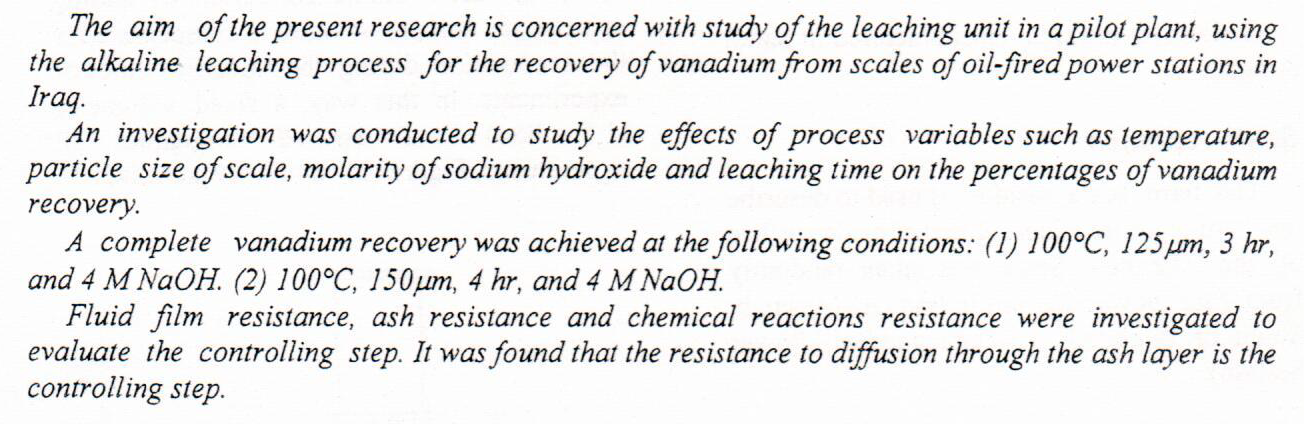
Recovery of Vanadium from Scale Residues of Oil-Fired Power Stations

This study employed the biosynthetic technique for creating vanadium nanoparticles (VNPs), which are affordable and user-friendly; VNPs was synthesized using vanadium sulfate (VOSO4.H2O) and a plant extract derived from Fumaria Strumii Opiz (E2) at a NaOH concentration of 0.1 M. This study aims to investigate the potential applications of utilizing an adsorbent for metal ions to achieve environmentally friendly production and assess its antibacterial activity and cytotoxicity. The reaction was conducted in an alkaline environment with a pH range of 8–12. The resulting product was subjected to various characterization techniques, including Fourier transform infrared spectroscopy, ultraviolet-visible spectroscopy, x-ray diffraction (XRD), t
... Show MoreA variety of oxides were examined as additives to a V2O5/Al2O3 catalyst in order to enhance the catalytic performance for the vapor phase oxidation of toluene to benzoic acid. It was found that the modification with MoO3 greatly promoted the little reaction leading to improve catalyst performance in terms of toluene conversion and benzoic acid selectivity. The effect of catalyst surface area, catalyst promoters, reaction temperature, O2/toluene, steam/toluene, space velocity, and catalyst composition to catalyst performance were examined in order to increase the benzoic acid selectivity and yield.
Thin films of vanadium oxide nanoparticles doped with different concentrations of europium oxide (2, 4, 6, and 8) wt % are deposited on glass and Si substrates with orientation (111) utilizing by pulsed laser deposition technique using Nd:YAG laser that has a wavelength of 1064 nm, average frequency of 6 Hz and pulse duration of 10 ns. The films were annealed in air at 300 °C for two hours, then the structural, morphological and optical properties are characterized using x-ray diffraction (XRD), Field emission scanning electron microscopy (FESEM) and UV-Vis spectroscopy respectively. The X-ray diffraction results of V2O5:Eu2O3 exhibit that the film has apolycrystalline monoclinic V2O5 and triclinic V4O7 phases. The FESEM image shows a h
... Show More (2)
(2)
 (39)
(39)
Used vegetable oil was introduced to transesterfication reaction to produce Biodiesel fuel suitable for diesel engines. Method of production was consisted of filtration, transesterfication, separation and washing. Transesterfication was studied extensively with different operating conditions, temperature range (35-80oC), catalyst concentration (0.5-2 wt. % based on oil), mixing time (30-120 min.) with constant oil/methanol weight ratio 5:1 and mixing speed 1300 rpm. The concentration of Fatty acid methyl esters (Biodiesel) was determined for the transesterficated oil samples, besides of some important physical properties such as specific gravity, viscosity, pour point and flash point. The behavior of methyl esters production and the physica
... Show MoreUsed vegetable oil was introduced to transesterfication reaction to produce Biodiesel fuel suitable for diesel engines. Method of production was consisted of filtration, transesterfication, separation and washing. Transesterfication was studied extensively with different operating conditions, temperature range (35-80o C), catalyst concentration (0.5-2 wt. % based on oil), mixing time (30-120 min.) with constant oil/methanol weight ratio 5:1 and mixing speed 1300 rpm. The concentration of Fatty acid methyl esters (Biodiesel) was determined for the transesterficated oil samples, besides of some important physical properties such as specific gravity, viscosity, pour point and flash point. The behavior of methyl esters production and the
... Show MoreUsed vegetable oil was introduced to transesterfication reaction to produce Biodiesel fuel suitable for diesel engines. Method of production was consisted of filtration, transesterfication, separation and washing. Transesterfication was studied extensively with different operating conditions, temperature range (35-80oC), catalyst concentration (0.5-2 wt. % based on oil), mixing time (30-120 min.) with constant oil/methanol weight ratio 5:1 and mixing speed 1300 rpm. The concentration of Fatty acid methyl esters (Biodiesel) was determined for the transesterficated oil samples, besides of some important physical properties such as specific gravity, viscosity, pour point and flash point. The behavior of methyl esters production and the phys
... Show More
(1)
The ability of pulverized walnut-shell to remove oil from aqueous solutions has been studied. It involves two-phase process which consists of using walnut-shell as a filtering bed for the accumulation and adsorption of oil onto its surface. Up to 96% oil removal from synthetic wastewater samples was achieved while tests results showed that 75% of oil can be removed from the actual wastewater discharged from Al- Duara refinery in the south of Baghdad.
Used vegetable oil was introduced to transesterfication reaction to produce Biodiesel fuel suitable for diesel engines. Method of production was consisted of filtration, transesterfication, separation and washing. Transesterfication was studied extensively with different operating conditions, temperature range (35-80oC), catalyst concentration (0.5-2 wt. % based on oil), mixing time (30-120 min.) with constant oil/methanol weight ratio 5:1 and mixing speed 1300 rpm. The concentration of Fatty acid methyl esters (Biodiesel) was determined for the transesterficated oil samples, besides of some important physical properties such as specific gravity, viscosity, pour point and flash point. The behavior of methyl esters production and the
... Show More
(1)
 (1)
(1)
