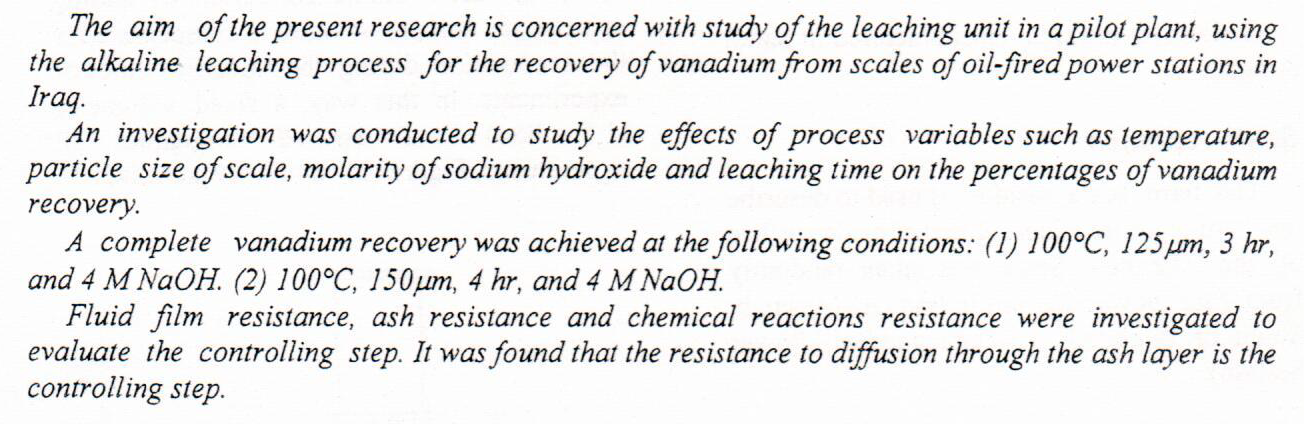
Recovery of Vanadium from Scale Residues of Oil-Fired Power Stations

The study aimed to prepare a nanocapsules formulation from the acetonic extract of Moringa oleifera leaves, using polymeric capsules, and test its toxicity against the third instar larvae of Culex pipiens mosquitoes. The leaf extract was prepared using acetone as a solvent, and the nano polymeric capsules were prepared using the synthetic polymer polyethylene glycol 4000. The results showed the successful preparation of nano polymeric capsules from the leaf extract, with an average particle size of 259.2 nm, and a nanocapsule diameter of 263.83 nm, as determined by DLS and SEM analysis, respectively. The toxicity results indicated that the nano polymeric capsules of the leaf extract exhibited higher mortality rates, reaching 97.6% a
... Show More

The aim of the current research is to know the degree to which middle school teachers and female teachers in the southern border schools use electronic educational alternatives in the field of education from their point of view and its relationship to some variables, and to achieve this goal, a random sample of (200) teachers was selected in southern border schools, and a questionnaire was prepared to collect The data, as well as the descriptive approach was used to achieve this goal. T-test and analysis of variance were used for the statistical treatment. The results concluded that the educational courses provided to male and female teachers are not sufficient. It has also been concluded that the use of electronic educational alternativ
... Show MoreThe research includes the preparation of several complexes of the internal transition elements lanthanide (Ln = La, Nd, Er, Gd, and Dy) containing the 4f shell, with Schiff bases resulting from condensation reactions between 4-antipyrinecarboxaldehyde and 2-aminobenzothiazoles. Schiff's base was identified using FTIR spectra, UV-vis spectroscopy, elemental microanalysis CHNSO, nuclear magnetic resonance, mass spectrometry, and TGA thermal analysis. The complexes were studied and identified with elemental microanalysis CHNSO, FTIR spectroscopy, UV-vis spectroscopy, TGA thermal analysis, conductivity measurement, and magnetic sensitivity. The result showed that these complexes were classified as homogeneous bidentate complexes with th
... Show More (8)
(8)
 (3)
(3)

Quantum key distribution (QKD) provides unconditional security in theory. However, practical QKD systems face challenges in maximizing the secure key rate and extending transmission distances. In this paper, we introduce a comparative study of the BB84 protocol using coincidence detection with two different quantum channels: a free space and underwater quantum channels. A simulated seawater was used as an example for underwater quantum channel. Different single photon detection modules were used on Bob’s side to capture the coincidence counts. Results showed that increasing the mean photon number generally leads to a higher rate of coincidence detection and therefore higher possibility of increasing the secure key rate. The secure key rat
... Show More
The purpose of this paper is to introduce and study the concepts of fuzzy generalized open sets, fuzzy generalized closed sets, generalized continuous fuzzy proper functions and prove results about these concepts.
(1)
(1)
Ni and Cd complexes of new Schiff base derived from 5-Amino-2-phenyl-2,4-dihydro-pyrazol-3-one with 4-chlorobenzalaldehyde (A) , 2-Hydroxy-benzalaldehyde (B) and 4-Hydroxy-benzaldehyde (C) have been prepared and characterized by elemental analysis , molar conductivity measurements , FTIR , UV- vis , 1HNMR, mass spectrometer and magnetic susceptibility. Analytical data revealed that six complexes were a distorted tetrahedral geometry and exhibited (1:1) metal :ligand ratio. The biological activity for the three ligands and its complexes were studied
This research aims to removes dyes from waste water by adsorption using banana peels. The conduct experiment done by banana powder and banana gel to compare between them and find out which one is the most efficient in adsorption. Studying the effects different factors on adsorption material and calculate the best removal efficiency to get rid of the methylene blue dye (MB).
Candida Berkh. (1923) occurs naturally in the body. But it becomes opportunistic fungi, meaning that it infects humans when there is any weakening of the immune system, such as exposure to chemotherapy, diabetes, or organ transplantation. Most species of Candida grow at a temperature between 20-40 °C and have a pH of 3-8. Human pathogens of Candida species include C. albicans, C. glabrata, C. lusitaniae, C. parapsilosis, C. tropicalis and C. utili. C. albicans has many virulence factors that facilitate injury process. Virulence factors are considered as a measure of pathogenicity, and it is in the form of fungal toxins, enzymes, or cell structures that facilitate infection, as well as pathogen resistance in different conditions. This study
... Show More