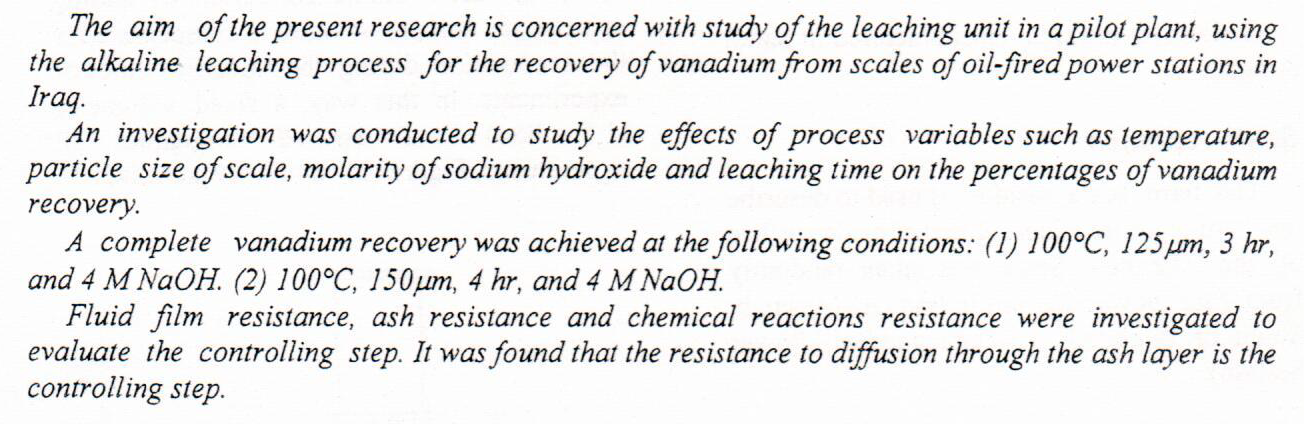
Recovery of Vanadium from Scale Residues of Oil-Fired Power Stations

 (7)
(7)
 (3)
(3)



This article aims to determine the time-dependent heat coefficient together with the temperature solution for a type of semi-linear time-fractional inverse source problem by applying a method based on the finite difference scheme and Tikhonov regularization. An unconditionally stable implicit finite difference scheme is used as a direct (forward) solver. While by the MATLAB routine lsqnonlin from the optimization toolbox, the inverse problem is reformulated as nonlinear least square minimization and solved efficiently. Since the problem is generally incorrect or ill-posed that means any error inclusion in the input data will produce a large error in the output data. Therefore, the Tikhonov regularization technique is applie
... Show More
(2)
(3)
In this work the radioactive wastes in the Old Russian
Cemetery Al -Tuwaitha site were classified according to risks for
workers who are involved in the retrieval process. The exposure
assessment results expressed as estimates of radionuclide intakes by
inhalation and ingestion, exposure rates and duration for external
exposure pathways, and committed effective dose equivalents to
individuals from all relevant radionuclides and pathways. Results
showed the presence of natural radionuclides Ra-226, Th-234 and K-
40, as well as the produced radionuclide Cs-137 and Eu-152 in the
cemetery wells. The absorbed doses from the waste were classified to
two categories; exempt waste and low level waste according to
In this work, the detection of zinc (Zn) ions that cause water pollution is studied using the CSNPs- Linker-alkaloids compound that was prepared by linking extracted alkaloids from Iraqi Catharanthus roseus plant with Chitosan nanoparticles (CSNPs) using maleic anhydride. This compound is characterized by an X-ray diffractometer (XRD) which shows that it has an orthorhombic structure with crystallite size in the nano dimension. Zeta Potential results show that the CSNPs-Linker-alkaloids carried a positive charge of 54.4 mV, which means it possesses high stability. The Fourier transform infrared spectroscopy (FTIR) shows a new distinct band at 1708.93 cm-1 due to C=O esterification. Scanning electron microscope (SEM) image
... Show More
(3)
(1)
(216)
(193)
The shape dimensions and characteristics of pollen grains and seeds have importance in distinguish among species. Therefore, the present study included morphological characteristics of pollen grains and seeds for eight species belonging to eight genera of the family Brassicaceae and these species are: Alliaria petiolata (M.Bieb) Cavara et Grand, Aubrieta parviflora Boiss, Cardamine hirsuta L., Crambe orientalis L., Eromobium aegyptiacum (Spreng.) Schweinf.et Asch.ex Boiss., Parlatoria cakiloidea Boiss., Sterigmostemum sulphureum (Banksetsol.) Bornm. Neotorularia torulosa (Desf.) Hedge & J. Leonard. The pollen grains were studied in morphological and full measurements were taken, the study showed that the majority of the pollen grai
... Show More
(7)
The aim of this work is to detect the best operating conditions that effect on the removal of Cu2+, Zn2+, and Ni2+ ions from aqueous solution using date pits in the batch adsorption experiments. The results have shown that the Al-zahdi Iraqi date pits demonstrated more efficient at certain values of operating conditions of adsorbent doses of 0.12 g/ml of aqueous solution, adsorption time 72 h, pH solution 5.5 ±0.2, shaking speed 300 rpm, and smallest adsorbent particle size needed for removal of metals. At the same time the particle size of date pits has a little effect on the adsorption at low initial concentration of heavy metals. The adsorption of metals increases with increas
... Show More
(11)
(13)
(8)