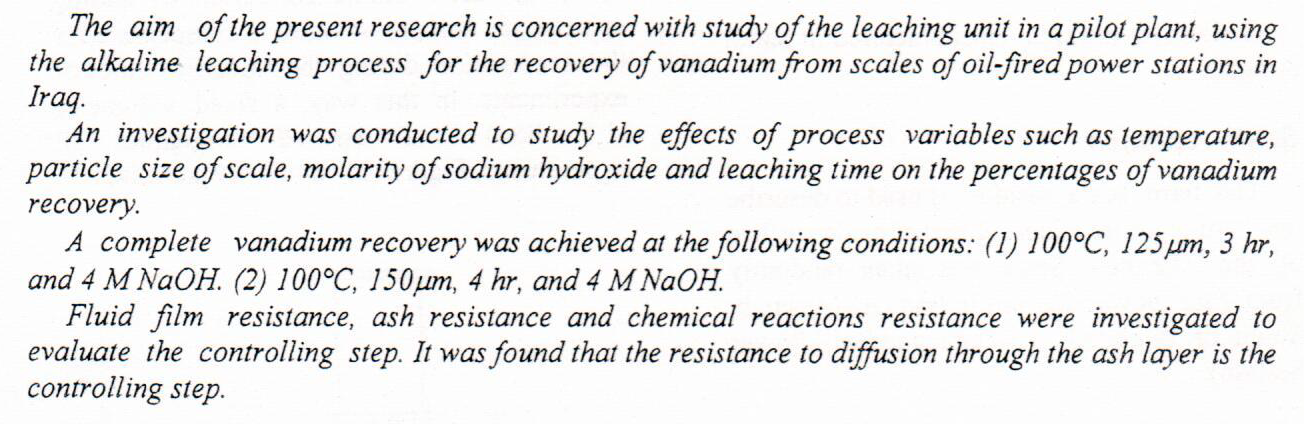
Recovery of Vanadium from Scale Residues of Oil-Fired Power Stations

The kinetic of atropine pertraction from seeds of Datura Metel Linn plant was studied. Diisopropyl ether, n-hexane and n-heptane were used as membranes for atropine recovery. The effect of speed of agitation and time in the range of 200-300 rpm and 0-3.5h, respectively were studied using the proposed membranes. The pertraction experiments were carried outs in a batch laboratory unit. The liquid-liquid pertraction was found to be very suitable for atropine recovery from its liquid extracts of Datura Metel seeds. A high purity (94-96%) can be obtained in the receiver phase. The pertraction process was found to be very selective for atropine recovery with diisopropyl ether membrane. As the speed of agitation increases the efficiency of pertrac
... Show More
Yersinia enterocolitica has ranked a third among the pathogens that most frequently cause gastrointestinal disorders transmitted to humans through food materials, especially contaminated meats. The meat infected with Yersinia enterocolitica had no change in apparent texture or smell. The aim of this research is to survey the frequency of Y. enterocolitica in ovine meat, compare their ratio of infection between the season, To carry out this study (125) samples of local ovine meat were collected by random sampling from the middle region of Iraq. The samples were divided into two groups steak and mince, then many microbiological tests (culture, & staining, biochemical Tests Api 20E, Vitik 2 and species-specific PCR amplicon for 16S RNA gene) w
... Show More
 (1)
(1)
The present study was conducted to determine the optimum conditions required for lipase enzyme activity extracted from germinated sunflower seeds, including temperature, pH, agitation, time of incubation, enzyme concentration, substrate type, and concentrations of mineral salts and EDTA. Optimum pH, temperature and time of incubation required for lipase stability were also determined. The results showede optimum lipase activity (3.251U/ml) wasund at 30 ÌŠC and pH 7 after 20 minutes of incubation when using 1 ml lipase enzyme with 0.02 ml of CaCl2 (10 mM) at 100 rpm of agitation and in the presence of olive oil as the substrate for enzyme reaction. EDTA appeared to have inhibitory effects, while Ca+2 and Mg+2 have stimulatory effec
... Show More
(8)
 (3)
(3)
This study was conducted to isolate and identify killer yeast Hanseniaspora uvarum from dates vinegar and measurement the ability of this yeast to produce killer toxin. The antimicrobial activity of the concentrated supernatant containing partially purified concentrated killer toxin was also detected against several pathogenic bacteria and yeast species, which includes two types of yeast Rhodotorula mucilaginosa and Candida tropicalis and four human pathogenic bacteria Staphylococcus aureus, Escherichia coli, Klebsiella pneumoniae and Pseudomonas aeurginosa. In addition, the antagonistic activity of examined yeast have been studied toward four types of fungi, where two are pathogenic
... Show More
(6)
(2)

The present study introduces description of a new species of genus Arboridia Zakhvaticin 1946, based on a large collection of Cicadellids. External morphological characters particularly male genitalia were discussed and illustrated. The genus Arboridia Zalchvatkiia (Typhlocybinae: Erythroneurini) contains small slender, fragil and attractively coloured and patterned leafhoppers. It was erected by Zakhvatkin in 1946 (Zalchvatkin, 1946). The overall length of adults ranges from 2.5 to 3.4 mm. Members of this genus can be recognized by inner apical cell of forewing which is long with oblique base; Cu confluent with this base at a point near the middle of the length of inner apical cell; two prominent circular deep brown spots on vertex (Zal
... Show MoreIn this study, synthesised new ligand: potassium 2,2'-(quinoxaline-2,3- diyl)bis(1-phenylhydrazinecarbodithioate) (L). The ligand synthesised by reacting N1,N2-dip-tolyloxalamide as the starting material with CS2 and KOH to add the CS2 group and then with phenylendiammine to achieve (L). The ligand used in the synthesis of complexes with (CoII, NiII and CdII). The new ligand and its complexes characterised by FT-IR, UV-Vis, 1H, 13C-NMR, Mass spectroscopy, and elemental analysis, in addition to the above techniques were using magnetic moment, atomic absorption, chloride content, and melting point to describe the metal complexes.
Polyhydroxyalkanoates (PHAs) have gained much attention as biodegradable polymers, many efforts are being made to minimize the cost of PHAs by finding cheap carbon source depending on the type of microorganism and fermentation conditions. The aims of this study were to evaluate the effects of different glucose concentrations and other important conditions on the PHA production by Bacillus cereus isolated from soil. Polyhydroxyalkanoates PHAs accumulated by soil microorganisms were examined by screening the isolated bacteria using Sudan B Black and Nile Blue staining process. A Gram positive strain was identified using the 16s rRNA gene, deposited in the NCBI GenBank sequence database. Different growth conditions (favorite glucose concentrat
... Show More
(27)
(31)
The fresh water green alga Chlorella vulgaris was selected to study its ability to degrade one of polycyclic aromatic hydrocarbon (PAHs)known is anthracene (ANT). ANT is widely used in artificial products such as wood preservatives; insecticides; dye and coating materials. This algae was cultivated in CH-10 medium under constant laboratory conditions and exposed to different concentrations (1, 3, and 5 mg/l) of anthracene for 3, 5, 7, 9 and 15 days, with the concentration of ANT measured by high performance liquid chromatographic analysis (HPLC). The results showed that C.vulgaris has high ability to reduce anthracene to 80% at 1mg/Lcon centration after 3 days and 100% after 5 days, while at 3 and 5 mg / L concent
... Show More
(5)
(1)
Celery and coriander are vastly applied in modern medicine and traditionally because various medicinal and nutritional benefits depend on their medicinal characteristics. The study aimed to detect, isolate and compare extracts contents of phenolic acids (caffeic and p-coumaric acids) in ethyl acetate fraction of fresh and dry aerial parts of coriander (Coriandrum sativum L.) and celery (Apium graveolens L.) of the Apiaceae family. The extraction of these constituents was carried out by maceration method using 70% ethanol and fractionation was done by using petroleum ether, and ethyl acetate. The existence of caffeic and p-coumaric acids in aerial part extracts of two plants was identified by thin-layer chromatography (TLC) and high-
... Show More
(5)
(3)