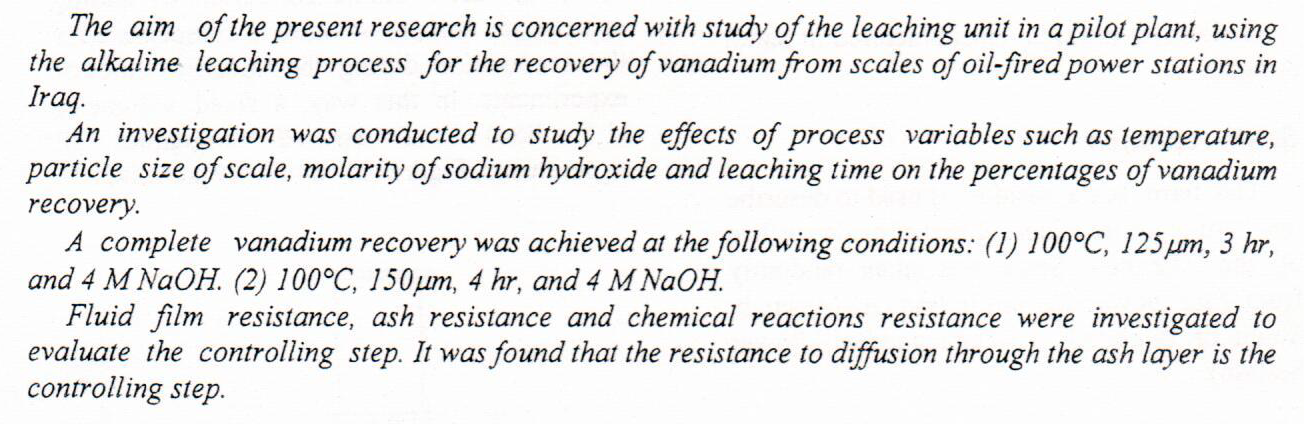
Recovery of Vanadium from Scale Residues of Oil-Fired Power Stations

This paper was aimed to study the efficiency of forward osmosis (FO) process as a new application for the treatment of wastewater from textile effluent and the factors affecting the performance of forward osmosis process.
The draw solutions used were magnesium chloride (MgCl2), and aluminum sulphate (Al2 ( SO4)3 .18 H2O), and the feed solutions used were reactive red, and disperse blue dyes.
Experimental work were includes operating the forward osmosis process using thin film composite (TFC) membrane as flat sheet for different draw solutions and feed solutions. The operating parameters studied were : draw solutions concentration (10 – 90 g/l), feed solutions concentration (5 – 30 mg/l), draw solutions flow rate (10 – 50 l/hr
 (3)

This study was aimed to evaluate atotal phenolic content, antibacterial activity, and antioxidant activity of M. communis callus extracts were evaluated. Callus induction in general Murashige and Skoog (MS) media is completed by the Benzil adenine's unique knowledge of callus formation. A well diffusion experiment was used to examine antibacterial interest in Staphylococcus aureus, Escherichia coli, Klebsiella pneumonia, and Pseudomonas aeruginosa. The DPPH radical scavenging activity test was used to measure antioxidant activity. FTIR and HPLC have been used to pinpoint the presence of polyphenol compounds in calluses. The total phenol content of plant leaves extract (0.1, 0.5, and 1) mg/ml was 42.12, 94.08, and 189 mg of Gallic ac
... Show More (6)
(1)

The presence of dyes in wastewater has become a major issue all over the world. The discharge of dyes in the environment is concerned for both toxicological and esthetical reasons. In this study, the removal of dyes from aqueous solution by electrocoagulation using aluminum electrodes as cathode and anode were investigated with the electrocoagulation cell of 1litter. The study included: the impact of various operating parameters on the dyes removal efficiency like pH, NaCl concentration, distance between electrodes, voltage, initial dyes concentration and type of electrodes. The dye (congo red) concentrations were (50, 100, 150, and 200 ppm), stirring speed was 120 rpm at room temperature. pH used was maintained constant
... Show More
(11)
Due to the broad range uses of chromium for industrial purposes, besides its carcinogenic effect, an efficient, cost effective removal method should be obtained. In this study, cow bones as a cheap raw material were utilized to produce active carbon (CBAC) by physiochemical activation, which was characterized using: SEM to investigate surface morphology and BET to estimate the specific surface area. The best surface area of CBAC was 595.9 m2/gm which was prepared at 600 ᵒC activation temperature and impregnation ratio of 1:1.5. CBAC was used in aqueous chromium ions adsorption. The investigated factors and their ranges are: initial concentration (10-50 mg/L), adsorption time (30-300 min), temperature (20-50
... Show More
(10)
Objective: The research aimed to develop a scale for students' logical reasoning in football, prepare educational exercises for the idea filtering strategy and its application in physical education football lessons on outdoor fields, and identify its impact on logical reasoning and performance in the skills of forward shooting from dribbling and from side passes in football. Research methodology: The experimental method was adopted with a two-group design (experimental and control) with (58) students randomly selected and divided into the two groups, representing (65.909%). The researchers used (120) students to develop the scale under study, employing systematic steps and various sequential statistical analyses. They also prepared
... Show More
The study focused on the treatment of real oilfield produced water from the East Baghdad field affiliated to the Midland Oil Company (Iraq) using an oil skimming process followed by a coagulation/flocculation process for zero liquid discharge system applications. Belt type oil skimmer was utilized for evaluating the process efficiency with various operating conditions such as temperature (17-40 °C) and time (0.5-2.5 hr.). Polyaluminum chloride (PAC) coagulant and polyacrylamide (PAM) flocculant was used to investigate the performance of the coagulation/flocculation process with PAC dosage (5-90 ppm) and pH (5-10) as operating conditions. In the skimming process, the oil content, COD, turbidity, and TSS decreased with an increase in tempera
... Show MoreAbstract
The research aims at the relationship between Servant leadership dimensions test as an independent variable and an organizational trust as a variable dependent. Thus it was necessary to answer the following question: Is there a correlation relationship and impact between Servant leadership dimensions and organizational trust? To investigate the contents of the answer, the researcher selected a group of employees in Oil Products Distribution Company / Baghdad. The researcher adopted the analytical descriptive approach in completing his research which dealt with a random sample of (190) individuals representing the research society out of the total number of (376) person from the middle and high Leaders. Depending
... Show More
(1)
Gas lift is one of the oldest methods used to produce hydrocarbon fluids from wells experiencing declining production. It works by aerating the mixture inside production tubing and forcing it to the surface. One of the reasons for declining production in oil wells is an increase in water cut or a drop in reservoir pressure, which requires one of the artificial lift methods to restore production. (A) oil field suffers from an increase in water cut, which has affected well productivity. The wells under study have a water cut of up to 66%, resulting in very low production rates. In this research, Pipesim software was used to build a physical and fluid model, then design an optimal gas lift system that achieves the highest possible prod
... Show More
In this study, polymeric composites were prepared from unsaturated polyester as a base material with glass powder (fluorescent) in different weight ratios (4, 6, 8, 10,and 11%) as a support material and after comparison before and after reinforcement of the prepared composites, an increase was found. In the values of mechanical properties (hardness, compressive strength), the shock resistance values decreased, but an increase in temperature leads to an increase in the values of shock resistance, as well as the values of compressive strength And it reduces the hardness value.