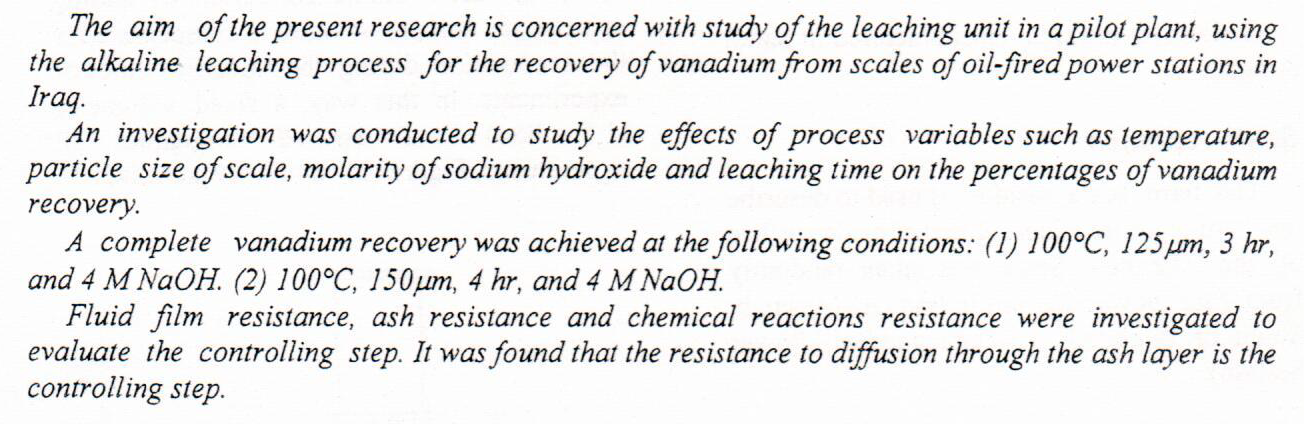
Recovery of Vanadium from Scale Residues of Oil-Fired Power Stations

Fullerene nanotube was synthesized in this research by pyrolysis of plastic waste Polypropylene (PP) at 1000 ° C for two hours in a closed reactor made from stainless steel using molybdenum oxide (MoO3) as a catalyst and nitrogen gas. The resultant carbon was purified and characterized by energy dispersive X-ray spectroscopy (EDX), X-ray powder diffraction (XRD). The surface characteristics of C60 nanotubes were observed with the Field emission scanning electron microscopy (FESEM). The carbon is evenly spread and has the highest concentration from SEM-EDX characterization. The result of XRD and FESEM shows that C60 nanotubes are present in Nano figures, synthesized at 1000 ° C and with pyrolysis tempera
... Show More (4)
(4)
 (1)
(1)



Lipase enzyme has attracted a lot of attention in recent years because of its diverse biotechnological applications. The present study was conducted to screen germinated seeds of four crops, namely sunflower (Helianthus annuus), flaxor linseed (Linum usitatissimum ), peanut (Arachis hypogaea ) and castor bean (Ricinus communis), for the activity of their lipases. to the study also included the extraction and purification of lipase from the seeds of the most promising crop using different solvents. The results indicated that the maximum enzymatic activity (0.669 U/ml) was obtained when 0.1 M Tris-HCl buffer extract was used after 3 days of seed germination of all the tested species, as compared to the other test solvents
... Show More
(12)
(6)
The fauna of bees (Hymenoptera, Apoidea) from different regions of Iraq is surveyed in this study; there were 16 species, 13 genera that belong to four families which are collected in this investigation.
Also, all the species that are recorded for Iraq in previous investigations are revised; totally there are 110 species, 32 genera belonging to five families: Apidae, Andernidae, Colletidae, Halictidae and Megachilidae were listed.
(17)
(9)
Dietary components and changes cause shifts in the gastrointestinal microbial ecology that can play a role in animal health and a wide range of diseases. However, most information about the microbial populations in the gut of horses has not been quantitative. The objective of this study was to characterize the fecal bacterial and its prevalence in healthy horses and diarrheal one in a period from September 2010 to July 2013. Out of 100 Fecal samples of horses (from farms in Al-furusyia club) in Baghdad were examined for microbial differentiation founded eighty percent of the fecal samples isolated from healthy horses. The most common pathogen found were Streptococcus spp. (33.7%), Escherichia coli (20.9%), , and Staphylococcus aureus (9.2
... Show MoreA total of 37 Staphylococcus epidermidis isolates, isolated from corneal scraping of patients with bacterial keratitis and 20 isolates from healthy eyes (as control) (all isolates, isolated from, Ibn Al- Haietham eye hospital / Baghdad), were tested for slime production, 52.63% of all isolates were positive-slime production (23 isolates from patients and 7 isolates from controls). It was found that positive-slime producing S. epidermidis were exhibited a high resistance to antibiotics as compared to negative-slime producing isolates.
The presence of alkaloids in Crassula ovata is a topic that is still unexplored, as there are no published studies on the matter. This study demonstrates the presence of an alkaloid compound (and its class) for the first time in Crassula ovata. The plant material was defatted with n-hexane, and a Soxhlet apparatus was used for the extraction process, while the acid-base method was used for the isolation of alkaloids from the chloroform fractions. The quaternary alkaloid was precipitated from the aqueous layer spontaneously, in high quantity. By using standard spectroscopic methods (including liquid chromatography - mass spectroscopy) we were able to clarify the structure of the precipi¬tated compound as a tetrahydroprotoberberine a
... Show More
(2)
In this work the production of activated carbon (AC) from Imperata is done by microwave assisted Potassium hydroxide (KOH) activation and using this activated carbon for the purpose of the uptake of amoxicillin (AMX) by adsorption process from aqueous solution. The effects for irradiation power (450-800W), irradiation time (6-12min) as well as impregnation ratio (0.5-1 g/g) on the AMX uptake and yield AMX uptake at an initial concentration of AMX (150 mg/g). The optimum conditions were 700 W irradiation power, 10 min time of irradiation, as well as 0.8 g/g impregnation ratio with 14.821% yield and 12.456 mg/g AMX uptake. Total volume of hole and the area of the surface (BET) are 0.3027 m³/g, and 552.7638 m²/g respectively. The properti
... Show More