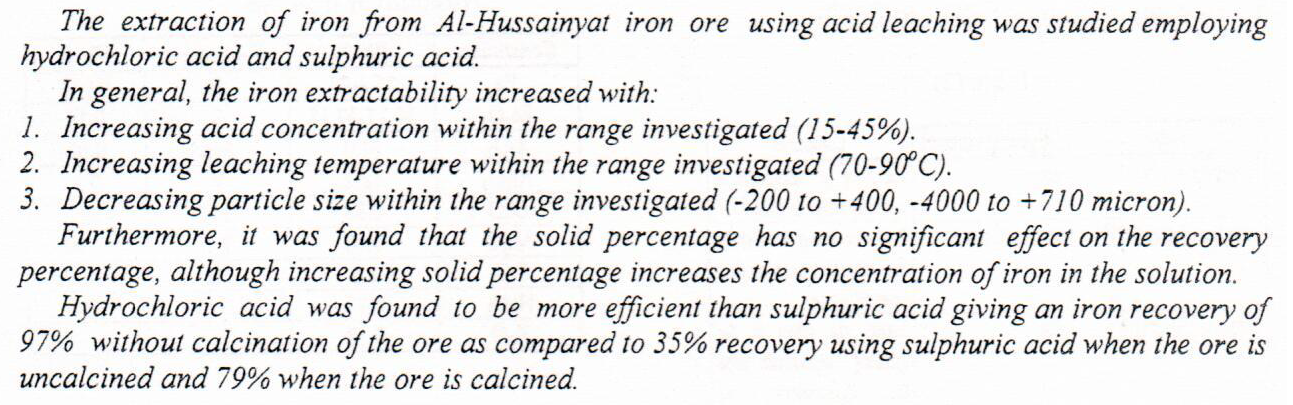
Extraction of Iron from Al-Hussainyat Iron Ore using Acid Leaching

Emulsion Liquid Membrane (ELM) is an emerging technology that removes contaminants from water and industrial wastewater. This study investigated the stability and extraction efficiency of ELM for the removal of Chlorpyrifos Pesticide (CP) from wastewater. The stability was studied in terms of emulsion breakage. The proposed ELM included n-hexane as a diluent, span-80 as a surfactant, and hydrochloric acid (HCl) as a stripping agent. Parameters such as mixing speed, aqueous feed solution pH, internal-to-organic membrane volume ratio, and external-to-emulsion volume ratio were investigated. A minimum emulsion breakage of 0.66% coupled with a maximum chlorpyrifos extraction and stripping efficiency were achieved at 96.1% and 95.7% at b
... Show More (14)

RA Ali, LK Abood, Int J Sci Res, 2017 - Cited by 2
The apricot plant was washed, dried, and powdered after harvesting to produce a fine powder that was used in water treatment. created an alcoholic extract from the apricot plant using ethanol, which was then analysed using GC-MS, Fourier transform infrared spectroscopy, and ultraviolet-visible spectroscopy to identify the active components. Zinc nanoparticles were created using an alcoholic extract. FTIR, UV-Vis, SEM, EDX, and TEM are used to characterize zinc nanoparticles. Using a continuous processing procedure, zinc nanoparticles with apricot extract and powder were employed to clean polluted water. Firstly, 2 g of zinc nanoparticles were used with 20 ml of polluted water, and the results were Tetra 44% and Levo 32%; after
... Show More (4)
(4)
 (6)
(6)
Bio-diesel is an attractive fuel fordiesel engines. The feedstock for bio-diesel production is usually vegetable oil, waste cooking oil, or animal fats. This work provides an overview concerning bio-diesel production. Also, this work focuses on the commercial production of biodiesel. The objective is to study the influence of these parameters on the yield of produced. The biodiesel production affecting by many parameters such s alcohol ratio (5%, 10%,15 %, 20%,25%,30%35% vol.), catalyst loading (5,10,15,20,25) g,temperature (45,50,55,60,65,70,75)°C,reaction time (0-6) h, mixing rate (400-1000) rpm. the maximum bio-diesel production yield (95%) was obtained using 20% methanol ratio and 15g biocatalyst at 60°C.
(2)
In the recent years the research on the activated carbon preparation from agro-waste and byproducts have been increased due to their potency for agro-waste elimination. This paper presents a literature review on the synthesis of activated carbon from agro-waste using microwave irradiation method for heating. The applicable approach is highlighted, as well as the effects of activation conditions including carbonization temperature, retention period, and impregnation ratio. The review reveals that the agricultural wastes heated using a chemical process and microwave energy can produce activated carbon with a surface area that is significantly higher than that using the conventional heating method.
(7)
(6)
The measurement of natural radioactivity in a given region or country is essential to provide a reference base-line map to follow up a possible variation in future. In order to perform such measurement, the natural radioactivity was measured in different locations. The locations (50 sites) were distributed over Al-Jabal Al-Gharbi Mountain, starting from the city Al-Azeeziah in the eastern part to Wazen on the Tunisian border in the west. The measurements showed obvious variation from one site to another. The levels were fluctuating from (12.8 counts/minute) in Bir-Ayad to (45.7 counts/minute) in Gherian.
In order to investigate the cause for such variation, samples were collected from (27) sites for detailed study. The levels of natur
synthesis and characterization of New Bidentate schiff base Ligand Type(NO)Donor Atoms Derived from isatin and 3-Amino benzoic acid and Its complexes with Co(||),Cu(||),Cd(||)and Hg(||)Ions
The study dosage ethanol in the total content of acid sialic TC and acid sialic associated fat (LBSA) in blood serum and congener brain Dkor Jerd eggs study included dosage 20 animals of male rat Ald ethanol daily for a period of four weeks and concentrations 20% and 30%, 40%, 50% and size of dose 5mlThe results of the study showed that levels of TSA homogeneous in the brain and blood serum significantly reduced Ankhvaza
Esterification reaction is most important reaction in biodiesel production. In this study, oleic acid was used as a suggested feedstock to study and simulate production of biodiesel. Batch esterification of oleic acid was carried out at operating conditions; temperature from 40 to 70 °C, ethanol to oleic acid molar ratio from 1/1 to 6/1, H2SO4 as the catalyst 1 and 5% wt of oleic acid, reaction time up to 180 min. The optimum conditions for the esterification reaction were molar ratio of ethanol/oleic acid 6/1, 5%wt H2SO4 relative to oleic acid, 70 °C, 90 min and conversion of oleic 0.92. The activation energy for the suggested model was 26625 J/mole for forward reaction and 42189 J/mole for equilibrium constant. The obtained results s
... Show More