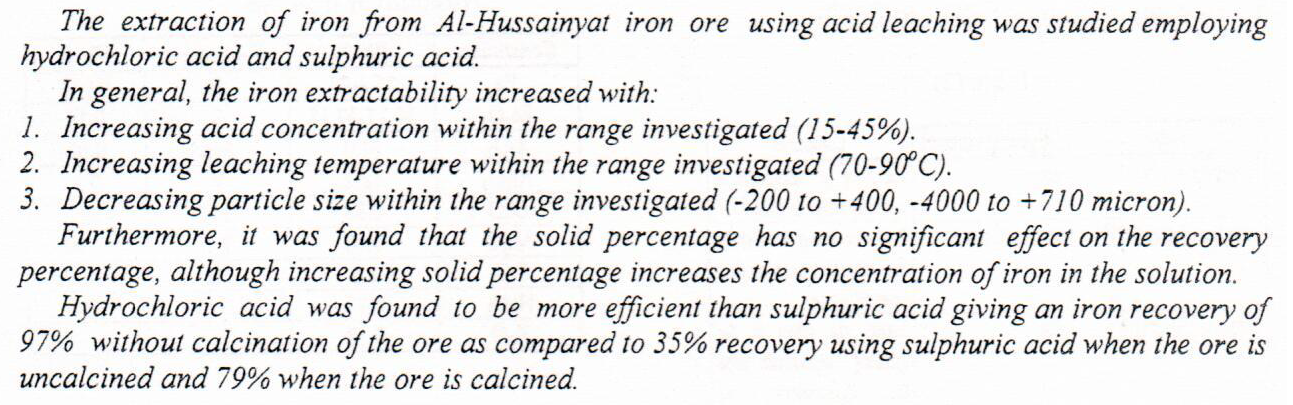
Extraction of Iron from Al-Hussainyat Iron Ore using Acid Leaching

Background: Tooth extraction is one of the most commonly performed procedures in dentistry. It is usually a traumatic process often resulting in immediate destruction and loss of alveolar bone and surrounding soft tissues. Various instruments have been described to perform atraumatic extractions which can prevent damage to the paradental structures. The physics forceps is one of those innovations in dental extraction technologies that claim to provide an efficient means for atraumatic dental extractions. Materials and method: A randomized clinical trial was conducted to compare the physics forceps with the conventional forceps for the removal of 28 mandibular single rooted teeth under the following parameters: incidence of crown, root, b
... Show More (3)
 (5)


Background: Pain, swelling and trismus are the main minor complications encountered after surgical extraction of impacted third molars, minimizing these postoperative complications is the center of many studies, one proposed method is the prophylactic administration of corticosteroids, the aim of this study is to evaluate the effect of prophylactic Dexamethasone administration on facial swelling and trismus after surgical extraction of impacted third molars. Materials and methods: 20 patients were included in this study, they were randomly divided into 2 groups of 10 patients each; a study group in which patients were given 8 mg. Dexamethasone 1 hour before surgical extraction of impacted third molar and 4 mg. 6 hours postoperatively, and a
... Show MoreDevelopment of a precise and delicate reaction has been acquired for the determination of vancomycin hydrochloride using batch and cloud point extraction (CPE) methods. The first method is based on the formation of azo dye as a result of diazotized dapsone coupled with vancomycin HCl (VAN) in a basic medium. The sensitivity of this reaction was enhanced by utilizing a nonionic surfactant (Triton X-114) and the cloud point extraction technique (second method). The azo dye formed was extracted into the surfactant-rich phase, dissolved in ethanol and detected at λmax 440 nm spectrophotometrically. The reaction was investigated using both batch and CPE methods (with and without extraction), and a simple comparison between the two
... Show More
(7)
(5)
(2)
(3)
Abstract: Background: High percentage of diabetes patients complain from post extraction hemorrhage. Many types of hemostatic materials are used to stop bleeding after teeth extraction: diode lasers are good hemostatic agents owing to their highly absorption by hemoglobin therefore they are used in soft tissue procedures with relatively no effects on dental hard tissues due to their poorly absorption by water and hydroxyapatite. Objectives: The aim of this study is to evaluate the efficiency of diode laser to assist the clot formation after tooth extraction for type II diabetes patients with minimum temperature elevation to prevent periodontal destruction. Materials and methods: From 12 type II diabetes patients (7 males and 5 females wi
... Show MoreObjective: To evaluate two kinds of extraction (aqueous and ethanolic) for coriander using seeds, leaves and stems and
studying their antibacterial activity against nine different microorganisms.
Methodology: Coriander was selected to carry out this study. Seeds, leaves and stems were collected from local markets in
Baghdad then dried in shade for at least 10 days and grinded to fine powder. Aqueous hot extracts for 1hr. at (50
c) and
cold extracts for 24 hrs at (4
c) were performed by using seeds, leaves and stems then studied antibacterial effect against
nine different microorganisms by using well diffusion technique. Cold aqueous extracts of coriander seeds for 48 hrs. and
72 hrs and ethanolic extraction
The present study is an academic attempt to show how the threeUmayyad poets ; Jarir ,
Al-Farazdaq and Al-Akhtal have skillfully employed old conventions and traditions in their
poetry to serve a dual purpose of making their ideas striking , memorable and compelling and
of reaching eminence as poets.
The primary aim of the poets has been to amuse , convince and influence the readers or
listeners of their poetry . as it were, a mirror image of the social , religious and historical
beliefs , values and customs which prevailed throughout the ages before the emergence.
Abstract
The space occupied by the dialogic imperative in the language is a very wide range, as it is present in most of the speeches received by the recipient, and this is not limited to dialogues. That the literary discourse is a dialogical and fulfillment imperative, as the implication is related to the implicit connotations, as if the implication covers the indirect actions of the speech act theory.
The present study is an attempt to show how the three Umayyad poets ; Jarir , Al-
Farazdaq and Al-Akhtal have consciously and skillfully employed in their poetry som ancient
Arab legends ,historical events and wars as they provide atrue image of the values and
customs of the peoples who lived before them .
Their employed , how ever, takes avarying degrees depending, to alarge extent , an the
vast but personal knowledge of each poet the past tradition , and practices . Jarir ,in many
respects out , stands the first , Al-Farazdaq , the second and Al-Akhtal , the third .
(1)