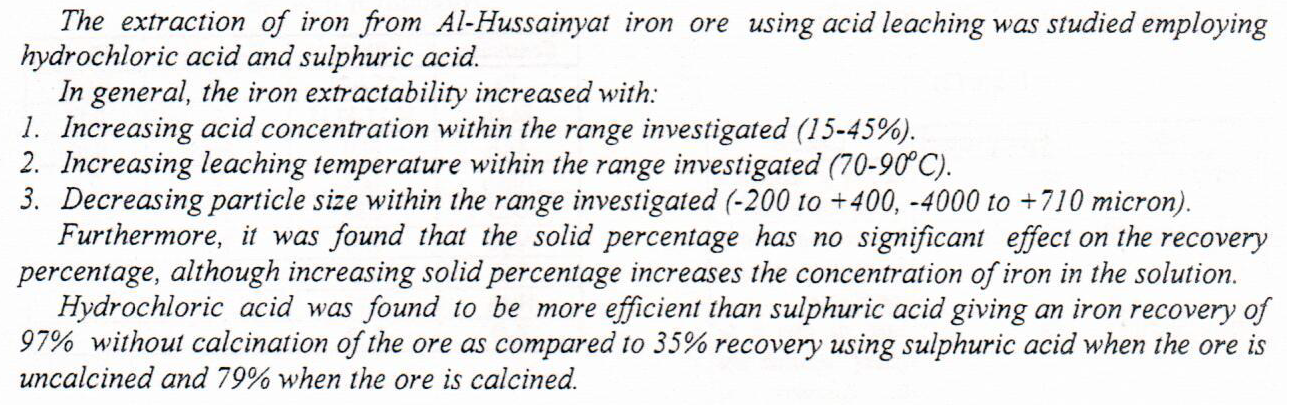
Extraction of Iron from Al-Hussainyat Iron Ore using Acid Leaching

A novel Schiff base ligand (DBC) synthesized from 4-chlorobenzoic acid, along with its Cu (II) and Co (II) complexes, was prepared and characterized using FT-IR, 1H and 13C-NMR, UV-Vis spectroscopy, as well as magnetic and conductivity measurements. Based on this, a tetrahedral structure of [M(DBC)Cl2] was proposed for the complexes. Antioxidant activity of the compounds was assessed and compared to ascorbic acid, revealing that the copper complex exhibited superior antioxidant properties compared to the cobalt complex and the ligand. Furthermore, the antibiofilm potential of the copper and cobalt complexes was assessed against five clinically relevant bacterial species (P.aeruginosa, E.coli, K.pneumoniae, S.aureus and S.typhi) usin
... Show More (2)
(2)
 (1)
(1)


A new poly chain derivative of polyacrolein has been synthesized from the two basic precursors, polyacrolein and aromatic amine/substituted amine in chloroform to prepare poly Schiff base compounds (A1-A4). The novel poly subs.β-lactam derivative is obtained via coupling of poly schiff base with chloroacetyl chloride and trimethylamine (B1-B4). Newly synthesized compound was identified via spectral methods; their [13C-NMR, 1H-NMR, and FTIR] also measurement of some of its physical properties. Furthermore the inhibition effect of synthesized compounds (B1-B4) on the corrosion of stainless steel in 1N HCl was studied by wight loss method. The results of weight loss measurements showed that corrosion inhibition efficiency by increasing the co
... Show More
(3)
(3)
تم تحضير ثلاث معقدات جديدة Ni (II)و Cu (II) و Zn (II) باستخدام الليكند المحضر الجديد من تفاعل حامض مالونيك ثنائي هيدرازايد مع 2-بيريدين كربوكسالديهايد. حيث شخصت المعقدات لمحضرة وكذلك الليكند باستخدام تقنيات مختلفة مثل FT-IR و UV-Vis و Mass و 1H-NMR و 13C-NMR وتحليل العناصر CHN و تقدير محتوى الكلور والموصلية المولارية والحساسية المغناطيسية والامتصاص الذري لتشخيص هذه المركبات. لكل معقد محضر جديد من النيكل والنحاس والزنك ، كشفت نتائج ا
... Show More
(7)
(2)
 (26)
(13)
(26)
(13)
The distribution of the intensity of the comet Ison C/2013 is studied by taking its histogram. This distribution reveals four distinct regions that related to the background, tail, coma and nucleus. One dimensional temperature distribution fitting is achieved by using two mathematical equations that related to the coordinate of the center of the comet. The quiver plot of the gradient of the comet shows very clearly that arrows headed towards the maximum intensity of the comet.
This research concern to analyse and simulate the temperature distribution in the spot welding joints using tungsten arc welding shielded with inert gas (TIG Spot) for the aluminum-magnesium alloy type (5052-O).
The effect of and the quantity of the heat input that enter the weld zone has been investigated welding current, welding time and arc length on temperature distribution. The finite element method (by utilizing programme ANSYS 5.4) is presented the temperature distribution in a circular weld pool and the weld pool penetration (depth of welding) through the top sheet ,across the interface into the lower sheet forming a weld spot. &nbs
... Show MoreIntroduction: The study was intended for Roseomonas gilardii NTCC 13290 strain pigment extraction and characterization. Methodology: The pigment-producing bacterial were cultured on Columbia blood agar and nutrient media agar. Then the pigments were extracted by ethanol. The candidate pigment was further characterized by different biotechnological techniques: UV-Vis spectroscopy, FT-IR to analyze the functional group of the targeted pigment, and TLC media. Results: The cultivation of Roseomonas gilardii on media showed pink color and nearly runny texture. The bacterial colonies were microscopically gram stained and examined, the R. gilardii was seen as coccobacillus colonies that mostly form pairs arranged as short chains. The R. gilardii b
... Show More
People’s ability to quickly convey their thoughts, or opinions, on various services or items has improved as Web 2.0 has evolved. This is to look at the public perceptions expressed in the reviews. Aspect-based sentiment analysis (ABSA) deemed to receive a set of texts (e.g., product reviews or online reviews) and identify the opinion-target (aspect) within each review. Contemporary aspect-based sentiment analysis systems, like the aspect categorization, rely predominantly on lexicon-based, or manually labelled seeds that is being incorporated into the topic models. And using either handcrafted rules or pre-labelled clues for performing implicit aspect detection. These constraints are restricted to a particular domain or language which is
... Show More
(13)
(14)