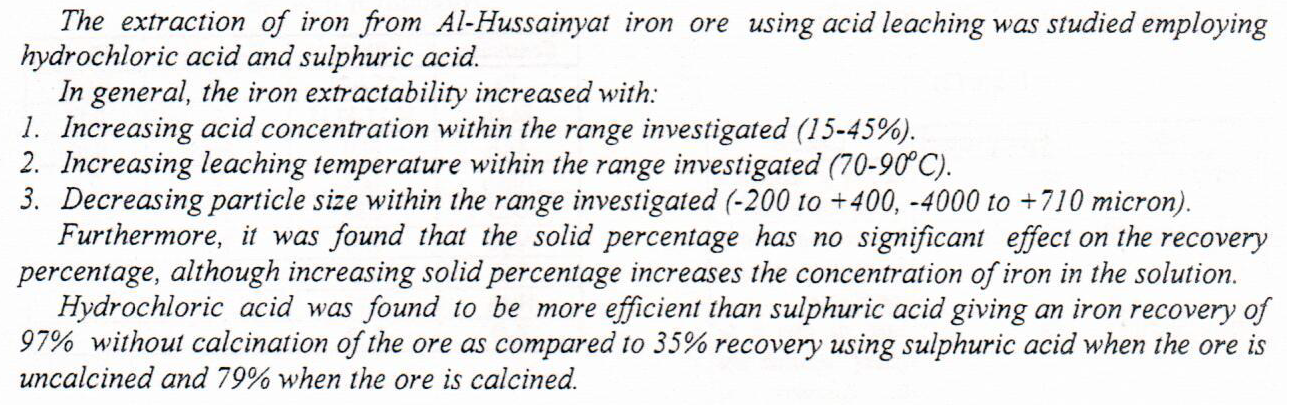
Extraction of Iron from Al-Hussainyat Iron Ore using Acid Leaching

This study aims to test ceramic waste's capacity to remove nickel from aqueous solutions through adsorption. Ceramic wastes were collected from the Refractories Manufacturing Plant in Ramadi. Through a series of lab tests, the reaction time (5, 10, 15, 20, 25, 30, 35, 40, 45, and 50 minutes, and Ni concentrations (20, 40, 60, and 80) were tested using ceramic wastes with a solid to liquid ratio of 2g/30ml. At a temperature of 30ºC, the pH, total dissolved solids (TDS), and electrical conductivity (EC) were all measured. The equilibrium time was set at 30 min. Thereafter, the sorption (%) somewhat increased positively with the Ni concentration. Freundlich's equation showed that the adsorption intensity is 1.1827 and the Freundlich c
... Show More (1)
(1)


Cadmium is one of the heavy metal found in the wastewater of many industries. The electrocoagulation offers many advantages for the removal of cadmium over other methods. So the removal of cadmium from wastewater by using electrocoagulation was studied to investigate the effect of operating parameters on the removal efficiency. The studied parameters were the initial pH, initial concentration, and applied voltage. The study experiments were conducted in a batch reactor with with two pairs of aluminum electrodes with dimension and 2mm in thick with 1.5 cm space between them. The optimum removal was obtained at pH =7, initial concentration = 50 mg/L, and applied voltage = 20 V and it was 90%.
 (10)
(10)
In this study, the circulating fluidized bed was used to remove the Tetracycline from wastewater utilizing a pistachio shell coated with ZnO nanoparticles. Several parameters including, Tetracycline solution flowrate, initial static bed height, Tetracycline initial concentration and airflow rate were systematically examined to show their effect on the breakthrough curve and the required time to reach the adsorption capacity and thus draw the fully saturated curve of the adsorbent. Results showed that using ZnO nanoparticles will increase the adsorbent surface area and pores and as a result the adsorption increased, also the required time for adsorbent saturation increased and thus the removal efficiency may be achieved at mi
... Show More
(21)
The exploitation of obsolete recyclable resources including paper waste has the advantages of saving resources and environment protection. This study has been conducted to study utilizing paper waste to adsorb phenol which is one of the harmful organic compound byproducts deposited in the environment. The influence of different agitation methods, pH of the solution (3-11), initial phenol concentration (30-120ppm), adsorbent dose (0.5-2.5 g) and contact time (30-150 min) were studied. The highest phenol removal efficiency obtained was 86% with an adsorption capacity of 5.1 mg /g at optimization conditions (pH of 9, initial phenol concentration of 30 mg/L, an adsorbent dose of 2 g and contact time of 120min and at room temperature).
... Show More
(6)
In this study, the adsorption of Zn (NO3)2 is carried out by using surfaces of malvaparviflora. The validity of the adsorption is evaluated by using atomic absorption Spectrophotometry through determination the amount of adsorbed Zn (NO3)2. Various parameters such as PH, adsorbent weight and contact time are studied in terms of their effect on the reaction progress. Furthermore, Lagergren’s equation is used to determine adsorption kinetics. It is observed that high removal of Zn (NO3)2 is obtained at PH=2. High removal of Zn (NO3)2 is at the time equivalent of 60 min and reaches equilibrium,where 0.25gm is the best weight of adsorbant . For kinetics the reaction onto malvaparviflora follows pseudo first order Lagergren’s equation.
(1)
The biochar prepared from sawdust raw material was applied in this study for the treatment of wastewater polluted with methyl orange dye. The effect of pH (2-11), initial concertation (50-250 mg/L) and time were studied. The isotherm of Langmuir, Frendluch and temkin models studied. The Langmuir model was the best to explain the adsorption process, maximum uptake was 136.67 mg/g at 25Co of methyl orange dye. Equilibrium reached after four hours of contact for most adsorbents.The values of thermodynamic parameters ∆G were negative at various temperatures, so the process spontaneous, while ∆H values were 16683 j/mol and ∆S values was 60.82 j/mol.k.
(16)
The concerns about water contaminants affect most developing countries bypassing rivers over them. The issue is challenging to introduce water quality within the allowed limits for drinking, industrial and agricultural purposes. In the present study, physical-chemical parameters measurements of water samples taken from eleven stations were collected during six months in 2020 through flow path along the whole length of Tigris River inside AL Kut city (center of Wassit government) were investigated for six parameters are total hardness TH, hydrogen ion pH, biological oxygen demand BOD5, total dissolved solids TDS, nitrate NO3, and sulfate SO4. The water quality analysis results were compared with the maximum allowable limit concentrat
... Show More
(11)
(4)
The current study aims to cover the health topics in the Iraqi journalism , to know the concern 's level of the Iraqi journalism when covering the health subjects and to know the size of its performance under the diversity of visual and audio medias. The researcher has discussed his research by wording it with a set of inquiries that should be answered via the research and study. He could have determined that by the following:
What is the concern's level of Iraqi journalism over the health subjects? What are the forms and press arts that are functionalized by the Iraqi journalism as to get the health message to the republics? What is t
... Show More
(1)
This search includes the preparation of Schiff base ligand (SB) from condensation primary amine with vanillin. The new ligand was diagnosed by spectroscopic methods as Mass, NMR, CHN and FTIR. Ligand complexes were mixed from new (SB) and Anthranillic acid (A) with five metal (II) chlorides. The preparation and diagnosis were conducted by FTIR, CHN, UV-visible, molar conductivity, atomic absorption and magnetic moment. The octahedral geometrical shape of the complexes was proposed. The ligands and their new complexes were screened with two different types of bacteria.
(23)
(4)
