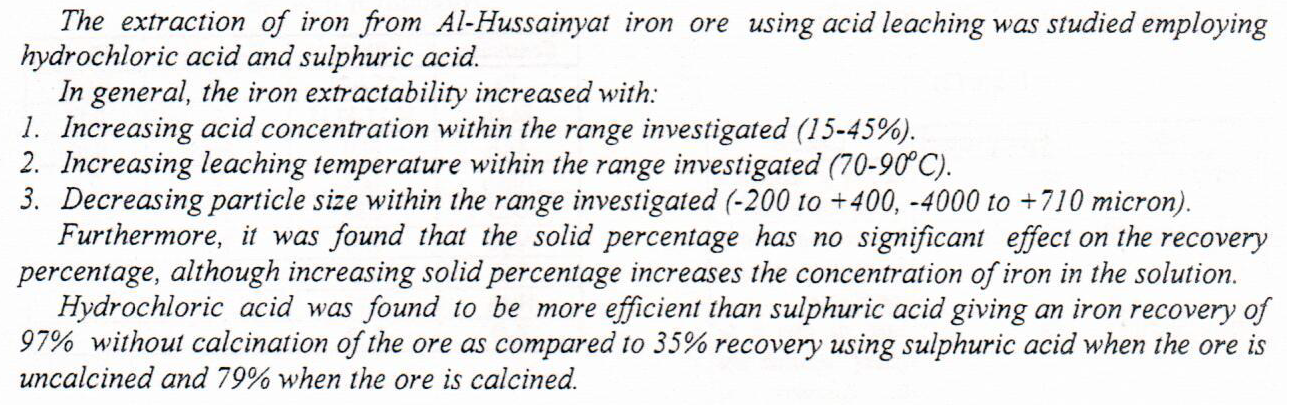
Extraction of Iron from Al-Hussainyat Iron Ore using Acid Leaching

0
Biodiesel production process was attracted more attention recently due to the surplus quantity of glycerol (G) as a byproduct from the process. Glycerol Utilization must take in to consideration to fix this issue also, to ensure biodiesel industry sustainability. Highly amount of Glycerol converted to more benefit material Glycerol carbonate (GC) was one of the most allurement compound derived from glycerol by transesterification of glycerol with dimethyl carbonate (DMC). Various parameters have highly impact on transesterification was investigated like catalyst loading (1-5) %wt., molar ratio of DMC: glycerol (5:1 – 1:1), reaction time (30 - 150) min and temperature (40 – 80) ᴼC. The Optimum glycerol carbonate yie
... Show More
Uropathogenic E. coli (UPEC) is problematic and still the leading cause of urinary tract infections worldwide. It is developed resistance against most antibiotics. The investigation, surveillance system, and efficient strategy will facilitate selecting an appropriate treatment that could control the bacterial distribution. The present study aims to investigate the epidemiology and associated risk factors of uropathogenic E. coli and to study their antibiotic resistance patterns. 1585 midstream urine specimens were collected from symptomatic urinary tract infections (UTI) patients (225 males and 1360 females) admitted to Zakho emergency hospital, Zakho, Kurdistan Region, Iraq from January 2016 until the end of December 2
... Show More (19)
(19)
 (8)
(8)

 (133)
(131)
(133)
(131)
This study investigates the stomach morphology and histochemistry of Clarias gariepinus. Grossly, the stomach is a J-shaped organ with three distinct regions: cardiac, fundic, and pyloric. Histologically, its wall comprises four layers: mucosa, submucosa, muscularis externa, and serosa. The mucosa exhibits broad longitudinal folds lined by high columnar cells with basal oval nuclei. These cells contain apical mucosubstances that react positively with Periodic Acid Schiff (PAS) stain and negatively with Alcian Blue (AB). Gastric pits result from mucosal invaginations. Glands are present in the fundic and cardiac regions but absent in the pyloric. Oxynticopeptic cells exclusively line the fundic glands. Enteroendocrine cells are distr
... Show More
To study the comparative use of some soil minerals (zeolite, bentonite, phosphate rock, and limestone) in the adsorption and release of lead and its removal rates from its aqueous solutions using adsorption equations. Two laboratory experiments were carried out for the adsorption and release of lead. The adsorption experiment took 0.5 g of some of the above soil minerals. Lead was added as Pb (NO3)2 at levels of 3.0, 2.0, 1.5, 1.0, 0.5, and 0.0 mmol L-1 containing a concentration of 0.01M of calcium chloride. The experimental unit’s number was 72, the concentration of dissolved lead in the equilibrium solution was estimated and the amount of lead adsorbed was calculated. As for the lead release experiment, samples fo
... Show More
The data preprocessing step is an important step in web usage mining because of the nature of log data, which are heterogeneous, unstructured, and noisy. Given the scalability and efficiency of algorithms in pattern discovery, a preprocessing step must be applied. In this study, the sequential methodologies utilized in the preprocessing of data from web server logs, with an emphasis on sub-phases, such as session identification, user identification, and data cleansing, are comprehensively evaluated and meticulously examined.
Background: The interest in herbal extracts as antimicrobial agents has increased over the past few years in endodontic therapy. Nasturtium officinale (watercress) is a promising plant with great medicinal values. This study aimed to investigate the antifungal activity of watercress oil in combination with calcium hydroxide against Candida albicans as intracanal medicament. Materials and Methods: Candida albicans was isolated from patients with necrotic root canal or failed root canal treatment. The sensitivity of Candida albicans to different concentrations of watercress oil extract was determined by using the agar well diffusion method in comparison with calcium hydroxide paste. The agar plate method was used to determine the minimum fung
... Show More
(6)
(6)
This study investigates the stomach morphology and histochemistry of Clarias gariepinus. Grossly, the stomach is a J-shaped organ with three distinct regions: cardiac, fundic, and pyloric. Histologically, its wall comprises four layers: mucosa, submucosa, muscularis externa, and serosa. The mucosa exhibits broad longitudinal folds lined by high columnar cells with basal oval nuclei. These cells contain apical mucosubstances that react positively with Periodic Acid Schiff (PAS) stain and negatively with Alcian Blue (AB). Gastric pits result from mucosal invaginations. Glands are present in the fundic and cardiac regions but absent in the pyloric. Oxynticopeptic cells exclusively line the fundic glands. Enteroendocrine cells are distr
... Show More
The number of infections caused by microorganisms is increasing significantly over the last few years. A total of 140 patients admitted to the central teaching hospital of pediatrics from the 1st of Jun 2017 to 31 October 2017. The Clinical samples was processed from culture and sensitivity testing. Antibiotic discs used for gram negative isolates. The most prevalent gram negative isolates included Escherichia coli 63 (45.0 %), Pseudomonas spp. 21 (15.0 %), Klebsiella spp. 19 (13.6 %) predominantly. Escherichia coli were the most prevalent isolates from urine 45 (71.4 %), Klebsiella spp. 11 (57.9 %) and Enterobacter spp. 11 (68.8 %) followed by Escherichia coli 10 (15.9 %) predominant from blood. 68 (48.6 %) of specimens were urine, 47 (33.
... Show More
(3)
(1)