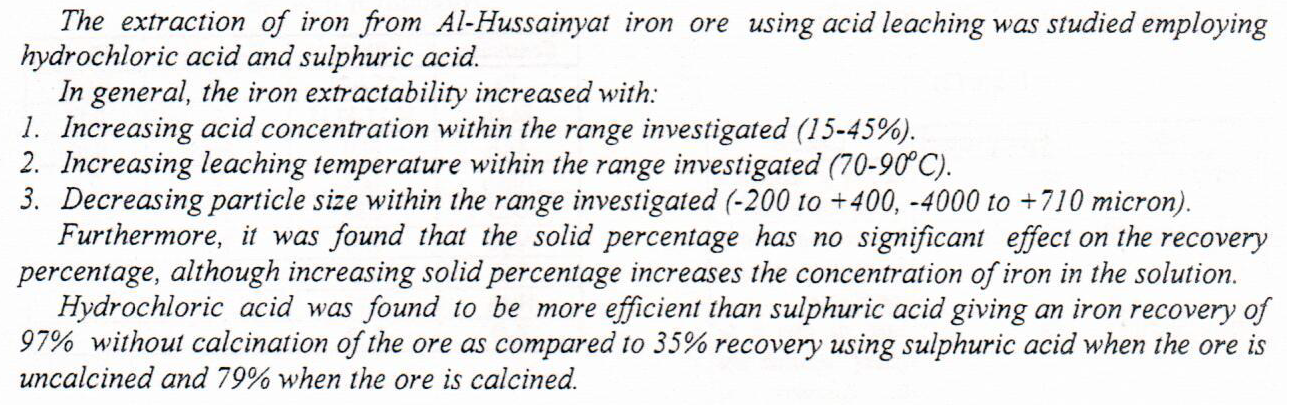
Extraction of Iron from Al-Hussainyat Iron Ore using Acid Leaching

This study is aimed to Green-synthesize and characterize Al NPs from Clove (Syzygium aromaticum
L.) buds plant extract and to investigate their effect on isolated and characterized Salmonella enterica growth.
S. aromaticum buds aqueous extract was prepared from local market clove, then mixed with Aluminum nitrate
Al(NO3)3. 9 H2O, 99.9% in ¼ ratio for green-synthesizing of Al NPs. Color change was a primary confirmation
of Al NPs biosynthesis. The biosynthesized nanoparticles were identified and characterized by AFM, SEM,
EDX and UV–Visible spectrophotometer. AFM data recorded 122nm particles size and the surface roughness
RMs) of the pure S. aromaticum buds aqueous extract recorded 17.5nm particles s
 (4)
(4)
 (3)
(3)


Background: Kocuria kristinae (earlier known as Rothia kristinae) is a relatively new opportunistic pathogen responsible for ear infections. The ability of this organism to form biofilms increases its resistance to therapy and promotes the development of antimicrobial resistance, necessitating new treatment methods. Objective: To assess the effect of 3-caffeoylquinic acid on K. kristinae isolated from patients with ear infections. Methods: Isolation of five clinical strains was done by conventional microbiological procedures. The ability of K. kristinae to form biofilms was determined by the crystal violet method (absorbance at OD₅₇₀) before and after 3-caffeoylquinic acid exposure; statistical data analysis was done using a
... Show More
Reaction of  p-fluoro benzoic acid with the thiosemicarbazide and salcialdehyde gave the new bidentate ligand .The prepared ligand Identified by FT-I.R and U.V-Visible spectcopic technique .Treatment of the prepared   ligand   with following metal ions  M=Tb(III),Eu(III),Nd(III) and La(III) ,in ethanol with a (1:1) M:L ratio and at pH=7 yielded series of neutral complexes as the general formula  [M LCl (H O ]. The prepared complexes were characterized using (FT-IR, UV-Vis) spectra , melting point, molar conductivity measurements . chloride ion content were also evolution by (mhor method) . The proposed structure of the complexes using program , chem office 3D(2004) .
Background: In the traditional protocol, the patient should wait after extraction up to six months to place the dental implant in healed bone, this waiting time accompanied by varying degrees of alveolar bone changes. In order to overcome these problems, immediate implant placement in the fresh extraction socket was introduced. The Aim of this study was to evaluate the outcome of the immediate implant placement utilizing Resonance Frequency Analysis (RFA) to quantify implant stability and osseointegration. Materials and Methods: A total of (23) patients participated in the study, receiving (44) implants placed in the sockets of teeth indicated for extraction. Clinical and radiographic preoperative assessment was accomplished for each patie
... Show More
(3)
The esterification of oleic acid with 2-ethylhexanol in presence of sulfuric acid as homogeneous catalyst was investigated in this work to produce 2-ethylhexyl oleate (biodiesel) by using semi batch reactive distillation. The effect of reaction temperature (100 to 130°C), 2-ethylhexanol:oleic acid molar ratio (1:1 to 1:3) and catalysts concentration (0.2 to 1wt%) were studied. Higher conversion of 97% was achieved with operating conditions of reaction temperature of 130°C, molar ratio of free fatty acid to alcohol of 1:2 and catalyst concentration of 1wt%. A simulation was adopted from basic principles of the reactive distillation using MATLAB to describe the process. Good agreement was achieved.
(51)
(44)
 (4)
(4)
This research presents a study in ultra-desulfurization of diesel fuel produced from conventional hydro desulfurization process, using oxidation and solvent extraction techniques. Dibenzothiophene (DBT) was the organosulfur compound that had been detected in sulfur removal. The oxidation process used hydrogen peroxide as an oxidant and acetic acid as homogeneous catalyst . The solvent extraction process used acetonitrile (ACN) and N-methyl – 2 - pyrrolidone (NMP) as extractants . Also the effect of five parameters (stirring speed :150 , 250 , 350 , and 450) rpm, temperature (30 , 40 , 45 , and 50) oC, oxidant/simulated diesel fuel ratio (0.5 , 0.75 , 1 , and 1.5) , catalyst/oxidant ratio(0.125,0.25,0.5
... Show MoreIn this work we present a technique to extract the heart contours from noisy echocardiograph images. Our technique is based on improving the image before applying contours detection to reduce heavy noise and get better image quality. To perform that, we combine many pre-processing techniques (filtering, morphological operations, and contrast adjustment) to avoid unclear edges and enhance low contrast of echocardiograph images, after implementing these techniques we can get legible detection for heart boundaries and valves movement by traditional edge detection methods.
(2)