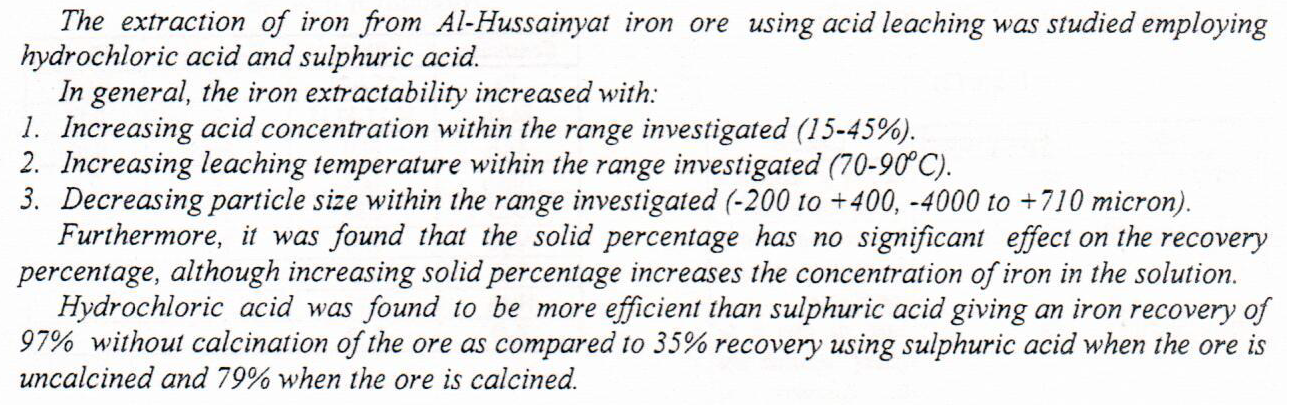
Extraction of Iron from Al-Hussainyat Iron Ore using Acid Leaching

In petroleum reservoir engineering, history matching refers to the calibration process in which a reservoir simulation model is validated through matching simulation outputs with the measurement of observed data. A traditional history matching technique is performed manually by engineering in which the most uncertain observed parameters are changed until a satisfactory match is obtained between the generated model and historical information. This study focuses on step by step and trial and error history matching of the Mishrif reservoir to constrain the appropriate simulated model. Up to 1 January 2021, Buzurgan Oilfield, which has eighty-five producers and sixteen injectors and has been under production for 45 years when it started
... Show More (1)
(1)

Aeromonas salmonicida is a fish pathogen and recognized to cause a variety of diseases in humans. There are a few information about A.salmonicida in Iraq and there is no any previous molecular study on it. During the period of December 2017 to May 2018; Sixteen isolates of the A. salmonicida were isolated and identified from 300 common carp (Cyprinus carpio) fishes stomach in aquarium of Erbil city/ Iraq by using manual, automated Vitek 2 compact system, and confirmed by PCR using gene TonB-dependent siderophore (364bp). Antimicrobial susceptibility was determined by disk diffusion method and the results found that all isolates 100% susceptible to imipenem, 100% resistant to nalidixic acid and variable resistan
... Show More

The calculation. of the nuclear. charge. density. distributions. ρ(r) and root. mean. square. radius.( RMS ) by elastic. electron. scattering. of medium. mass. nuclei. such. as (90Zr, 92Mo) based. on the model. of the modified. shell. and the use of the probability. of occupation. on the surface. orbits. of level 2p, 2s eroding. shells. and 1g gaining. shells. The occupation probabilities of these states differ noticeably from the predictions of the SSM. We have found. an improvement. in the determination. of ground. charge. density. and this improvement. allow. more precise. identification. of (CDD) between. (92Mo- 90Zr) to illustrate the influence of the extra
... Show More
Yeasts are distributed in all environments and have been reported as potential biocontrol agents against various phytopathogenic fungi. To investigate their enzymatic and biological activities, 32 yeasts were isolated from 15 date vinegar samples. Evaluation of the antagonistic activities of isolated yeasts against the plant pathogens Fusarium oxysporium, Sclerotinia sclerotiorum, and Macrophomina phaseolina indicated that there are two yeasts had the highest inhibitory effect against plant pathogens, these yeasts identified as Kluyveromyces marxianus and Torulaspora delbrueckii using traditional and molecular methods. These yeast isolates were tested for fungal cell wall degrading enzymes (in vitro), and results indicated that the
... Show More (8)
(7)
(8)
(7)
Removal of heavy metals from waste water has received a great deal of attention. The compare Cr
(VI) adsorption characteristics removing from wastewater by using thermally modified and non-modified
eggshells were examined
(6)
(3)
Aromatic hydrocarbons present in Iraqi national surface water were believed to be raised principally from combustion of various petroleum products, industrial processes and transport output and their precipitation on surface water.
Polycyclic aromatic hydrocarbons (PAHs) were included in the priority pollutant list due to their toxic and carcinogenic nature. The concern about water contamination and the consequent human exposure have encouraged the development of new methods for
PAHs detection and removal.
PAHs, the real contaminants of petroleum matter, were detected in selected sites along Tigris River within Baghdad City in summer and winter time, using Shimadzu high performance liquid chromatography (HPLC) system.
Analysi
(214)
(192)
It is well known that petroleum refineries are considered the largest generator of oily sludge which may cause serious threats to the environment if disposed of without treatment. Throughout the present research, it can be said that a hybrid process including ultrasonic treatment coupled with froth floatation has been shown as a green efficient treatment of oily sludge waste from the bottom of crude oil tanks in Al-Daura refinery and able to get high yield of base oil recovery which is 65% at the optimum operating conditions (treatment time = 30 min, ultrasonic wave amplitude = 60 micron, and (solvent: oily sludge) ratio = 4). Experimental results showed that 83% of the solvent used was recovered meanwhile the main water
... Show More
(1)
(22)
(10)