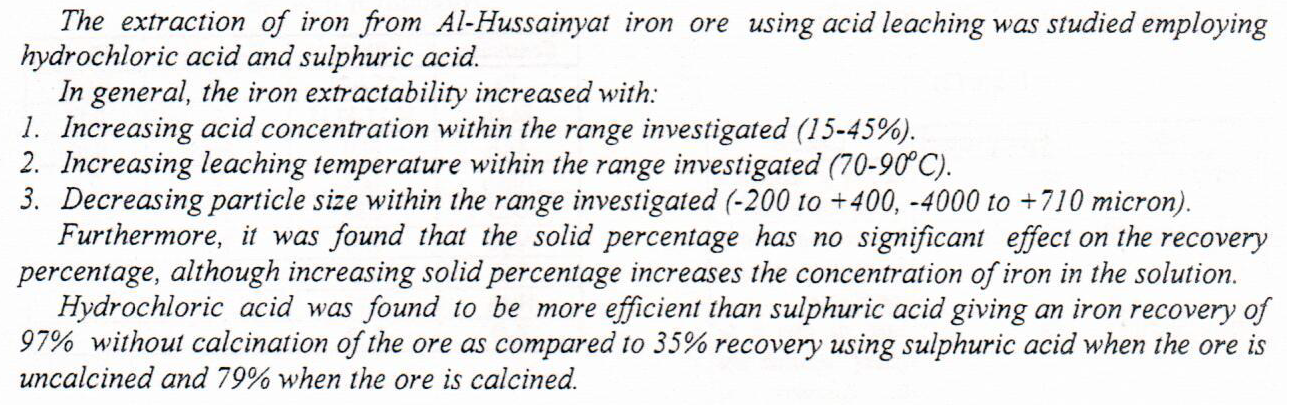
Extraction of Iron from Al-Hussainyat Iron Ore using Acid Leaching

The adsorption behavior of congo red dye from its aqueous solutions was investigated onto natural and modified bauxite clays. Both bauxite and modified bauxite are primarily characterized by using, FTIR, SEM, AFM, and XRD. Several variables are studied as a function of adsorption including contact time, adsorbent weight, pH, ionic strength, particle size and temperature under batch adsorption technique. The absorbance of the solution before and after adsorption was measured spectrophotometrically. The equilibrium data fit with Langmuir model of adsorption and the linear regression coefficient R2 is found to be 0.9832 and 0.9630 for natural and modified bauxite respectively at 37.5°C which elucidate the best fitting isotherm model. The gene
... Show More (7)
(7)
 (2)
(2)


Face recognition and identity verification are now critical components of current security and verification technology. The main objective of this review is to identify the most important deep learning techniques that have contributed to the improvement in the accuracy and reliability of facial recognition systems, as well as highlighting existing problems and potential future research areas. An extensive literature review was conducted with the assistance of leading scientific databases such as IEEE Xplore, ScienceDirect, and SpringerLink and covered studies from the period 2015 to 2024. The studies of interest were related to the application of deep neural networks, i.e., CNN, Siamese, and Transformer-based models, in face recogni
... Show More
(9)
(6)
A new set of metal complexes by the general formula [M(C)2(H2O)2]Cl2 has been prepared through the interaction of the new Ligand [N1, N4-bis(4-chlorophenyl)succinamide] (C) derived from succinyl chloride with 4-Chloroaniline with the transition metal ions Mn(II), Co(II), Ni(II), Hg(II), Cu(II) and Cd(II). Compounds diagnosed by TGA, 1 H, 13CNMR and Mass spectra (for (C)), Fourier-transform infrared and Electronic spectrum, Magnetic measurement, molar conduct, (%M, %C, %H, %N). These measurements indicate that (C) is associated with the metal ion in a bi-dentate fashion by nitrogen atoms (the amide group) and the octahedral composition of these complexes is suggested. The anti-bacterial action of the compounds towards three types of bacteria
... Show More
(5)
A modified chemical method was used to prepare titanium dioxide nanoparticles (TiO2 NPs), which were diagnosed by several techniques: X-ray diffraction, Fourier transform infrared, field emission scaning electron microscopy, energy disperse X-ray, and UV-visible spectroscopy, which proved the success of the preparation process at the nanoscale level. Where the titanium oxide particles have an average particle size equal to 6.8 nm, titanium dioxide particles were used in the process of adsorption of Congo red dye from its aqueous solutions using a batch system. The titanium oxide particles gave an adsorption efficiency of Congo red dye up to more than 79 %. The experimental data of the adsorption process were analyzed with kinetic models and
... Show More
(1)
Parasitological examination of gills of three species of sparid fishes in the territorial waters of Iraq was performed, two diplectanid monogenoids were isolated and described; Lamellodiscus indicus Tripathi, 1959 from both Haffara seabream Rhabdosargus haffara (Forsskål, 1775) and Goldline seabream R. sarba (Forsskål, 1775) and Protolamellodiscus senilobatus Kritsky, Jiménez-Ruiz and Sey, 2000 from King soldierbream Argyrops spinifer (Forsskål, 1775). The record of the parasites is considered new to the parasite fauna of Iraq. The redescription of L. indicus for the first time which is collected from a new distribution area (Arabian Gulf). R. haffara is considered a new host record .
(5)
(3)
Polycystic ovary syndrome (PCOS) is one of the most common endocrine disorder. To determine the metabolic disorders in women with PCOS, (25) women with PCOS ages (15 - 47) years have been investigated and compared with (20) healthy individuals. All the studied groups were carried out to measure fasting blood sugar, (anti-GAD Ab, anti β-islet cell Ab by IFAT) and measured insulin level by ELISA. There was significant elevation in the concentration of fasting blood sugar than in control groups (p ≤ 0.05) and there was negative results for anti-GAD Ab and anti β-islet cell Ab by IFAT test for serum of women with PCOS, while there was significant differences in the insulin level for women with PCOS compared with control groups (p ≤ 0.05),
... Show MoreRemoving of terasil yellow (W-6GS) dye it was studied by using Iraqi Siliceous Rocks Powder (SRP). The study included adsorption isotherms and some effects: temperature, salty medium and the acidity the study that the adsorption isotherms obeys to Temkin equation more than other equations the results showed that the adsorption increased with increasing temperature (Endothermic process. Based on the results, thermodynamic functions (˜H, ˜G, ˜S) were estimated. The amount of adsorbent on the surface increasing with increasing the acidity solution. The kinetics study of the adsorption treated according (Lagergren equation). The kinetic data of experiments properly correlated with the first order kinetic equation.
Objective: Using green chemistry, an effective, inexpensive, and environmentally safe method, sulfur nanoparticles with specific properties can be prepared and used in nanotechnology. This research aimed to prepare sulfur nanoparticles from chilli pepper extract and determine their effectiveness against colon cancer. Method: Chilli pepper extract obtained from local markets was treated with aqueous sodium thiosulfate (Na2S2O7.5H2O). After mixing, it was continuously stirred, heated, and filtered. NaBH4 was then added, resulting in a yellow precipitate. The precipitate was centrifuged, purified, and dried at 250°C. Results: Standardised tests such as UV-Vis, XRD, SEM, TEM, AFM, and EDX were used, resulting in sulfur nanoparticles with an av
... Show MoreThe presence of heavy metals in the environment is major concern due to their toxicity. In the present study a strong acid cation exchange resin, Amberlite IR 120 was used for the removal of lead, zinc and copper from simulated wastewater. The optimum conditions were determined in a batch system of concentration 100 mg/L, pH range between 1 and 8, contact time between 5 and 120 minutes, and amount of adsorbent was from 0.05 to 0.45 g/100 ml. A constant stirring speed, 180 rpm, was chosen during all of the experiments. The optimum conditions were found to be pH of 4 for copper and lead and pH 6 for zinc, contact time of 60 min and 0.35 g of adsorbent. Three different temperatures (25, 40 and 60°C) were selected to investigate the effect
... Show More
(7)