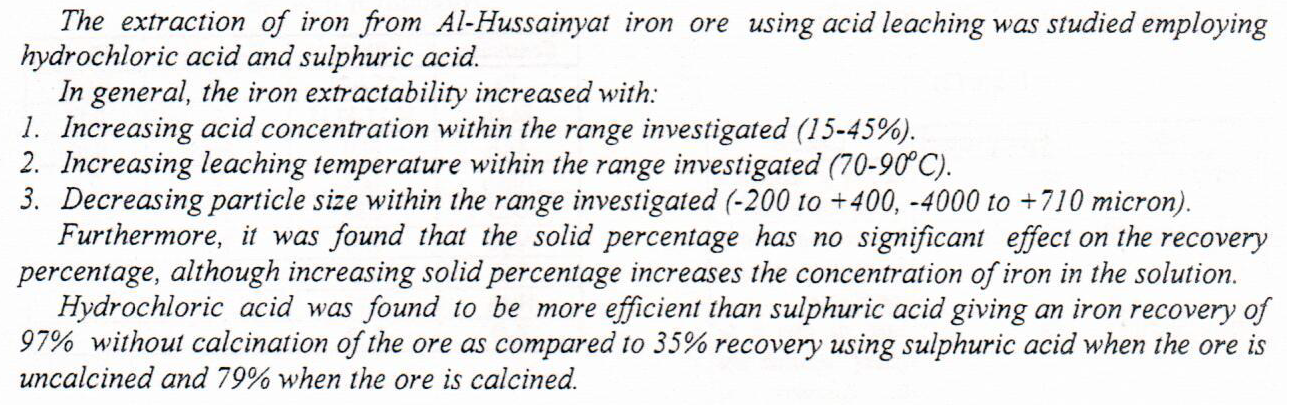
Extraction of Iron from Al-Hussainyat Iron Ore using Acid Leaching

Background: Increasing interest in quality of life (QoL) is the new approach for understanding and improvement of health care. Although there are many studies about quality of life, there is deficiency of data about quality of life of peoples survived from terroristic explosions.Objectives: To study the QoL for peoples survived from terroristic explosions and compare it with that of a controlled people. Methods: This study was conducted between, 1st of July till 31st of December 2013. The sample of this study was collected from peoples attending the outpatient clinics in four primary health care centers, Baghdad city (2 from Rusafa and 2 from Karkh). 183 individuals proved to be exposed to terroristic explosion and 199 individual not exp
... Show More (5)
(5)
 (4)
(4)



Pseudomonas aeruginosa has been identified as the main causative agent responsible for severe infections in burn patients worldwide. This study aimed to investigate the prevalence of the exoU/exoS genotype in P. aeruginosa isolates collected from burn wound infections in Iraq. From January to April 2023, a total of eighty isolates of P. aeruginosawere obtained from patients with burn wound infections in two Iraqi hospitals (Teaching Baghdad Hospital and AL-Yarmok Hospital).The isolates were first identified using biochemical tests and then verified using molecular techniques, specifically by targeting the 16S rRNA gene with specific primers. The exoU/exoS genotype was detected using conventional polymerase chain reaction (PCR) by specifical
... Show MoreIn this study involves removing of Brilliant Dyes, were which (Brilliant Green {BG} and Brilliant Cresyl Blue {BCB}) by using Iraqi Siliceous Rocks Powder (SRP). Adsorption isotherms were studied and the factors which prefer it, like temperature and salt effect, Adsorption isotherms of dyes, Brilliant Cresyl Blue {BCB} was found to be comparable to Langmuir equation according to Giles classification, isotherms dye Brilliant Green {BG} was found to be comparable to Freundlich equation more than dye Brilliant Blue {BCB} according to Giles classification. The adsorption process on this surface (SRP) studied at different temperatures, the results showed that the adsorption of dyes (BCB, BG) on the surface increased with increased temperature (E
... Show MoreThe process of discharging the quantities of dyes resulting from industrial processes with wastewater leads to the occurrence of a serious environmental problem that threatens the environmental health security of humans. Therefore, a number of studies have been addressed that include presenting many physical and chemical treatment methods to get rid or reduce the proportion of pigments such as biological decomposition, ion exchange, and sedimentation. Chemotherapy, reverse osmosis, coagulation, Toxic sludge generation, flocculation. In addition to the above, this review deals with a number of studies that present activated carbon of plant origin, methods of obtaining it, types and advantages of it being cheap and environmentally friendly. A
... Show MoreThe current theoretical research targeted to construct a model of terrorist personality and its differentiation from psychopathic personality . Several assumptions or theories of perspectives of psychopathic personality have been compared with the terrorist personality studies that concerned . The suggested theoretical model is interrupting the terrorist personality . The conclusions , discussions are mentioned. Finally, recommendation is suggested .
Rare earth metal oxides (REMOs) have gained considerable attention in recent years owing to their distinctive properties and potential applications in electronic devices and catalysts. Particularly, cerium dioxide (CeO2), also known as ceria, has emerged as an interesting material in a wide variety of industrial, technological, and medical applications. Ceria can be synthesized with various morphologies, including rods, cubes, wires, tubes, and spheres. This comprehensive review offers valuable perceptions into the crystal structure, fundamental properties, and reaction mechanisms that govern the well-established surface-assisted reactions over ceria. The activity, selectivity, and stability of ceria, either as a stand-alone catalyst or as
... Show More
(27)
(26)
This study included the extraction properties of spatial and morphological basins studied using the Soil and Water Assessment Tool (SWAT) model linked to (GIS) to find the amount of sediment and rates of flow that flows into the Haditha reservoir . The aim of this study is determine the amount of sediment coming from the valleys and flowing into the Haditha Dam reservoir for 25 years ago for the period (1985-2010) and its impact on design lifetime of the Haditha Dam reservoir and to determine the best ways to reduce the sediment transport. The result indicated that total amount of sediment coming from all valleys about (2.56 * 106 ton). The maximum annual total sediment load was about (488.22 * 103 ton) in year 1988
... Show MoreUsed cooking oil was undergoing trans-esterification reaction to produce biodiesel fuel. Method of production consisted of pretreatment steps, trans-esterification, separation, washing and drying. Trans-esterification of treated oils was studied at different operation conditions, the methanol to oil mole ratio were 6:1, 8:1, 10:1, and 12:1, at different temperature 30, 40, 50, and 60 º C, reaction time 40, 60, 80, and 120 minutes, amount of catalyst 0.5, 1, 1.5, and 2 wt.% based on oil and mixing speed 400 rpm. The maximum yield of biodiesel was 91.68 wt.% for treated oils obtained by trans-esterification reaction with 10:1 methanol to oil mole ratio, 60 º C reaction temperature, 80 minute reactio
... Show MoreIn this work Aquatic plant (Nile rose) was used to study adsorption of industrial dye (safranin-O from aqueous solution within several operation conditions. The dried leaves of Nile rose plant were used as adsorbents safranin-O from aqueous solution after different activations such as wet and dry enhancements. The data show increasing in dye solution removal percentage for both activation methods of the adsorbent and also dye removal percentage that was obtained by using adsorbent without any treatment with the progress contact time. The dye removal percentages at equilibrium time 40 minutes were 88.7% at non-activation, 92.3% at thermal activation, and 98.3% at acidic activation. The samples adsorbents before and after adsorption which wer
... Show More
(10)
(4)