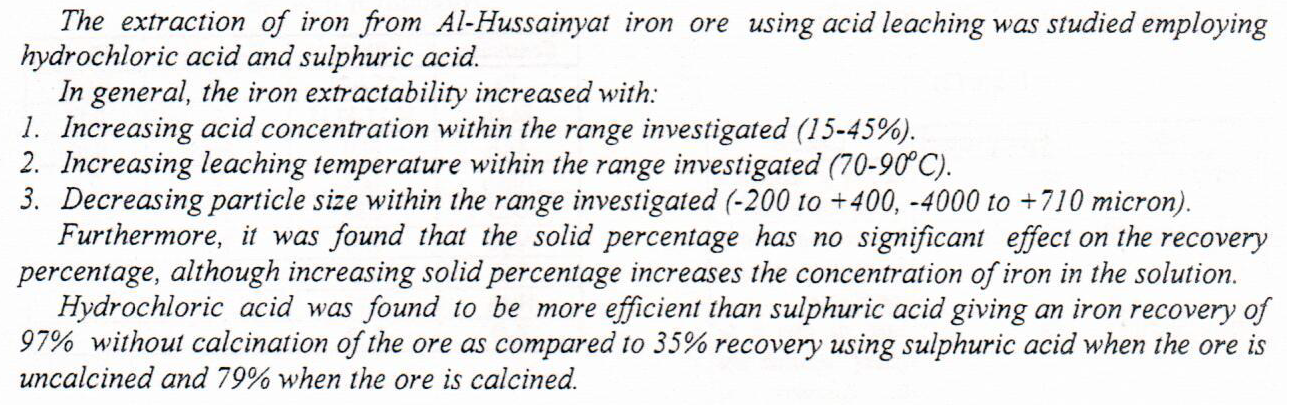
Extraction of Iron from Al-Hussainyat Iron Ore using Acid Leaching

This work included synthesis of several new polymers of polyacryloyl chloride in two steps . The first step the included the reaction of N-( sub. or un sub. benzoyl and sub. or un sub. acetyl ) amidyl sub. 2,6- diamino -4-methyl-1,3,5-triazine (1-5) by condensation of many substituted acid chlorides with 2,6- diamino -4-methyl-1,3,5-triazine . While the second step included the reaction of polyacryloyl chloride with the produced compounds (1-5) in step (1) in the presence amount triethyl amine (Et3N) to obtain new polyimides (6-10). The prepared compounds were characterized by UV. , FT-IR, and some of them by 1H-NMR and 13C- NMR spectroscopy.

Studies in Iraq that concerned identification of free-living Protozoa (sarcodina) are scarce; so the current study deals with these protozoan communities inhabiting the Tigris River in Baghdad City. Sampling collection stations have been selected at each of AL-Gheraiˈat and AL-Adhamiyah area adjacent to the river. Monthly intervals sampling with three samples were collected from each station from June to September 2020. Total of 23 sarcodina taxa were listed, out of them 5 taxa were new record to the Tigris River in Baghdad: Difflugia urceolata Carter, 1864 (Arcellinida, Difflugiidae), Heleopera perapetricola Leidy, 1879 (Arcellinida, Heleoperidae), Rhaphidiophrys pallida F.E. Schulze, 1874 (Centrohelida, Raphidiophridae), Saccamoeba sp
... Show More (4)
(4)

This study focused on treating wastewater to remove phosphorus by adsorption onto naturaland local materials. Burned kaolin, porcelinite, bauxite and limestone were selected to be testedas adsorption materials.The adsorption isotherms were evaluated by batch experiments, studyingthe effects of pH, temperature and initial phosphorus concentration. The results showed that at pH6, temperature 20°C and 300 mg/l initial phosphorus concentration; the sorption capacity was0.61, 9, 10 and 13 mg/g at 10 h contact time, for burned kaolin, porcelanite, limestone and bauxiterespectively. As the pH increased from 2 to 10 the removal efficiency for the materials differs inbehaviour. The removal efficiency increased from 40 to 90 % for limestone, and dec
... Show More (3)
(3)
The Wheat husk is one of the common wastes abundantly available in the Middle East countries especially in Iraq. The present study aimed to evaluate the Wheat husk as low cost material, eco-friendly adsorbents for the removal of the carcinogenic dye (Congo red dye) from wastewater by investigate the effect of, at different conditions such as, pH(3-10), amount of adsorbents (1-2.3gm/L),and particle size (125-1000) μm, initial Congo red dye concentration(10, 25 , 50 and 75mg/l) by batch experiments. The results showed that the removal percentage of dye increased with increasing adsorbent dosage, and decreasing particle size. The maximum removal and uptake reached (91%) , 21.5mg/g, respectively for 25 initial concent
... Show More
(4)
The study's objective is to produce Nano Graphene Oxide (GO) before using it for batch adsorption to remove heavy metals (Cadmium Cd+2, Nickel Ni+2, and Vanadium V+5) ions from industrial wastewater. The temperature effect (20-50) °C and initial concentration effect (100-800) mg L-1 on the adsorption process were studied. A simulation aqueous solution of the ions was used to identify the adsorption isotherms, and after the experimental data was collected, the sorption process was studied kinetically and thermodynamically. The Langmuir, Freundlich, and Temkin isotherm models were used to fit the data. The results showed that Cd, Ni, and V ions on the GO adsorbing surface matched the Langmuir mo
... Show More
(6)
This research includes a detaile description of new species Rhyncomya irakensis sp. nov.
from Iraq.
Localities distribution, host plants and data of collection were recorded.
In this work, a novel biocatalytic process for the production of 7-methylxanthines from theobromine, an economic feedstock has been developed. Bench scale production of 7-methlxanthine has been demonstrated. The biocatalytic process used in this work operates at 30 OC and atmospheric pressure, and is environmentally friendly. The biocatalyst was E. coli BL21(DE3) engineered with ndmB/D genes combinations. These modifications enabled specific N7- demethylation of theobromine to 7-methylxanthine. This production process consists of uniform fermentation conditions with a specific metabolically engineered strain, uniform induction of specific enzymes for 7-methylxanthine production, uniform recovery an
... Show More
(9)
This study was aimed to evaluate atotal phenolic content, antibacterial activity, and antioxidant activity of M. communis callus extracts were evaluated. Callus induction in general Murashige and Skoog (MS) media is completed by the Benzil adenine's unique knowledge of callus formation. A well diffusion experiment was used to examine antibacterial interest in Staphylococcus aureus, Escherichia coli, Klebsiella pneumonia, and Pseudomonas aeruginosa. The DPPH radical scavenging activity test was used to measure antioxidant activity. FTIR and HPLC have been used to pinpoint the presence of polyphenol compounds in calluses. The total phenol content of plant leaves extract (0.1, 0.5, and 1) mg/ml was 42.12, 94.08, and 189 mg of Gallic ac
... Show More
(4)
