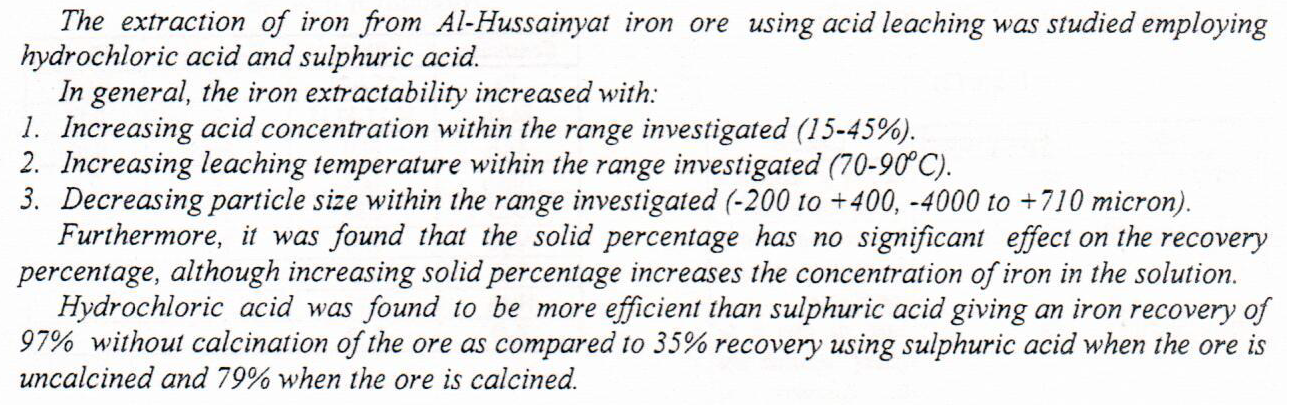
Extraction of Iron from Al-Hussainyat Iron Ore using Acid Leaching

Most dinoflagellate had a resting cyst in their life cycle. This cyst was developed in unfavorable environmental condition. The conventional method for identifying dinoflagellate cyst in natural sediment requires morphological observation, isolating, germinating and cultivating the cysts. PCR is a highly sensitive method for detecting dinoflagellate cyst in the sediment. The aim of this study is to examine whether CO1 primer could detect DNA of multispecies dinoflagellate cysts in the sediment from our sampling sites. Dinoflagellate cyst DNA was extracted from 16 sediment samples. PCR method using COI primer was running. The sequencing of dinoflagellate cyst DNA was using BLAST. Results showed that there were two clades of dinoflag
... Show More (4)
(4)
 (3)
(3)


The aim of the current research is to know the degree to which middle school teachers and female teachers in the southern border schools use electronic educational alternatives in the field of education from their point of view and its relationship to some variables, and to achieve this goal, a random sample of (200) teachers was selected in southern border schools, and a questionnaire was prepared to collect The data, as well as the descriptive approach was used to achieve this goal. T-test and analysis of variance were used for the statistical treatment. The results concluded that the educational courses provided to male and female teachers are not sufficient. It has also been concluded that the use of electronic educational alternativ
... Show MoreKE Sharquie, SA Al Mashhadani, AA Noaimi, RK Al-Hayani, SA Shubber, Iraqi Postgraduate Medical Journal, 2012 - Cited by 1
(25)
In this study, poly4-(nicotinamido)-4-oxo-2-butenoic acid (PNOE) was prepared by the electro polymerization of 4-(nicotinamido)-4-oxo-2-butenoic acid (NOE) monomer on a 316 stainless steel (St.St) which acts as an anticorrosion coating. Fourier transforms infrared (FTIR), atomic force microscopy (AFM), scanning electron microscopy (SEM), and cyclic voltammetry were used to diagnose the structure and the properties of the prepared polymer layer. The corrosion behavior of the uncoated and coated 316 St.St were evaluated by using an electro chemical polarization technique in 0.2 M hydrochloric acid solution as a corrosive medium at a temperature range of 293 to 323 K. Nano materials, such as nano ZnO and graphene were added in di
... Show More
(8)
(2)
Plantation of humic acid nanoparticles on the inert sand through simple impregnation to obtain the permeable reactive barrier (PRB) for treating of groundwater contaminated with copper and cadmium ions. The humic acid was extracted from sewage sludge which is byproduct of the wastewater treatment plant; so, this considers an application of sustainable development. Batch tests signified that the coated sand by humic acid (CSHA) had removal efficiencies exceeded 98 % at contact time, sorbent dosage, and initial pH of 1 h, 0.25 g/50 mL and 7, respectively for 10 mg/L initial concentration and 200 rpm agitation speed. Results proved that physicosorption was the predominant mechanism for metals-CSHA interaction because the sorption data followed
... Show More
(39)
Abstract
The aim of this research is to identify the effectiveness of thinking skills in developing the life skills of the students of the first Academic year, particularly the differences in life skills according to the variable of study specialization (human-scientific). To achieve the research objectives, the life skills scale was constructed on the classification of (WHO). The psychometric properties of the scale were examined. The validity of the scale, which is the final form of (60) items, was valid for measuring the life skills. The scale was then applied to the research sample of (112) students of the first year of the University of Bisha. The SPSS program processed
... Show MoreThe waste sorting and recycling plant in the district of al- Mahmudiya (Yusufiya) is the only laboratory in Baghdad governorate. It is the only one in Iraq that collects and recycles waste. After sorting, we have packages of raw materials (aluminum cans, glass bottles, plastic bottles, Nylon bags) as well as natural fertilizers (food residues and others) and a sanitary landfill with specifications that meet international standards; However, the absence of a structure for the management of the plant (manager, assistant manager, accountant, etc.) in addition to the non-supply of waste on a daily and continuous basis and the lack of cooperation of the Municipality of Baghdad with the management of the plant led to delay in the work
... Show MoreZeolite Y nanoparticles were synthesized by sol - gel method. Dffirent samples using two silica sources were prepared.
Sodium metasilicate (Na2SiO3) (48% silica) and silicic acid silica (H2SiO3) (75% silica) were employed as silica
source and aluminum nitrate (Al(NO3)3.9H2O) was the aluminum source with tetrapropylammonium hydroxide
(TPAOH) as templating agent.
The synihesized-samples were characterized by X-ray diffraction, showed the requirement of diffirent aging time for
complete crystallization to be achieved. Transmission Electronic Microscope (TEM) images, showed the particles were
in the same range of 30 - 75 nm. FT-IR spectroscory, showed the synthesized samples having the zeolite Y crystal
properties. The i
Background: Regeneration dentistry demonstrates significant challenges due to the complexity of different dental structures. This study aimed to investigate osteogenic differentiation of human pulp stem cells (hDPSCs) cultured on a 3D-printed poly lactic acid (PLA) scaffold coated with nano-hydroxyapatite (nHA) and naringin (NAR) as a model for a dental regenerative. Methods: PLA scaffolds were 3D printed into circular discs (10 × 1 mm) and coated with nHA, NAR, or both. Scaffolds were cultured with hDPTCs to identify cellular morphological changes and adhesion over incubation periods of 3, 7, and 21 days using SEM. Then, the osteogenic potential of PLA, PLA/nHA/NAR, or PLA scaffolds coated with MTA elutes (PLA/MTA scaffolds) were evaluate
... Show More
(6)
(7)