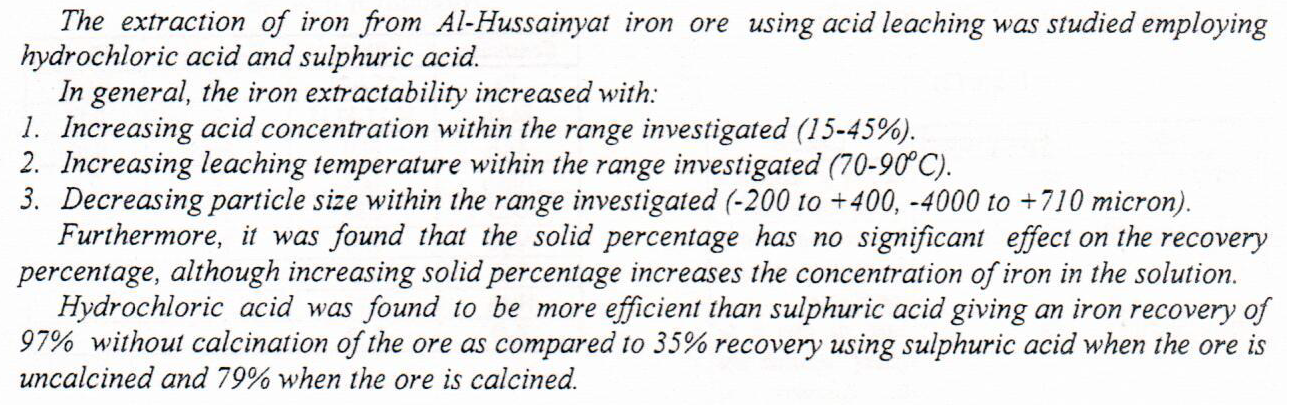
Extraction of Iron from Al-Hussainyat Iron Ore using Acid Leaching

III-V zinc-blende AlP, AlAs semiconductors and their alloy Aluminum Arsenide phosphide Al AsxP1-x ternary nanocrystals have been investigated using Ab- initio density functional theory (Ab-initio-DFT) at the generalized-gradient approximation (GGA) level with STO-3G basis set coupled with large unit cell method (LUC). The dimension of crystal is found around (1.56 – 2.24) nm at a function of increasing the sizes (8, 16, 54, 64) with different concentration of arsenide (x=0, 0.25, 0.5, 0.75 and 1) respectively. Gaussian 03 code program has been used throughout this study to calculate some of the physical properties such as the electronic properties energy gap, lattice constant, valence and conduction band as well as density of state. Re
... Show More (7)
(7)

Background: Fiber-optic endoscopy is an important
investigation of the large intestine, whether or not the
radiologist (barium enema) has discovered a lesion in
the bowel. Colonoscopy affords a unique opportunity
to direct visualization of entire colonic mucosa. At
the same time, the physician can obtain biopsy specimens, remove polyps, and decompress volvuli.
Most experienced endoscopists and well prepared
patients can reach the cecum in over 90% of patients.
If colonoscopy is properly performed, it has a low
risk of complications, such as perforation and bleeding.
Methods: A total of 70 consecutive patients admitted
to Endoscopy department at Al-Kindy Teaching hospital from September- 2008 to July-2009.
During a period of two years, from January 1995 till December 1996, the first survey on fish parasites in Bahr Al-Najaf depression, mid Iraq, was achieved. A total of 6992 fishes, belonging to 11 species, were collected and inspected for external and internal parasites. These fishes were infected with three protozoans (Ichthyophthirius multifiliis, Trichodina domerguei and Myxobolus pfeifferi), two monogeneans (Dactylogyrus cornu and Gyrodactylus elegans), two digenetic trematodes (Clinostomum complanatum and Ascocotyle coleostoma), one nematode (Contracaecum sp.) and one acanthocephalan (Neoechinorhynchus iraqensis). Five fish species were recorded as new h
... Show MoreParonomasia is a recognized rhetorical device by which poets could play with words that are similar or identical in form but different in meaning. The present study aims to identify paronomasia in Arabic and English. To achieve the aim of the study, a corpus of selected verses chosen from two famous figures in Arabic and English literatures and analyzed thoroughly. The analysis of data under investigation reveals that paronomasia is a crucial aid used by poets to portrait the real world as imaginative. It further shows that the concept of paronomasia in English is not the same as in Arabic. In English, there are echoes of the Arabic jinās, i.e., there are counterpart usages of similar devices, yet English rhetoricians have not defined or c
... Show MoreThis study aims to evaluate the performance of the sewage treatment plant in Al-Diwaniya, one of cities in the southern part in Iraq. This evaluation could be used to facilitate effluent quality assessment or optimal process control of the plant. The influent reaching the plant is considered a medium to strong in strength with BOD5/COD ratio in the range 0.23 and 0.69 which can be considered an easily degradable sewage by the biological processes performed by the activated sludge unit. The quality of the effluent was found to be higher than the Iraqi standards for disposal to water bodies. The BOD5/COD ratios of the treated sewage varied over a wide range as low of 0.13 to 1.48 indicating operational problems in the plant. Regression ana
... Show More
(4)
This study aims to evaluate the performance of the sewage treatment plant in Al- Diwaniya, one of cities in the southern part in Iraq. This evaluation could be used to facilitate effluent quality assessment or optimal process control of the plant. The influent reaching the plant is considered a medium to strong in strength with BOD5/COD ratio in the range 0.23 and 0.69 which can be considered an easily degradable sewage by the biological processes performed by the activated sludge unit. The quality of the effluent was found to be higher than the Iraqi standards for disposal to water bodies. The BOD5/COD ratios of the treated sewage varied over a wide range as low of 0.13 to 1.48 indicating operational problems in the plant. Regressio
... Show MoreThe researcher studies and explains the content of some pictures that are published in al-Mada newspaper. The research is important as it deals with a topic that has a relation with visual culture and its role to transfer the press letter to the audience. The researcher finds that cartoonist exposed the security services through important people who have a major role in state policy and reveals the level of corruption and the weak treatments for this phenomenon and its reflection on the whole society and individuals. In addition to that, cartoonists try to encourage the public for going on the peaceful demonstrations since it is a good tool to make pressure on the government to punish the corrupts.
Historic centers are often subject to urban renewal without the prior knowledge of the extent of the cohesion and attachment to place of its inhabitants. Identifying the rates of cohesion and place attachment can help urban designers to avoid decisions that lead to clashes with the reality of the social groups inhabiting the neighborhoods of the historic center. So the research aimed to measure cohesion and place attachment in a methodological approach based on a psychological instrument conducted by previous studies .The measurements were applied through a questionnaire given to the residents of six elected neighborhoods forming the historic center of Al- Adhamiya.The research assumed the relative disparity rates of cohesion and place atta
... Show MoreShatt Al-Hilla was considered one of the important branches of Euphrates River that supplies irrigation water to millions of dunams of planted areas. It is important to control the velocity and water level along the river to maintain the required level for easily diverting water to the branches located along the river. So, in this research, a numerical model was developed to simulate the gradually varied unsteady flow in Shatt AL-Hilla. The present study aims to solve the continuity and momentum (Saint-Venant) equations numerically to predict the hydraulic characteristics in the river using Galerkin finite element method. A computer program was designed and built using the programming language FORTRAN-77. Fifty kilometers was consid
... Show More