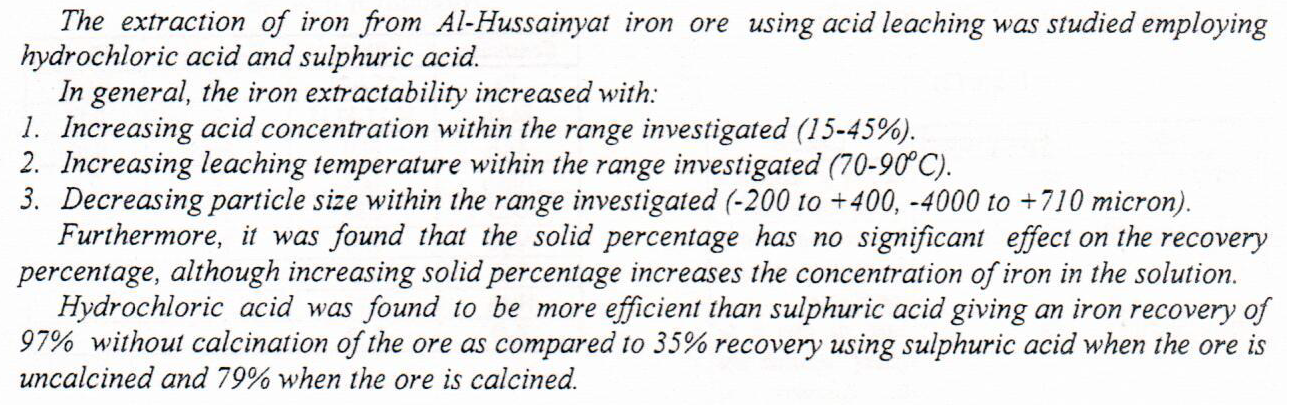
Extraction of Iron from Al-Hussainyat Iron Ore using Acid Leaching

Abstract Background: The novel coronavirus 2 (SARS?CoV?2) pandemic is a pulmonary disease, which leads to cardiac, hematologic, and renal complications. Anticoagulants are used for COVID-19 infected patients because the infection increases the risk of thrombosis. The world health organization (WHO), recommend prophylaxis dose of anticoagulants: (Enoxaparin or unfractionated Heparin for hospitalized patients with COVID-19 disease. This has created an urgent need to identify effective medications for COVID-19 prevention and treatment. The value of COVID-19 treatments is affected by cost-effectiveness analysis (CEA) to inform relative value and how to best maximize social welfare through evidence-based pricing decisions. O
... Show More (9)
(9)
 (5)
(5)


Abstract
Background: The novel coronavirus 2 (SARS?CoV?2) pandemic is a pulmonary disease, which leads to cardiac, hematologic, and renal complications. Anticoagulants are used for COVID-19 infected patients because the infection increases the risk of thrombosis. The world health organization (WHO), recommend prophylaxis dose of anticoagulants: (Enoxaparin or unfractionated Heparin for hospitalized patients with COVID-19 disease. This has created an urgent need to identify effective medications for COVID-19 prevention and treatment. The value of COVID-19 treatments is affected by cost-effectiveness analysis (CEA) to inform relative value and how to best maximize social welfare through eviden
... Show More
(9)
(5)
A new ligand 3-hydroxy-2-(3-(4-nitrobenzoyl) thiouriedo) propanoic acid (NTP) where synthesized by reaction of 4-nitro benzoyl isothiocyanate with serine amino acid. The ligand was characterized by FT-IR, NMR spectra and the elemental analysis. The transition metal complexes of this ligand where synthesize and characterized by UV-Visible spectra, FT-IR, magnetic suscpility, conductively measurement, The general formula [M (NTP) 2] where M+2= (Mn, Co, Ni, Cu, Zn, Cd, Hg,), the form of molecular for these complexes as tetrahedral except Cu has square planer.
New Schiff bases derivatives [IV]a-e is prepared via condensation of Derythroascorbic acid with p-substituted aldehydes in dry benzene. To obtain these derivatives, the 5,6-O-isopropylidene-L-ascorbic acid[I] was chosen as starting material, compound prepared from the reaction of L-ascorbic acid as starting material. Compound[I] was prepared from the reaction of L-ascorbic acid with dry acetone in the presence of hydrogen chloride. The esterification of hydroxyl groups at C-2 and C-3 positions with excess ofethyl α –chloroacetate in the presence of sodium acetate produce acorresebonding ester [II] , which was condensed with hydrazine hydrate to give new hydrazide [III] . The new Schiff bases [IV]a-e were synthesized by reaction of acid h
... Show MoreAn aromatic ester containing two azo groups namely p-nitro phenyl azo-β-naphthyl-(4'-azobenzoic acid)-4-benzoate was synthesized by esterfiaction of 4,4'-azo dibenzoic acid with p-nitro phenyl azo-β-naphthol. Synthesized ester was characterized by CHN-Elemental analysis, FTIR, 1H NMR and 13C NMR. A modified PVA polymer was obtained by grafting 10 g of PVA-polymer via partial esterification with (2, 3, 4 g) p-nitro phenyl azo-1-naphthyl-4-azobenzoic acid)-4-azo benzoate. Grafting PVA-polymer behaviours was studied, by physical measurements (solubility, swelling), thermal properties (DSC) and tensile.
A laboratory experiment was carried out at the College of Agriculture University of Baghdad in 2017. The aim was to improve the anatomical and physiological traits of broad bean seedling under salt stress by soaking it in salicylic acid. The concentrations of salicylic acid were 0, 10, and 20 mg L-1 and the electrical conductivity levels were 0, 3, and 6 dS m-1. The complete randomized design was used with four replications. The increasing of salicylic acid concentration up to 10 mg L-1 led to increasing the stem cortex thickness, stem vascular bundles thickness, and root cortex thickness significantly by (34.9,36.7,and 55 µm) respectively, while the treatment of 20 mg L-1 led to decreasing these traits by (28.2, 27.8, and 48.1 µm
... Show More
(20)
(1)
(3)
(1)