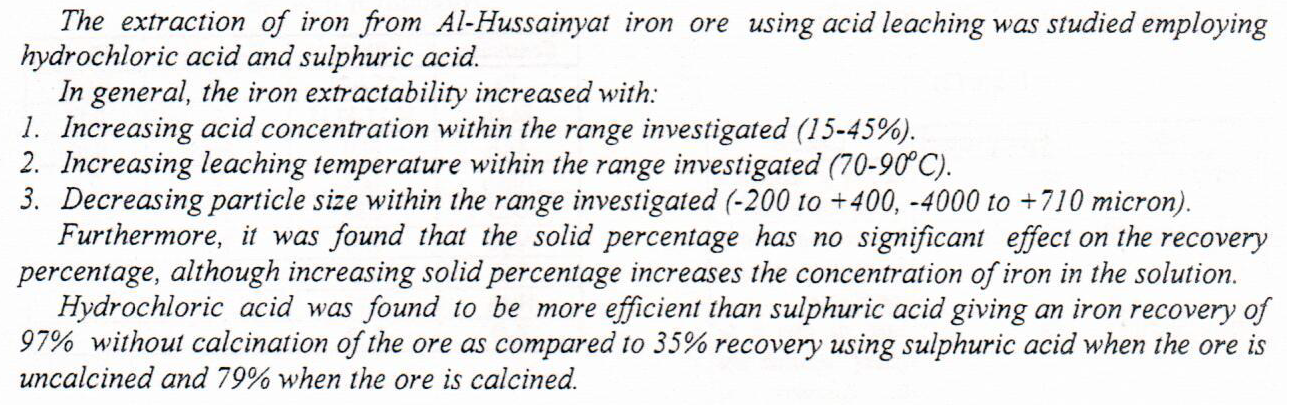
Extraction of Iron from Al-Hussainyat Iron Ore using Acid Leaching

Objectives: The study aimed to clarify the role of Al-Sayyid Al-Ajall and his family in the service of the Mongol Empire. They worked to develop its administrative and military institutions, benefiting from their extensive experience in administration, politics, economics, and urban affairs. Due to their capabilities, they received the patronage of Genghis Khan and subsequent generations, earning the confidence of the ruling Mongol authority. As a result, they were granted significant powers within the state. Methods: The study relied on the analytical method to analyze historical texts, compare them with others, and discuss them accurately. Results: The study yielded several results, including the minister's keen interes
... Show More (1)
(1)
 (1)
(1)


A poetic vision appeared in the poem of Al-Abbas bin Mardas Al-Sulami. He lived in the eras of pre-Islamic times and the emergence of Islam. The focus of this research: is the study of poetic text in the pre-Islamic era and the era of early Islam. The research followed a method in treating poetic texts, as it is based on presenting poetic texts from the collection of Al-Abbas bin Mardas, explaining the features of his poetic vision, and examining all the external factors that surrounded the poet and influenced his vision and all his thoughts. The results of this research was that Al-Abbas Ibn Mardas revealed some of the positions that he found contradicted the authentic Arab value before the advent of Islam, and the poet Abbas bin Mardas tr
... Show MoreThe research deals with the formal characteristics of folklore in contemporary Iraqi ceramics as a comparative study between the two potters Siham Al-Saudi and Sajida Al-Mashayikhi.
The research consists of four chapters. The first chapter is concerned with the research problem, the importance, the objectives, and the limits of the research, while the aim of the research answers the following question: The method and mechanisms of employing the traditional elements and vocabulary in the products of the potters “Seham Al-Saudi and Sajida Al-Mashaikhi”.
The second chapter came in the theoretical framework of the investigations and includes: The first topic: The second topic the movement in shaping contemporary Iraqi ceramics, whi
(32)
(30)

A new ligand 2,3-dihydrobenzo [d] thiazole-2-carboxylic acid (L) has been prepared from the reaction of ortho amino phenyl thiol with dichloroacetic acid in mole ratio (1:1). It has been characterized by elemental analysis (C.H.N.), IR, UV- Vis.spectraand 1H, 13C-NMR. A new series complexes of the bivalent ions (Co, Ni, Cu, Pd, Cd, Hg and Pb) and the trivalent (Cr) have been prepared and characterized too. The structural has been established by elemental analysis (C.H.N.), IR, UV-Vis. spectra, molar conductivity, atomic absorption and magnetic susceptibility measurements. The synthesized complexes were prepared in (1:2) ratio correspond to (Co(II), Ni(II), Cu(II), Pd(II), Cd(II), Hg(II) and Pb(II) complexes while in case Cr(III) complex is
... Show More
Iraqi calcium bentonite was activated via acidification to study its structural and electrical properties. The elemental analysis of treated bentonite was determined by using X-ray fluorescence while the unit crystal structure was studied through X-ray diffraction showing disappearance of some fundamental reflections due to the treatment processes. The surface morphology, on the other hand, was studied thoroughly by Scanning Electron microscopy SEM and Atomic Force Microscope AFM showing some fragments of montmorillonite sheets. Furthermore, the electrical properties of bentonite were studied including: The dielectric permittivity, conductivity, tangent loss factor, and impedance with range of frequency (0.1-1000 KHz) at different temperatu
... Show MoreNanostructured Al2O3has been applied as a protective coating against corrosion of the carbon steel (C.S) in seawater environment (3.5% NaCl) at temperatures range (298-328)K. Aluminananoparticles were deposited on carbon steel substrates by cathodic electrophoretic deposition (EPD) with ethanol as suspension medium and poly(acrylic acid) (PAA) as polymeric charging agent. Meanwhile, thesurface morphology was examined using Atomic-force microscopy (AFM). The cross-section AFM showed that the particles sizes for the Al2O3 NPs is around 60-80 nm. The anticorrosion behaviour of coated C.S was investigated in 3.5% NaCl at temperature range 298-328 K by potentiodynamic polarization measurements. Results show that using PAA in suspension coat incr
... Show More
(12)
Coupling reaction of 4-amino antipyrene with 4-amino benzoic acid gave bidentate azo ligand. The prepared ligand was identified by Microelemental Analysis, 1HNMR, FT-IR and UV-Vis spectroscopic techniques. Treatment of the prepared ligand with the following metal ions (CoII, NiII, CuII and ZnII) in aqueous ethanol with a 1:2 M:L ratio and at optimum pH, yielded a series of neutral complexes of the general formula [M(L)2]Cl2 . The prepared complexes were characterized using flame atomic absorption, (C.H.N) Analysis, FT-IR and UV-Vis spectroscopic methods as well as magnetic susceptibility and conductivity measurements. Chloride ion content was also evaluated by (Mohr method). The nature of the complexes formed were studied following the mol
... Show MoreThis study describe the effect of temperature on the optical
properties of nickel(ii) phthalocyanine tetrasulfonic acid tetrasodium
salt (NiPcTs) organic thin films which are prepared by spin coating
on indium tin oxide (ITO-glass). The optical absorption spectra of
these thin films are measured. Present studies reveal that the optical
band gap energies of NiPcTs thin films are dependent on the
annealing temperatures. The optical band gap decreases with increase
in annealing temperature, then increased when the temperature rising
to 473K. To enhance the results of Uv-Vis measurements and get
more accurate values of optical energy gaps; the Photoluminescence
spectra of as-deposited and annealed NiPcTs thin fi
(1)
The manganese doped zinc sulfide nanoparticles were synthesized by simple aqueous chemical reaction of manganese chloride, zinc acetate and thioacitamide in aqueous solution. Thioglycolic acid is used as capping agent for controlling the nanoparticle size. The main advantage of the ZnS:Mn nanoparticles of diameter ~ 2.73 nm is that the sample is prepared by using non-toxic precursors in a cost effective and eco-friendly way. The structural, morphological and chemical composition of the nanoparticles have been investigated by X-ray diffraction (XRD), Scanning Electron Microscopy (SEM) with energy dispersion spectroscopy (EDS) and Fourier transform infrared (FTIR) spectroscopy. The nanosize of the prepared nanoparticles was elucidated by Scan
... Show More