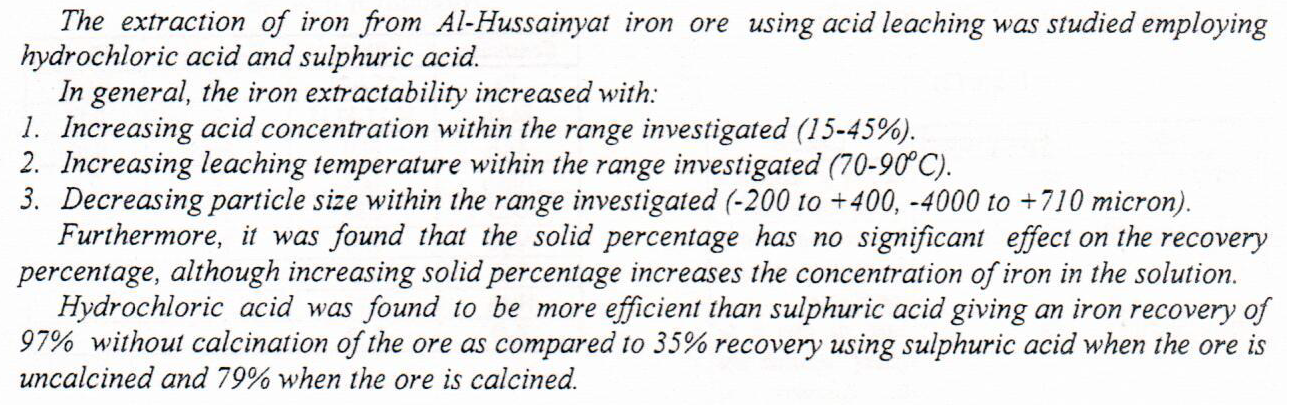
Extraction of Iron from Al-Hussainyat Iron Ore using Acid Leaching

 (10)
(10)
 (10)
(10)



In this research various of 2,5-disubstituted 1,3,4-oxadiazole (Schiff base, oxo-thiazolidine , and other compounds) were synthesized from 2,5-di(4,4?- amino-1,3,4-oxadiazole ) which use quently synthesized from mixture of 4-amino benzoic acid and hydrazine in the presence of polyphosphorus acid. The synthesized compounds were characterized by using some Spectral data (UV, FT-IR, and 1H-NMR).
(10)
(10)
Background: Lead-acid battery workers are at higher risk for systemic diseases as well as oral diseases like dental caries. The aim of this study was to assess selected salivary antioxidants and their relation with dental caries among lead acid battery factory workers in comparison with non-exposed group. Materials and methods: The sample consisted of 35 subjects aged 35-45 year-old who worked in Babylon lead acid battery factory in Baghdad city and matching group that not exposed to lead were selected as a control. Dental caries severity was recorded by using DMFS index, stimulated salivary samples were collected and analyzed for the measurement of salivary antioxidants (uric acid, total protein, catalase and glutathione peroxidase enzymes
... Show More
(10)
(10)
Background: In spite of all efforts, Non-small cell lung cancer (NSCLC) is a fatal solid tumor with a poor prognosis as of its high metastasis and resistance to present treatments. Tyrosine kinase inhibitors (TKI) such as erlotinib are efficient in treating NSCLC but the emergence of chemoresistance and adverse effects substantially limits their single use. Objective: in this study, the combination treatments of either 2-deoxy-D-glucose (2DG) or cinnamic acid (CINN) with erlotinib (ERL) were tested for their possible synergistic effect on the proliferation and migration capacity of NSCLC cells. Methods: In this study, NSCLC model cell line A549 was used to investigate the effects of single compounds and their combination on cell gro
... Show More
(6)
(3)
Mefenamic acid (MA) is one of the non-steroidal anti-inflammatory drugs, it is widely used probably due to having both anti-inflammatory and analgesic activity, the main side effects of mefenamic acid include gastrointestinal tract (GIT) disturbance mainly diarrhea, peptic ulceration, and gastric bleeding. The analgesic effects of NSAIDs are probably linked to COX-2 inhibition, while COX-1 inhibition is the major cause of this classic adverse effects. Introduction of thiazolidinone may lead to the increase in the bulkiness leads to the preferential inhibition of COX-2 rather than COX-1 enzyme. The study aimed to synthesize derivatives of mefenamic acid with more potency and to decrease the drug's potential side effects, new series of 4-t
... Show More
(1)
(4)
Samarium(III) ions react with (l-2(2-benzoinidazolyl-azo)-2-hydroxy-3-naphthoic acid in basic medium (pH = 8.0) forms a red-orange complex at A.max (550nm). The complex was found to be stable for at least 48 hrs. at the given pH. The apparent molar absorptivity is 7776.77 L.mol-1.Cm-1 and a linear calibration curve is obtained in the range (0.639x 10⁻⁵M - 6.350x 10 -5M). The stoichiometry of complex was confirmed by using mole ratio method which indicated that ratio of reagent to metal is 3:1. The effects of the presence of different cations and anions as interferences in the determination of samarium(III) under the given conditions were investigated
To investigate the effects of losartan and enalapril on serum uric acid in hypertensive patients with metabolic syndrome, one hundred and twenty six newly diagnosed mild hypertensive patients, having markers of metabolic syndrome included in the study. The patients were divided into two groups. Group 1 (60 patients) was given losartan (50 mg/ day) and group 2 (66 patients) enalapril (20 mg/ day) for a duration of 2 months. A control group of seventy apparently healthy individuals were included. Metabolic syndrome was diagnosed according to diagnostic criteria of metabolic syndrome related to the American National Cholesterol Education Program-Adult Treatment Panel III. Serum uric acid levels were measured bef
... Show More