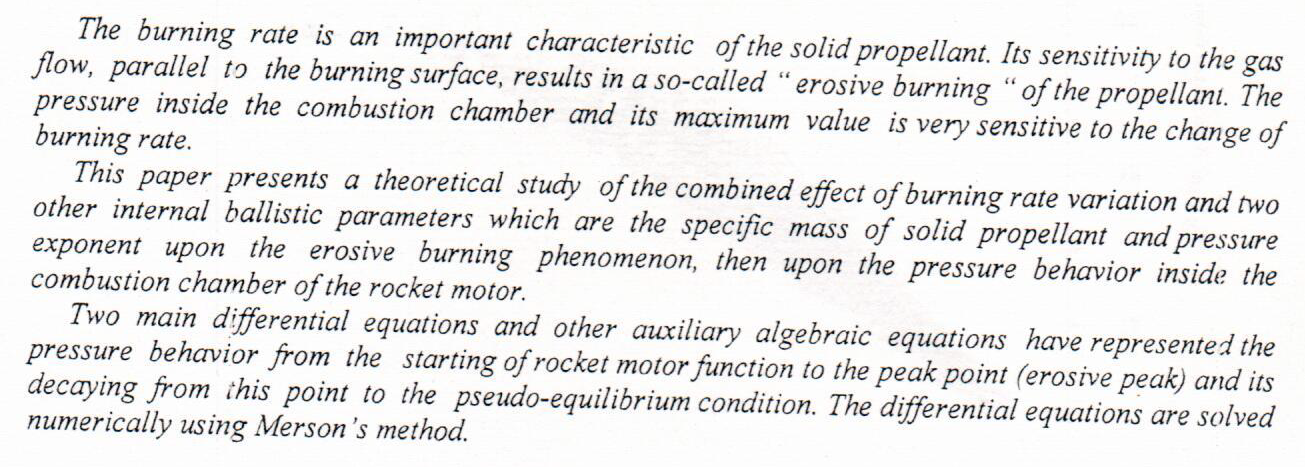
Combined Effect of Some Internal Ballisting Parameters on the Pressure Behavior of Solid Propellant Rocket Motor

In this study, the possible protective effects of daidzein on ifosfamide-induced neurotoxicity in male rats were examined by the determination of changes in selected oxidant–antioxidant markers of male rats’ brain tissue.
Twenty-eight (28) apparently-healthy Wistar male rats weighing (120-150gm) allocated into 4 groups (n=7) were used in this study. Rats orally-administered 1% tween 20 dissolved in distilled water/Control (Group I); rats were orally-administered daidzein suspension (100mg/kg) for 7 days (Group II); rats intraperitoneally-injected with a single dose of ifosfamide (500 mg/kg) (Group III); rats orally-administered for 7 days with the daidzein (100mg/
... Show More (3)
(3)
 (2)
(2)


In this study, the possible protective effects of daidzein on ifosfamide-induced neurotoxicity in male rats were examined by the determination of changes in selected oxidant–antioxidant markers of male rats’ brain tissue. Twenty-eight (28) apparently-healthy Wistar male rats weighing (120-150gm) allocated into 4 groups (n=7) were used in this study. Rats orally-administered 1% tween 20 dissolved in distilled water/Control (Group I); rats were orally-administered daidzein suspension (100mg/kg) for 7 days (Group II); rats intraperitoneally-injected with a single dose of ifosfamide (500 mg/kg) (Group III); rats orally-administered for 7 days with the daidzein (100mg/kg) before a single intraperitoneal dose of ifosfamide (
... Show More
(2)
(2)
The importance of the research in the preparation of special exercises to develop some types of basketball scoring as a contribution to help the physical education teacher to find successful educational alternatives. The purpose of the study was to prepare special exercises for the cognitive (cognitive) survey in the development of motor satisfaction and learning some types of Scoring for basketball for students. Learn about the effect of cognitive exercises in cognitive development in students. The survey included students from the first stage of the Faculty of Physical Education and Sports Science \ University of Diyala (159) divided into 6 people. The sample was randomized by (b) and (b) D) and after dispersion by the standard method In
... Show More
(1)
This work is concerned with the study of the effect of cement types, particularly OPC and SRPC, which are the main cement types manufactured in Iraq. In addition, study the effect of mineral admixtures, which are HRM and SF on the resistance of high performance concrete (HPC) to internal sulphate attack. The HRM is used at (10%) and SF is used at (8 and 10)% as a partial replacement by weight of cement for both types. The percentages of sulphate investigated are (1,2 and 3)% by adding natural gypsum as a partial replacement by weight of fine aggregate. The tests carried out in this work are: compressive strength, flexural strength, ultrasonic pulse velocity, and density at the age of 7, 28, 90 and 120 days.
The r
... Show MoreThis experiment was conducted to examine the effects of injected gibberellic acid GA3 in subcutaneous of hens neck and supplemental vitamin D3 to control basal diet on productive performance and egg shell thickness ,relative weight of egg shell of aged laying hens. Two hundred and seventy Lohmann Brown laying hens at 73 weeks of age were randomly assigned to three treatments groups. Each treatment consist of three replicates (30 hens / replicate). The treatments were : T1 control were injected subcutaneous with 0.2 ml / kg of body weight of ethanol: sesame oil solution, T2 and T3 were injected subcutaneous with 0.2 ml / kg of body weight of ethanol: sesame oil solution which contained 400 μg GA3/ kg of body weight /week during 8 weeks (tre
... Show More
(1)
The purpose of this study is designate quenching and tempering heat treatment by using Taguchi technique to determine optimal factors of heat treatment (austenitizing temperature, percentage of nanoparticles, type of base media, nanoparticles type and soaking time) for increasing hardness, wear rate and impact energy properties of 420 martensitic stainless steel. An (L18) orthogonal array was chosen for the design of experiment. The optimum process parameters were determined by using signal-to-noise ratio (larger is better) criterion for hardness and impact energy while (Smaller is better) criterion was for the wear rate. The importance levels of process parameters that effect on hardness, wear rate and impact energy propertie
... Show More
(2)
In this work, magnesium aluminate spinel (MA) (MgO 28 wt%, Al2O3 72 wt%) stoichiometric compound , were synthesized via solid state reaction (SSR) Single firing stage, and the impact of sintering on the physical properties and thermal properties as well as the fine structure and morphology of the ceramic product were examined. The Spinel samples were pressed at of (14 MPa) and sintering soaking time (2h). The effect of adding oxide titania (TiO2) was studied. The obtained powders were calcined at a temperature range of 1200 and 1400 °C. The calcined samples spinel were characterized by XRD, it showed the presence of developed spinel phase end also showed that the best catalyst is titania. The SEM image showed the high sintering temperat
... Show More