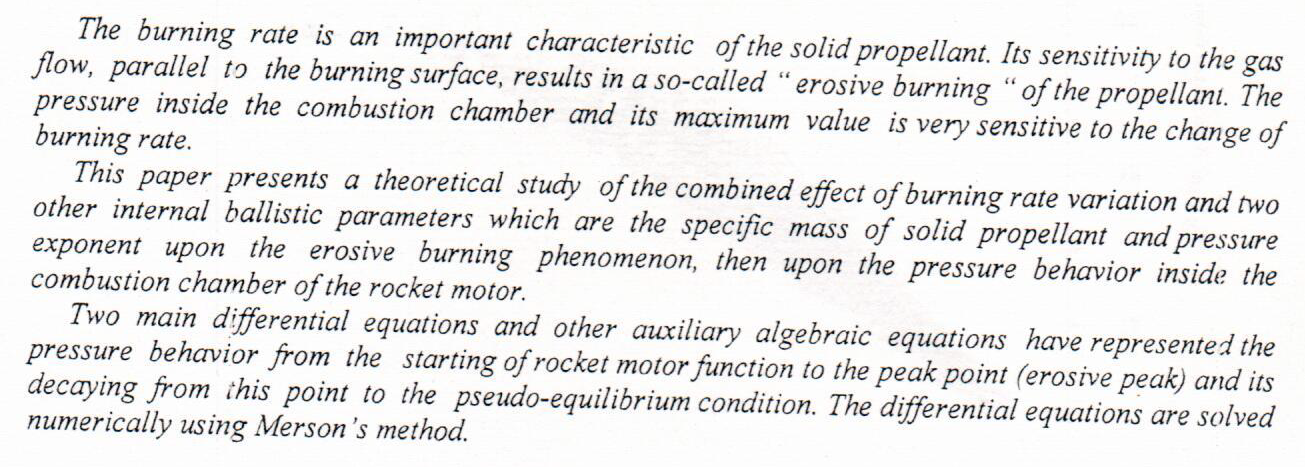
Combined Effect of Some Internal Ballisting Parameters on the Pressure Behavior of Solid Propellant Rocket Motor

Biological Activity of Complexes of Some Amino Acid
The research dealt with the subject of measuring the competitive performance of the National Insurance Company and some of its branches (Basra, Ninwa, Kirkuk and Babil), Depending on the Revenue Growth Index at the activity level, and the Revealed Comparative Advantage Index RCAIAt the branch level,To measure the competitiveness of the company And some branches, As the problem of research in the lack of adoption by some companies in the insurance service sector on scientific indicators to measure their competitive performance, The aims of the research is to measure the competitiveness of the National Insurance Company, as well as the competitiveness of its branches according to the scientific method, One of the main Conclusions of the re
... Show More
This work includes synthesis of new six membered heterocyclic rings with effective amino group using the reaction of benzylideneacetophenone (chalcone) (1) with thiourea or urea in alcoholic basic medium to form: 1,3-thiazen-2-amine (2), and 1,3-oxazin-2-amine (8) respectively. The diazotization reaction was carried out with sodium nitrite in presence of hydrochloric acid to form diazonium salts which suffered coupling reaction with naphthols and phenols in the presence of sodium hydroxide to form colored azo dyes (4-7, and 10-13). o-methylation reaction of compounds (7) and (10) yielded : 1,3-thiazin -2-yl-diazenyl (14), and 1,3-oxazin-2-yl-diazenyl (15) respectively.The new compounds were characterized using vario
... Show More (2)
(2)
Some metal ions (Mn+2, Co+2, Ni+2, Cu+2, Zn+2, Cd+2 and Hg+2) complexes of quinaldic acid (QuinH) and α-picoline (α-Pic) have been synthesized and characterized on the basis of their , FTIR, (U.V-Vis) spectroscopy, conductivity measurements, magnetic susceptibility and atomic absorption. From the results obtained the following general formula has suggested for the prepared complexes [M(Quin)2( α-Pic)2].XH2O where M+2 = (Mn, Co, Ni, Cu, Zn, Cd and Hg), X = 2, X = zero for (Co+2 and Hg+2) complexes, (Quin-) = quinaldate ion, (α-Pic) = α-picoline. The results showed that the deprotonated ligand (QuinH) by using (KOH) coordinated to metal ions as bidentate ligand through the oxygen atom of the carboxylate group (-COO-) and the nitrogen ato
... Show MoreIn order to have an idea about what happens in Iraqi food establishments in relation to implement quality management system ISO 9001, this study was performed to show the actual situation of Iraqi food establishments concerning quality management system (ISO 9001:2015), reasons of implementing, factors that hinder implementing and problems faced high administration for getting establishments certification ISO 9001:2015. The study demonstrated from the questionnaire some difficulties to implement ISO 9001 for both of establishments that implemented the quality system or which in implementing of this international standard. The most important problems during implementing were business culture and costs and the most important proble
... Show MoreSome metal ions (Mn+2, Co+2, Ni+2, Cu+2, Zn+2, Cd+2 and Hg+2) complexes of quinaldic acid (QuinH) and α-picoline (α-Pic) have been synthesized and characterized on the basis of their , FTIR, (U.V-Vis) spectroscopy, conductivity measurements, magnetic susceptibility and atomic absorption. From the results obtained the following general formula has suggested for the prepared complexes [M(Quin)2( α-Pic)2].XH2O where M+2 = (Mn, Co, Ni, Cu, Zn, Cd and Hg), X = 2, X = zero for (Co+2 and Hg+2) complexes, (Quin-) = quinaldate ion, (α-Pic) = α-picoline. The results showed that the deprotonated ligand (QuinH) by using (KOH) coordinated to metal ions as bidentate ligand through the oxygen atom of the carboxylate group (-COO-) and the nitrogen ato
... Show MoreThree types of medical commercial creams Silvazine, Cinolon Tar and Hydroquinon Domina were incorporated in this study. The medical creams were taken directly and placed uniformly on the glass slide. Each type of pharmaceutical was weighed at 1 mg and dispersed on an area of 1x1 cm. This process ensures same thickness for all samples. The creams were analyzed by using double-beam UV/visible spectrophotometer Metertech SP8001. The absorption spectrum for each of samples was measured against wavelength range of 300–700 nm.
 (1)
(1)
