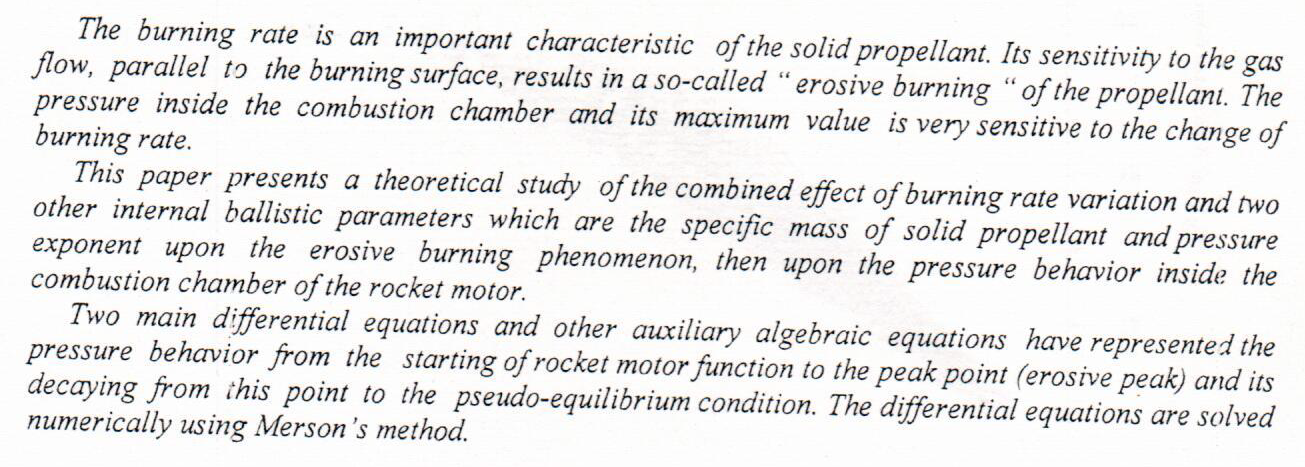
Combined Effect of Some Internal Ballisting Parameters on the Pressure Behavior of Solid Propellant Rocket Motor

The assessment of a river water’ quality is an essential procedure of monitor programs and is used to collect basic environmental data. The management of integrated water resources in a sustainable method is also necessary to allow future generations to meet their water needs. The main objective of this research is to assess the effect of the Diyala River on Tigris River water quality using Geographic Information System (GIS) technique. Water samples have been collected monthly from November 2017 to April 2018 from four selected locations in Tigris and Diyala Rivers using the grab sampling method. Fourteen parameters were studied which are Turbidity, pH, Dissolved Oxygen, Biological Oxygen Demand, Electrical Conductivi
... Show More (3)

ABSTRACT:In this paper, Cd10–xZnxS (x = 0.1, 0.3, 0.5) films were deposited by using chemical spray pyrolysis technique, the molar concentration precursor solution was 0.15 M/L. Depositions were done at 350°C on cleaned glass substrates. X-ray dif- fraction technique (XRD) studies for all the prepared film; all the films are crystalline with hexagonal structure .The optical properties of the prepared films were studied using measurements from VIS-UV-IR spectrophotometer at wave- length with the range 300 - 900 nm; the average transmission of the minimum doping ratio (Zn at 0.1%) was about 55% in the VIS region, it was decrease at the increasing of Zn concentration in the CdS films, The band gap of the doped CdS films was varied as 3.7, 3
... Show More (2)
(1)
 (18)
This work was conducted to study the treatment of industrial waste water, and more particularly those in the General Company of Electrical Industries.This waste water, has zinc ion with maximum concentration in solution of 90 ppm.
The reuse of such effluent can be made possible via appropriate treatments, such as chemical coagulation, Na2S is used as coagulant.
The parameters that influenced the waste water treatment are: temperature, pH, dose of coagulant and settling time.
It was found that the best condition for zinc removal, within the range of operation used ,were a temperature of 20C a pH value of 13 , a coagulant dose of 15 g Na2S /400ml solution and a settling time of 7 days. Under these conditions the zinc concentrat
Analyzing plantar pressure trajectories is crucial for assessing foot behavior in dynamic gait stability. We propose the identification of foot symmetry and the detection of deformities by analyzing the trajectories of the center of pressure (CoP) and peak pressure (PP). First, using a foot pressure mapping system, plantar pressure data are acquired during a normal gait cycle. After the data have been acquired, post processing extracts both the CoP and PP trajectories over the spatiotemporal domain of foot motion for each foot independently. For this purpose, we used the optical flow technique which accurately estimates the direction of foot motion. The extracted trajectories of each foot are then segmented into, the medial and lateral regi
... Show More
(1)
(1)

Soil improvement has developed as a realistic solution for enhancing soil properties so that structures can be constructed to meet project engineering requirements due to the limited availability of construction land in urban centers. The jet grouting method for soil improvement is a novel geotechnical alternative for problematic soils for which conventional foundation designs cannot provide acceptable and lasting solutions. The paper's methodology was based on constructing pile models using a low-pressure injection laboratory setup built and made locally to simulate the operation of field equipment. The setup design was based on previous research that systematically conducted unconfined compression testing (U.C.Ts.). Th
... Show More
(4)
(2)
(5)
Excessive skewness which occurs sometimes in the data is represented as an obstacle against normal distribution. So, recent studies have witnessed activity in studying the skew-normal distribution (SND) that matches the skewness data which is regarded as a special case of the normal distribution with additional skewness parameter (α), which gives more flexibility to the normal distribution. When estimating the parameters of (SND), we face the problem of the non-linear equation and by using the method of Maximum Likelihood estimation (ML) their solutions will be inaccurate and unreliable. To solve this problem, two methods can be used that are: the genetic algorithm (GA) and the iterative reweighting algorithm (IR) based on the M
... Show More
Background: During acrylic resin processing, the mold must be separated from the surface of the gypsum to prevent liquid resin from penetrating into the gypsum, and water from the gypsum seeping into the acrylic resin. For many years, tin foil was the most acceptable separating medium, and because it's difficult to apply, a tin-foil substitute is used. In this study, olive oil is used as an alternative to tin foil separating medium for first time, and evaluating its effect as a separating medium on some mechanical properties such as (indentation hardness and transverse strength) of acrylic resins denture base comparing it with those processed using tin-foil and tin foil substitute such as (cold mold seal) separating medium. Materials and M
... Show More