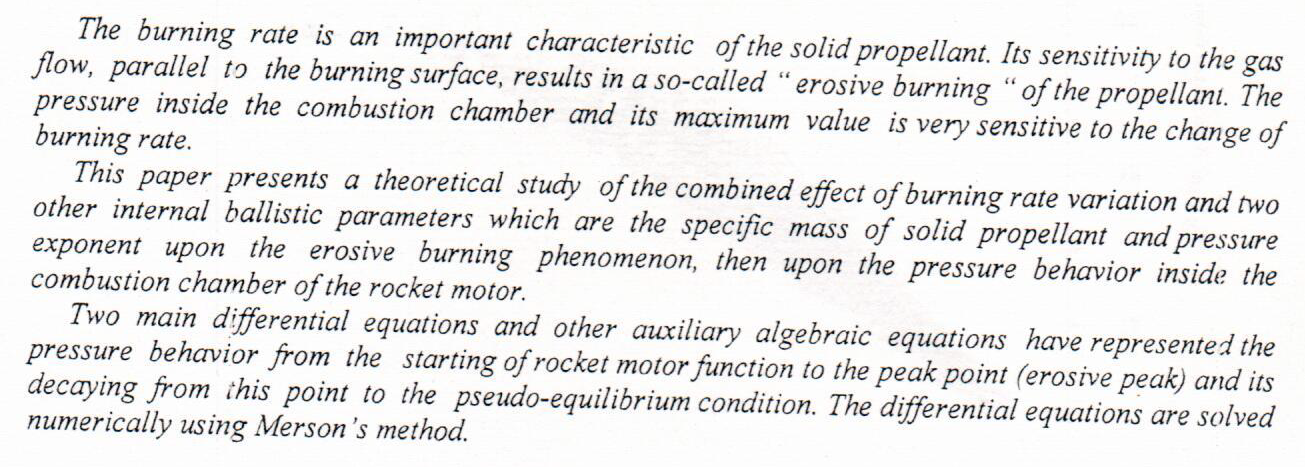
Combined Effect of Some Internal Ballisting Parameters on the Pressure Behavior of Solid Propellant Rocket Motor

The effect of Low-Level Laser (LLL) provided by green semiconductor laser with an emission wavelength of 532 nm on of human blood of people with brain and prostate cancer has been investigated. The effect of LLL on white blood cell (WBC), NEUT, LYMPH and MONO have been considered. Platelet count (PLT) has also been considered in this work. 2 ml of blood sample were irradiating by a green laser of the dose of 4.8 J/cm2. The results suggest a potential effect of LLL on WBC, PLT, NEUT, LYMPH, and MONO of people with brain and prostate cancer Key words: white blood cell , platelet , low-level laser therapy
Cryptography algorithms play a critical role in information technology against various attacks witnessed in the digital era. Many studies and algorithms are done to achieve security issues for information systems. The high complexity of computational operations characterizes the traditional cryptography algorithms. On the other hand, lightweight algorithms are the way to solve most of the security issues that encounter applying traditional cryptography in constrained devices. However, a symmetric cipher is widely applied for ensuring the security of data communication in constraint devices. In this study, we proposed a hybrid algorithm based on two cryptography algorithms PRESENT and Salsa20. Also, a 2D logistic map of a chaotic system is a
... Show More (33)
(33)
 (18)
(18)


Experiments were conducted to study the behavior of the solid particles (proppant) inside the hydraulic fracture during the formation stimulation, and study the effect of the proppant concentration on the hydraulic fracturing process, which lead to bridge and screen-out conditions inside the fractures across the fracture width that restricts fracturing fluid to flow into the hydraulic fracture. The research also studies the effect of the ratio between the fracture size and the average particles diameter “proppant", on fracture bridging. In this study two ratios were considered β= 2 and 3 ,where β=Dt / Dp where: Dt= hydraulic fracture size (width) and Dp=Average particles diameter.
This work pr
... Show MoreDue to their recalcitrant characteristics, Azo dyes such as methyl orange (MO) are extremely poisonous substances, making their removal from textile industry wastewater a major problem. By employing various EC-Adsorption combined system configurations and reusing alum sludge as an adsorbent, the current study seeks to investigate the efficiency of these various systems in removing MO dye. To estimate their benefits and limitations, experiments were carried out utilizing nickel foam (NiF) and aluminum plate (Al plate) as anodes, and stainless-steel mesh (SS mesh) as cathode in the presence of alum sludge as an adsorbent in all systems. The EC-Adsorption combined system with NiF as anode and two SS meshes as cathodes with 10 g/L
... Show More
Background: Orthodontic tooth movement is characterized by tissue reactions, which consist of an inflammatoryresponse in periodontal ligament and followed by bone remodeling in the periodontium depending on the forces applied. These processes trigger the secretion of various proteins and enzymes into the saliva.The purpose of thi study was to evaluate the activity of alkaline phosphatase (ALP) in saliva during orthodontic tooth movement using different magnitude of continuous orthodontic forces.
Materials and Methods: Thirty orthodontic patients (12 males and 18 females) aged 17-23 years with class II division I malocclusion all requiring bilateral maxillary first premolar extractions were randomly divided into three groups according t
CuInSe2 (CIS)thin films have been prepared by use vacuum thermal evaporation technique, of 750 nm thickness, with rate of deposition 1.8±0.1 nm/sec on glass substrate at room temperature and pressure (10-5) mbar. Heat treatment has been carried out in the range (400-600) K for all samples. The optical properties of the CIS thin films are been studied such as (absorption coefficient, refractive index, extinction coefficient, real and imaginary dielectric constant)by determined using Measurement absorption and transmission spectra. Results showed that through the optical constants we can made to control it is wide applications as an optoelectronic devices and photovoltaic applications.
The stability and releasing profile of 2:1 core: wall ratio ibuprofen microcapsules prepared by aqueous coacervation (gelatin and acacia polymers coat) and an organic coacervation methods (ethyl cellulose and sodium alginate polymers coat) in weight equivalent to 300mg drug, were studied using different storage temperatures 40°C, 50°C ,60°C and refrigerator temperature 4°C in an opened and closed container for three months (releasing profile) and four months (stability study).It was found that, these ibuprofen microcapsules were stable with expiration dates of 4.1 and 3.1 years for aqueous and an organic method respectively.Aqueous prepared ibuprofen microcapsules were found more stable than those microcapsules prepared by or
... Show More
The study concern with the preparation of three type of mixtures; which are prepared from different percentage of polyvenil Butyral, Di-n-butyl phathalate and paraffin wax pastillated. The solvent used is Xylolzul analyses. After washing, Drying and milling the kaolin Dukhla, as a matrix in this study, and by using sieving Tech. The range of particle size used is less than and less than as a mesh batch. The added percentage from prepared mixture were 5% and 10% to 95% and 90% of the matrix respectively. Then disk samples were prepared by using a compaction pressure with heating. After cooling and drying the samples were undergo heat treatment in the range of (1250 – 1350) oC. The measurement of shrinkage and Dielectric properties sho
... Show More
CuInSe2(CIS) thin films have been prepared by use vacuum thermal evaporation technique, of thickness750 nm with rate of deposition 1.8±0.1 nm/sec on glass substrate at room temperature and pressure (10-5) mbar. Heat treatment has been carried out in the range (400-600) K for all samples. The optical properties of the CIS thin films are been studied such as (absorption coefficient, refractive index, extinction coefficient, real and imaginary dielectric constant) by determined using Measurement absorption and transmission spectra. Results showed that through the optical constants we can make to control it are wide applications as an optoelectronic devices and photovoltaic applications.
