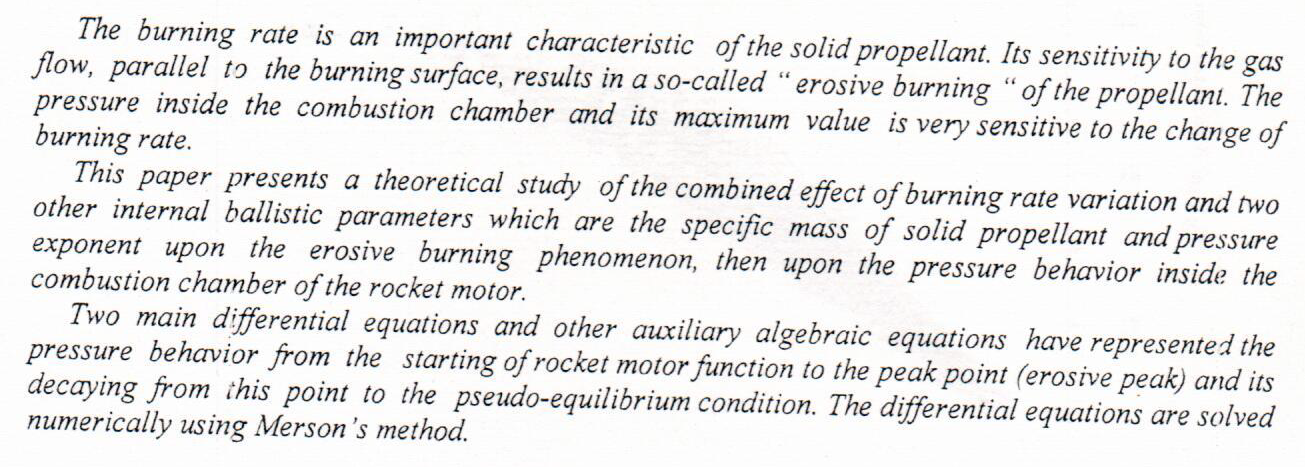
Combined Effect of Some Internal Ballisting Parameters on the Pressure Behavior of Solid Propellant Rocket Motor

Background: the early identification of developmental disabilities allows intervention at the earliest possible point to
improve the developmental potential.
Objective: Identify the scope of knowledge of nurses toward signs of gross motor delay for children and its relation to
their demographic characteristics.
Methodology: A descriptive study design was conducted at (18) primary health care centers in first of the primary
health care sector of Alhawija District in Kirkuk Governorate. This study started from September 2010 to the end of
January 2011, in order to identify the level of nurses' knowledge toward signs of gross motor delay for children in
primary health care centers. Non probability (purposive) sample of
 (11)
(11)
 (12)
(12)



The research include a pulsed Nd: YAG Laser with (300µs) pulse duration in the TEM00 mode at (1.06µm) wavelength for energies between (0.5-3) J was employed to drill Brass material which is use in industrial applications. The process of drill was assisted by an electric field. This resulted in an increase in the hole aspect ratio by the value (45%) and decrease in the hole taper by the value (25%) of its value under ordinary drilling conditions using the same input energy.
The present study deals with the effect of teaching speaking Strategies (SS) on
EFL Iraqi College students. The use of speaking strategies not only solves learners’
communication problems, but also enhances the learner’s interaction in target language,
and improves their oral proficiency .The aim of the study is to find out the effect of
teaching SS used by EFL College students .The learner of the first stage is population of
the study at the Department of English, College of Education /Ibn-Rushd .The sample
consists of (60) students distributed on experimental group(A) as well as control
group(B) each group contains (30) students . In order to achieve the aim of the study,
questionnaire has been constructed t
Toxoplasma gondii is an obligate intracellular protozoan parasite; it spreads via the circulatory system during infection and causes chronic infection in various organs. Toxoplasmosis affects nearly one third of people worldwide, especially immunocompromised people. This study aimed to determine the effect of toxoplasmosis on renal function in hemodialysis patients. Overall 300 patients referred to the Medical City, Al-Karama General Hospital, Baghdad, Iraq were enrolled from 2021 to 2022. All serum samples were tested for T. gondii immunoglobulins (IgG and IgM) antibodies, urea and creatinine levels. In patients undergoing hemodialysis, the results revealed a high positivity percentage for anti-Toxoplasma IgG. In hemodialysis patients infe
... Show More
(2)
This book presents the problem of tooth decay due to bacteria Streptococcus mutans one of methods of treatment using 3 extracts of S. persica (miswak) (aqueous, acetone and methanol) and prove its effectiveness and its impact on the gtf (B, C, and D) genes that code the glucosyltransferase (Gtf) enzymes that cause decay membrane compared to the usual means used for the prevention of tooth decay
the behavior of the first-order black and gray solitons propagtedin optical fiber in the presence of frequency chirp is studied analytically and numerically results show that phase profile of black solitons changes abruptly
Bentonite is widely used in industrial applications. The present study reports the effect of adding different weights of ZnO to the Iraqi bentonite, on surface area, pore volume and real density. These surface properties were evaluated for pure and modified bentonite. The modification was made by adding different ZnO weights such as; ( 0.5%, 1%, 5%, 10% ). The effect of heat exposing for all modified clay samples at 500 ?C have been also evaluated. The results show that the addition of 0.5% ZnO leads to increase the surface area percentage about 36%, increase pore volume percentage about 5.48% and increase the real density percentage about 27.116%. When the samples exposed to 500 ?C, their surface area and pore volumes have been decreased a
... Show More
The dried fruit peel of pomegranate in Punicaceae family was fractionated chromatographically on Sephadex-LH-20 column .Gallic acid (trihydroxybenzoic acid) and its related galloyl esters such as gallotannin(i.e. β-penta-O-galloyl–D-glucose) were obtained homogenously. Different concentrations of gallic acid and gallotannin were used to determine their inhibitory effect on human serum cholinesterase. The enzyme activity was measured according to the method reported by the WHO .The inhibitory effect of these compounds on the activity of human serum cholinesterase have been studied in vitro .The inhibitory effect was remarkably clear with increasing concentration of gallic acid .Whereas galloyl ester showed n
... Show More
Understanding of in-situ stress profiles and orientations plays a vital role in designing a successful hydraulic fracturing treatment. This paper is an attempet to examine the effect of lithology and in situ stress on geometery of hydraulic fractures. A hydraulic fracturing design simulator software called FracproPT with various capabilities for designing most of hydraulic fracture was used for simulate and optimize the hydraulic fracturing. For studying purpose, three different cases of stress gradient contrast between different formations are considered in this study (0.4, 0.5 and 0.75 psi/ft). The results obtained from the simulator showed that lithologies surrounding the pay zone have an effect on the fracture
... Show More