Gas Holdup in a Bubble Column
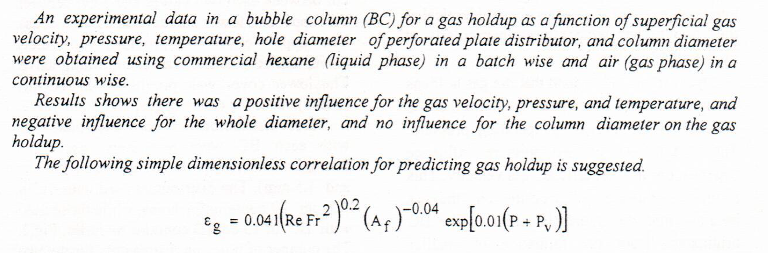

 (9)
(9)
 (11)
(11)


 (24)
(24)
(24)
(24)
Microfluidic devices provide distinct benefits for developing effective drug assays and screening. The microfluidic platforms may provide a faster and less expensive alternative. Fluids are contained in devices with considerable micrometer-scale dimensions. Owing to this tight restriction, drug assay quantities are minute (milliliters to femtoliters). In this research, a microfluidic chip consisting of micro-channels carved on substrate materials built using an Acrylic (Polymethyl Methacrylate, PMMA) chip was designed using a Carbon Dioxide (CO2) laser machine. The CO2 parameters influence the chip’s width, depth, and roughness. To have a regular channel surface, and low roughness, the laser power (60 W), with scanning speed (250 m/s)
... Show More
(4)
(3)
The integration of nanomaterials in asphalt modification has emerged as a promising approach to enhance the performance of asphalt pavements, particularly under high-temperature conditions. Nanomaterials, due to their unique properties such as high surface area, exceptional mechanical strength, and thermal stability, offer significant improvements in the rheological properties, durability, and resistance to deformation of asphalt binders. This research reviewed the application of various nanomaterials, including nano silica, nano alumina, nano titanium, nano zinc, and carbon nanotubes in asphalt modification. The incorporation of these nanomaterials into asphalt mixtures has shown potential to increase the stiffness and high-tempera
... Show More
(1)
(3)
The research seeks to examine the ability of fifth preparatory students in solving a mathematical problem in relation to system thinking. To this end, the researcher chose (140) fifth preparatory students from four-different secondary schools in Kirkuk city for the academic year (2016-2017). Two tests were adopted to collect study data: a test of (5) items about skills in solving math problem designed by (Al-raihan, 2006); and a test of system thinking skills designed by the researcher himself consisted of (14) items. It was divided into four skills (analyzing the main system to subsystems, eliminating all inner gaps of system, identifying the inner connection of system, and reorganizing the system). The findings indicated a good ability
... Show MoreBackground: Alveolar ridge expansion is proposed when the alveolar crest thickness is ≤5 mm. The screw expansion technique has been utilized for many years to expand narrow alveolar ridges. Recently, the osseodensification technique has been suggested as a reliable technique to expand narrow alveolar ridges with effective width gain and as little surgical operating time as possible. The current study aimed to compare osseodensification and screw expansion in terms of clinical width gain and operating time. Materials and methods: Forty implant osteotomies were performed in deficient horizontal alveolar ridges (3–5 mm). A total of 19 patients aged 21–59 years were randomized into two groups: the screw expansion group, which invo
... Show More
(4)
(3)
(6)
(5)
This paper introduces a complete design and simulation of a controller for the double fed induction generator (DFIG) turbine. The work also included the solar updraft tower (SUT) design to supply Al-Mahmoudia hospital in Baghdad/Iraq. The design includes the daily average load estimation, annual solar irradiance and, temperature monitoring, and logging.
According to the data obtained from the Ministry of Science and Technology, Baghdad has low wind speed. Therefore, the (SUT) has been designed to generate electrical power depending on the difference between the external and internal air temperature. The temperature difference will generate a suitable airspeed to drive the wind turbine, connected to the proposed (DFIG) generators
... Show More
(1)
(11)
(12)