Gas Holdup in a Bubble Column
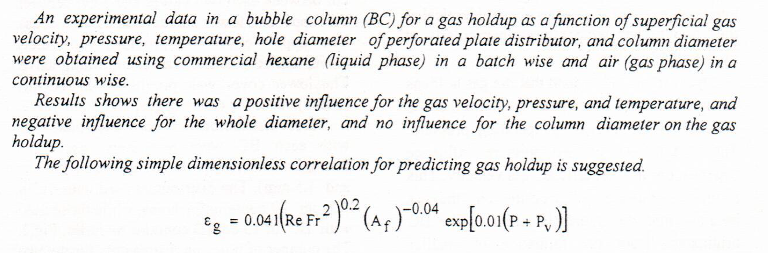

 (49)
(49)
 (42)
(42)



The Sadi reservoir is one of the largest and most important unconventional tight oil reservoirs in southern Iraq. However, it suffers from low production rates, necessitating many development strategies that require a correct and reliable characterization of reservoir fluid properties. Whilst these properties are originally obtained from laboratory experiments, measurement errors often occur despite rigorous workflows, which negatively affect the calculation of reservoir fluid properties. This study utilizes the fluid thermodynamics characterization program (PVTp) to generate a reliable model for determining the oil properties of Sadi reservoir. A methodology was developed to simulate fluid thermodynamic tests, including Differ
... Show More
Nitrogen dioxide NO2 is one of the most dangerous contaminant in the air, its toxic gas that cause disturbing respiratory effects, most of it emitted from industrial sources especially from the stack of power plants and oil refineries. In this study Gaussian equations modelled by Matlab program to state the effect of pollutant NO2 gas on area around Durra refinery, this program also evaluate some elements such as wind and stability and its effect on stacks height. Data used in this study is the amount of fuel oil and fuel gas burn inside refinery at a year 2017. Hourly April month data chosen as a case study because it’s unsteady month. After evaluate emission rate of the all fuel and calculate exit velocity from
... Show More
(20)
(8)
(36)
This study was conducted in the plant protection department/ College of Agriculture/ University of Baghdad to evaluate the efficiency of physical agents ozone, ultraviolet radiation, microwave for destroying afla produced in corn seeds. An isolate af A.flavus producing Aflatoxin B1 was obtained from plant protection dept. college of Agric. University of Baghdad. Results showed destroy toxin AFLA B1 the effect of radiation microwave in the media of Japex degree 80 and 100 co 57.14% and 85.71%, respectively, and for 20 sec, compared to the treatment comparison 0.00% as found significant differences were apparent between transactions and the treatment of comparison, as and notes the existence of a significant dif
... Show MoreIn this research, the effects of both current and argon gas pressure on the bending properties of welded joints were studied. Using the possible ranges of welding gas pressures and currents, Tungsten inert gas welding (TIG) of stainless steel (304) sheet was used to obtain their influence on the maximum bending force of the (TIG) welded joints. Design of experiment (DOE) ‘version 10' was used to determine the design matrix of experiments depending on the used levels of the input factors. Response surface methodology (RSM) technique was used to obtain an empirical mathematical model for the maximum bending force as a function of welding parameters (Current and Argon gas pressure). Also, the analysis of variance (ANOVA) was used to verif
... Show More
(4)
Commercial, industrial, and military activity, largely in the 19th and 20th centuries, have led to environmental pollution that can threaten human health and ecosystem function, liquid gas petroleum (LPG) products are the major sources of energy for industry and daily life that cause environmental contamination during various stages of production, transportation, refining and use. Screening of bacterial isolate by using clear zone techniques and biomass and optical density. Results revealed that isolate Burkholdaria cepatia showed a high ability for hydrocarbons biodegradation and this isolate identified depending on morphological cultural, gram stain, microscopic features, biochemical tests, and VITEK2 compact. In this study,
... Show More
(1)
In this research, Mn-doped TiO2 thin films were grown on glass, Si and OIT/glass substrates by R.F magnetron sputtering technique with thicknesses (250 nm) using TiO2:Mn target under Ar gas pressure and power of 100 Watt. Through the results of X-ray diffraction, the prepared thin films are of the polycrystallization type after the process of annealing at 600°C for two hour The average crystalline size were 145.32, 280.97 and 261.23 nm for (TiO2:Mn) thin film on glass, Si and OIT/glass substrates respectively, while the measured surface roughness is between 0.981nm and 1.14 nm. The fabricated (TiO2:Mn) thin film on glass sensors have high sensitivity for hydrogen( H2 reducing gas) compared to the sensitivity for hydrogen gas on Si and OIT/
... Show More
(31)
This work investigates the effect of the gas nitriding process on the surface layer microstructure and mechanical properties for steel 37, tool steel X155CrVMo12-1 and stainless steel 316L. Nitriding was conducted at a temperature of 550 °C for 2 hours during the first stage and at 750 °C for 4 hours during the second stage. SEM and X-ray diffraction tests were performed to evaluate the microstructural features and the major phases formed after surface treatment. SEM and X-ray diffraction tests were performed to assess the microstructural features and the primary phases formed after surface treatment. The new secondary precipitates were identified as γ′-Fe4N, ε (Fe2–3N), and α-Fe, exhibiting an uneven chain-like pattern wit
... Show More
(1)
(1)
Blades of gas turbine are usually suffered from high thermal cyclic load which leads to crack initiated and then crack growth and finally failure. The high thermal cyclic load is usually coming from high temperature, high pressure, start-up, shut-down and load change. An experimental and numerical analysis was carried out on the real blade and model of blade to simulate the real condition in gas turbine. The pressure, temperature distribution, stress intensity factor and the thermal stress in model of blade have been investigated numerically using ANSYS V.17 software. The experimental works were carried out using a particular designed and manufactured rig to simulate the real condition that blade suffers from. A new cont
... Show More
(2)