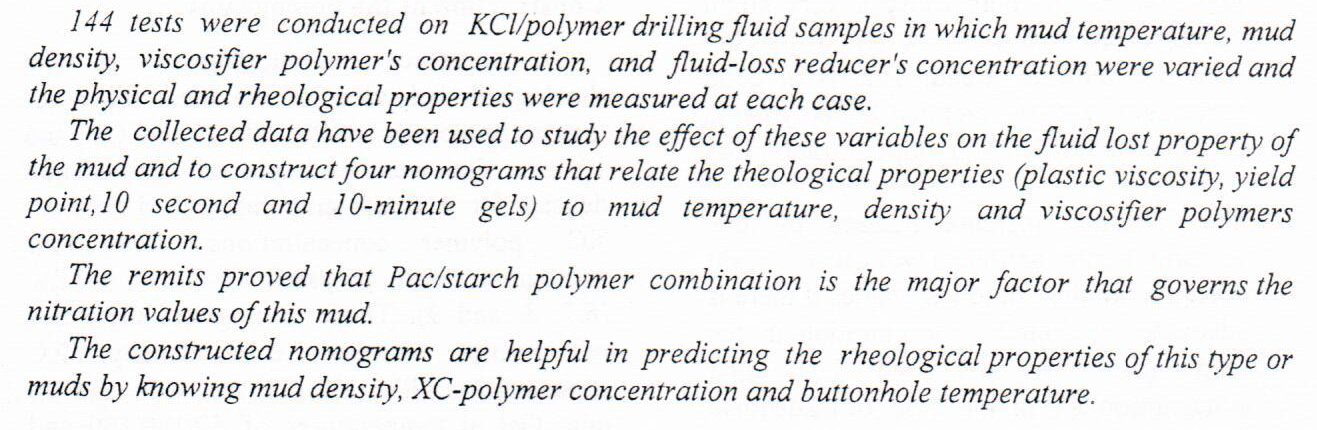
Construction of Nomograms Describing the Effect of Different Variables on the Behavior of a KCl/Polymer Drilling Fluid

 (26)
(26)
 (22)
(22)



In the present work, poly methyl methacrylate (PMMA) doped with Rhodamine 6G was prepared. The spectral properties (absorption and fluorescence) of the films were studied at different concentrations (1x10⁻⁵, 2x10⁻⁵, 5x10⁻⁵, 7x10⁻⁵, and 1x10⁻⁴mol/l). The investigated samples were made in the form of thin films. This was achieved by dissolving a certain weight of PMMA in a fixed volume of chloroform, composite films was with thickness (25.8μm) at room temperature. The achieved results were pointed out that absorption and fluorescence spectra have taken a wide spectral rang so when increased the concentratio
... Show More
In this research, A thin film of Rhodamine B dye and TiO2 Nanoparticles doped in PMMA Polymer has been prepared by a casting method. The sample was spectrum absorption by UV-Vis. The nonlinear optical properties were measured by Z- scan technique using Nd:YAG laser with (1064 nm) wavelength. The nonlinear refractive index (n2) and nonlinear absorption coefficient (β) were estimated for the thin film for different energies of the laser, n2 and β were decreased with increasing intensity of incident laser beam. Also, the type of β was two-photon absorption and n2 negative nonlinear reflective.
(2)
The aim of the research is to find out the effect of the SPAWN strategy on the life skills of second-intermediate-grade students. This study stage represented the research community within the intermediate and secondary governmental daytime schools affiliated with the Directorate of Education of Diwaniyah. The experiment was applied in Al-Razai Intermediate School on a sample of second-grade intermediate students, including 66 students distributed into two groups: (32) students within the experimental group and (34) students within the control group. The two groups were equivalent with a number of variables (chronological age, intelligence test, previous information test, life skills scale). The results indicated that the two groups were
... Show MoreThe aim of the research is to find out the effect of the SPAWN strategy on the life skills of second-intermediate-grade students. This study stage represented the research community within the intermediate and secondary governmental daytime schools affiliated with the Directorate of Education of Diwaniyah. The experiment was applied in Al-Razai Intermediate School on a sample of second-grade intermediate students, including 66 students distributed into two groups: (32) students within the experimental group and (34) students within the control group. The two groups were equivalent with a number of variables (chronological age, intelligence test, previous information test, life skills scale). The results indicated that the two groups were eq
... Show MoreNewcastle Disease is one of the most important disease world wide distributions which invade the flock in different age resulting in large economic losses. This study aimed to evaluate the effect of treatment with 4 different concentrations (0.25, 0.5, 1.0 and 2.0 %) of Sodium deoxycholate (SDC) on the vaccinal virus (La Sota) using inoculation in the fragments of Chorioallantoic membrane. The treatment with each of the above 4 concentrations of SDC resulted in an increase in the Hemagglutination titer (HA) of the virus (28, 29.6, 211.6, 214.6) respectively as compared to the HA titer value for the untreated virus (26.6). No significant differences were noticed among all concentrations with regard to their effect on the HA titer, except
... Show More
Cadmium sulfide and Aluminum doped CdS thin films were prepared by thermal evaporation technique in vacuum on a heated glass substrates at 373K. A comparison between the optical properties of the pure and doped films was made through measuring and analyzing the transmittance curves, and the effect of the annealing temperature on these properties were estimated. All the films were found to exhibit high transmittance in the visible/ near infrared region from 500nm to 1100nm.The optical band gap energy was found to be in the range 2.68-2.60 eV and 2.65-2.44 eV for CdS and CdS:Al respectively , with changing the annealing temperature from room temperature to 423K.Optical constants such as refractive index, extinction coefficient, and complex di
... Show MoreCarbides or nitrides thin films present materials with good mechanical properties for industrial applications as they can be coatings at low temperatures serve temperature sensitive surfaces. In this work the effect of the C percentage on the mechanical properties represented by the Young modulus (E) of combinatorial magnetron sputtered TiCx (34%x˂65%) has been studied. The structure of the produced films is TiC independent on the C concentration. The mechanical properties are increased with increasing the C concentration up to 50%, and then decreasing with further C % increasing. These results can be explained by considering the resultant residual stresses.
A numerical investigation has been performed to examine the effect of fluorine concentration on the chain reaction mechanisms and parameters of hydrogen fluoride (HF) chemical laser. The practical difficulties associated with this type of lasers impose that an alternative route might be quite useful. Thus, particular attention was paid to develop a computer program to investigate various processes. The results of this computer simulation program proved their credibility when compared with the little published data. This computer program is called Reaction Rate Simulation Model (RRSM). An entirely new approach to emulate the reaction mechanisms has been followed. The effectiveness of reaction rates in the processes of HF lase
... Show More
The paper include study the effect thickness of the polymeric sample which is manufactured by thermo press way. The sample was used as an active tunable R6G laser media. The remarks show that, when the thickness of the samples is increased, with the same concentration, the spectrum will shift towards the short wavelength, & the quantum fluorescence yield will increased. The best result we obtained for the quantum fluorescence yield is (0.68) at the sample, with thickness (0.304mm) in Ethanol solvent, while when we used the Pure Water as a solvent, we found that the best quantum fluorescence yield is (0.63) at (0.18mm) thickness of the sample.