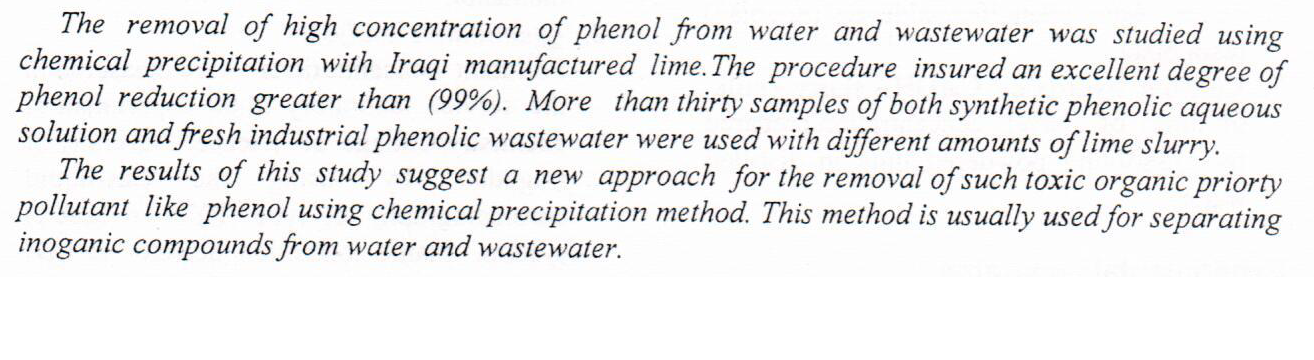
Removal of Phenol from Water and Wastewater by Chemical Precipitation with Lime

A liquid membrane process of Alkaloids extraction from Datura Innoxia solution was studied applying pertraction process in rotating discs contactor (RDC). Decane as a liquid membrane and dilute sulphuric acid as stripping solution were used. The effect of the fundamental parameters influencing the transport process, eg type of solvent used, effect of disks speed, amount of liquid membrane and effect of pH for feed and strip solution. The transport of alkaloids was analysed on the basis of kinetic laws of two consecutive irreversible first order reactions. Thus, the kinetic parameters (k1, k1,, tmax, and) for the transport of alkaloids were determined. The effect of organic membrane type on percentage of Alkaloids transport was found to be i
... Show MoreLiquid-liquid membrane extraction technique, pertraction, using three types of solvents (methyl isobutyl ketone, n-butyl acetate, and n-amyl acetate) was used for recovery of penicillin V from simulated fermentation broth under various operating conditions of pH value (4-6) for feed and (6-8) for receiver phase, time (0-40 min), and agitation speed (300-500 rpm) in a batch laboratory unit system. The optimum conditions for extraction were at pH of 4 for feed, and 8 for receiver phase, rotation speed of 500 rpm, time of 40 min, and solvent of MIBK as membrane, where more than 98% of penicillin was extracted.
The development of economic and environmentally friendly extractants to recover cobalt metal is required due to the increasing demand for this metal. In this study, solvent extraction of Co(II) from aqueous solution using a mixture of N,N0-carbonyl difatty amides (CDFAs) synthesised from palm oil as the extractant was carried out. The effects of various parameters such as acid, contact time, extractant concentration, metal ion concentration and stripping agent and the separation of Co(II) from other metal ions such as Fe(II), Ni(II), Zn(III) and Cd(II) were investigated. It was found that the extraction of Co(II) into the organic phase involved the formation of 1:1 complexes. Co(II) was successfully separated from commonly associated metal
... Show More (26)
(26)
 (14)
(14)



A liquid membrane process of Alkaloids extraction from Datura Innoxia solution was studied applying pertraction process in rotating discs contactor (RDC). Decane as a liquid membrane and dilute sulphuric acid as stripping solution were used. The effect of the fundamental parameters influencing the transport process, e.g. type of solvent used, effect of disks speed, amount of liquid membrane and effect of pH for feed and strip solution. The transport of alkaloids was analysed on the basis of kinetic laws of two consecutive irreversible first order reactions. Thus, the kinetic parameters (k1, k1, , tmax, and ) for the transport of alkaloids were determined. The effect of organic membrane type on percentage of Alkaloids transport was found
... Show MoreIn this work Aquatic plant (Nile rose) was used to study adsorption of industrial dye (safranin-O from aqueous solution within several operation conditions. The dried leaves of Nile rose plant were used as adsorbents safranin-O from aqueous solution after different activations such as wet and dry enhancements. The data show increasing in dye solution removal percentage for both activation methods of the adsorbent and also dye removal percentage that was obtained by using adsorbent without any treatment with the progress contact time. The dye removal percentages at equilibrium time 40 minutes were 88.7% at non-activation, 92.3% at thermal activation, and 98.3% at acidic activation. The samples adsorbents before and after adsorption which wer
... Show More
(11)
(4)
It included the introduction to the research and its importance, as the knee joint is one of the important joints in the human body that are susceptible to injury, and among these injuries is the roughness of the knee that occurs as a result of weakness and imbalance in the work of the quadriceps muscle, so its treatment is through rehabilitation exercises to treat weakness and gain flexibility and strength.Hence the importance of the research by developing rehabilitation exercises with different resistances in the water medium and restoring flexibility and muscular strength for patients with knee roughness for ages from 30-40 years, and the experimental method was used to solve the research problem, and the research sample included (6) of
... Show MoreHard-grade asphalt binders like AC20-30 typically exhibit excessive stiffness, reduced penetration, and compromised workability, necessitating modification before use in paving applications. This study evaluates the efficacy of regular polyalphaolefin (PAO), a synthetic olefin-based lubricant, as a performance-enhancing modifying agent for such binders. AC20-30 was blended with PAO at dosages ranging from 2 wt.% to 10 wt.%, and the modified binders were characterized via penetration, ductility, softening point, and rotational viscosity measurements, alongside advanced rheological and chemical-morphological analyses. Incorporating PAO in AC20-30 asphalt progressively reduced the binder stiffness and enhanced its flexibility, with all modifie
... Show More
Baghdad city has been faced numerous issues related to freshwater environment deteriorations due to many reasons, mainly was the discharge of wastewater without adequate treatment. Al-Rustamiya Wastewater Treatment Plant (WWTP) have been constructed among many plants in Baghdad city to reduce the amount of wastewater discharged into natural environment and its subsequent adverse effects. This study was conducted to evaluate the performance of the plant which consist of a conventional activated sludge (CAS) and sequencing batch reactors (SBR) systems as secondary treatment units and its ability to meet Iraqi specifications. A reliability level determination and analysis also were conducted to find the plant's stability an
... Show MoreBaghdad city has been faced numerous issues related to freshwater environment deteriorations due to many reasons, mainly was the discharge of wastewater without adequate treatment. Al- Rustamiya Wastewater Treatment Plant (WWTP) have been constructed among many plants in Baghdad city to reduce the amount of wastewater discharged into natural environment and its subsequent adverse effects. This study was conducted to evaluate the performance of the plant which consist of a conventional activated sludge (CAS) and sequencing batch reactors (SBR) systems as secondary treatment units and its ability to meet Iraqi specifications. A reliability level determination and analysis also were conducted to find the plant's stability and its capabi
... Show More
(12)
(10)