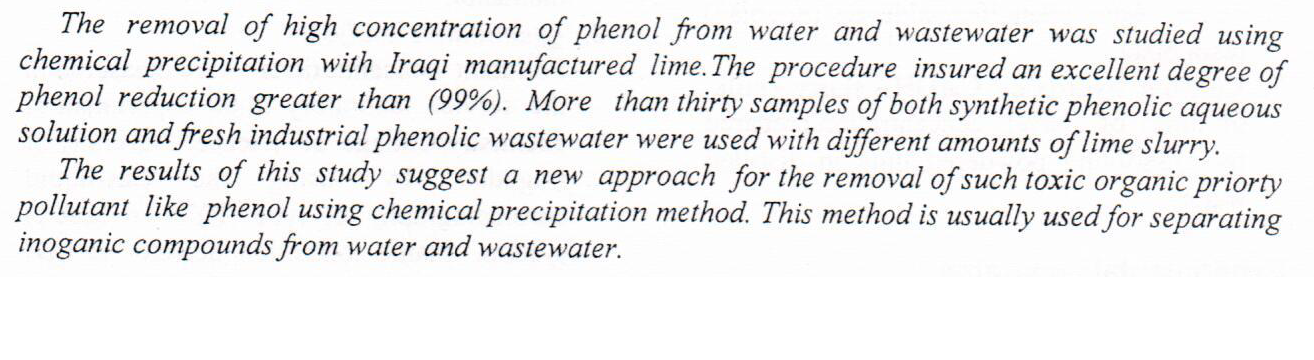
Removal of Phenol from Water and Wastewater by Chemical Precipitation with Lime

 (3)
(3)
 (2)
(2)



The Growth Differentiation Factor -15 (GDF-15) is a member of the transforming growth factor β superfamily. İt represents an example of the stress response cytokines. It's mostly found in cardiac myocytes, adipocytes, macrophages, endothelial cells, and vascular endothelial cells, whether they're generated normally or not. GDF-15 levels have increased and are associated with cardiovascular risk. Aim of the study: To investigate the correlation between angiotensin-converting enzyme (ACE) inhibitors and angiotensin II receptor blockers (ARBs) with the level of plasma GDF-15 in a group of hypertensive patients. Materials and methods: A case-control study involved 90 individuals, 60 hypertensive patients (36 on ACE inhibitors and 24 on ARBs)
... Show More
(2)
(2)
Cytokines are a group of immunomodulatory proteins leading to a variety of immune reactions in the human; these cytokines play a significant role in the development of appropriate immune responses against T. gondii. This study aims to reveal the association of toxoplasmosis with serum levels of IL-3, IL-17A, and IL-27 in aborted women. The blood samples of patients and controls were collected from Al-Alawiya Maternity Teaching Hospital/Baghdad/Iraq from 2019 to 2020 for detecting anti-T. gondii antibodies (IgG and IgM) and the level of interleukins by ELISA. The results of TORCH by rapid test for recurrent abortion recorded 25.3% seropositive for anti-Toxoplasma antibodies, and 31.5% seropositive for one or more cases of TORCH test (Cytomeg
... Show More
(11)
(8)
The percent work was designed to determine the effect of ginger plant aqueous extract on function and histological structure of kidney in mice treated with carbon tetrachloride (CCl4). Ginger plant caused a protective effect against CCl4 induced kidney damage and improved the kidney weight and biochemical parameters including urea, uric acid and creatinine. The ginger plant has a protective effect against injury in the kidney of mice treated with CCL4, because the ginger plant protects the tissues of kidney from toxic effect of CCL4. The kidney of CCL4 treated mice showed many histological alterations in the kidney included: atrophy, vascular degeneration and hemorrhage, death cell, degeneration of epithelial cells, destruction of basement
... Show More
(1)
(50)
(43)
Objective. Infection with Coxsackie virus. This virus that damages pancreatic cells, has long been linked to the onset of insulin-dependent diabetic mellitus (IDDM). Pro-inflammatory cytokines can be produced as a result of this illness. Tumor necrosis factor-a is one of these pro-inflammatory cytokines. Materials and Methods. Blood sample were collected from 180 Iraqi participants. Ninety of them is type 1 diabetic patients and other 90 is healthy control .both groups were tested for the incidence of Coxsackie virus B IgG. So the patients groups is divided to two groups according to sero positivity of CVB-IgG .all 180 patients tested to measure of level of TNF-α. Results. The Results showed increasing in levels of TNF-α in CBV po
... Show More
The goal of this study was to investigate the protein peroxidation role by measuring serum levels of advanced oxidation protein products (AOPP) in type 2 diabetic patients with or without retinopathy and comparing them to controls to see if circulating AOPP levels can be used as a detection biomarker for DR. And see which of the two widely used antidiabetic treatment groups had the most impact on this oxidative stress marker. The groups were divided into two subgroups: 1) 70 type 2 diabetic patients (36 male, 34 female), 35 with diabetic retinopathy (DR) and 35 with no evidence of DR, and 2) non-diabetic controls (11 male, 9 female) were chosen from Ibn AL-Haitham Hospital for Ophthalmology and a Specialized Center for Endocrinology and Dia
... Show More
(9)
(4)
(22)
(4)