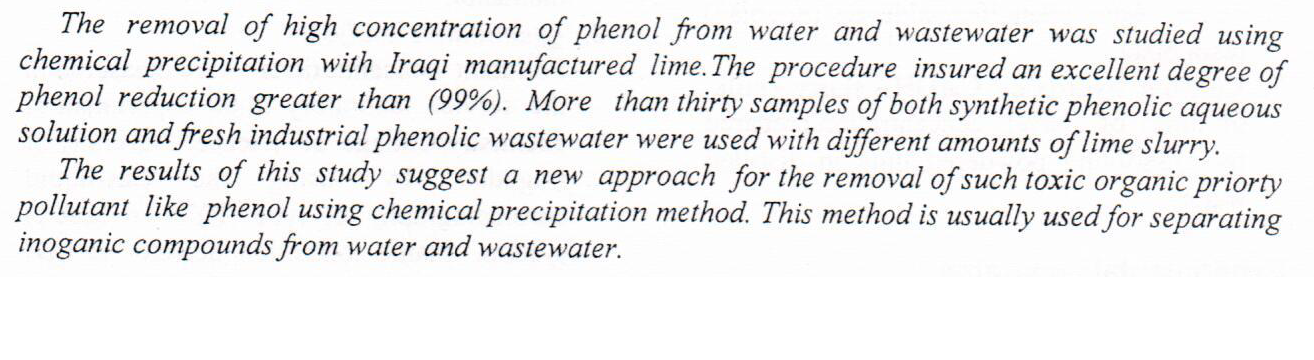
Removal of Phenol from Water and Wastewater by Chemical Precipitation with Lime

The purpose of this paper is to examine absorbance for the removal of the Red Congo using wheat husk as a biological pesticide. Several experiments have been conducted with the aim of configuring breakthrough data in a fluidized bed reactor. The minimum fluidized velocities of the bed were found to be 0.031 mm/s for mish sizes of (250) µm diameter with study the mass transfer be calculated KL values. The results showed a well-fitting with the experimental data. Different operating conditions were selected: bed height (2, 5 and 10) cm, flow rate (90, 100and 120) ml/sec and particle diameter (250, 600, 1000) µm. The breakthrough curves were plotted for Congo Red, Values showed that the lower the bed, the lower the number of ad
... Show More (4)
(4)

The foreguts of a total of 515 fish of Chondrostoma regium (Heckel, 1843) (locally: Bala’aot Malloky) were studied. These fish were collected from Tigris River at Salah Al-Deen Province (between Al-Hagag & Yathrib) for 20 months between March and October of the next year. Detritus, plant in origin materials (19.6%, 23.0% & 24.9%); green and blue green algae, mostly Cladophora, Cosmarium and Merismpedia sp. (17.1%, 12.9% & 12.2%) and diatoms, mostly Diatoma, Chanathes, Amphora and Cyulbella sp. (16.9%, 8.8% & 8.2%) were the main food categories taken by these fishes according to occurrence (O%), volumetric methods (V%) and ranking index (R%). Debris (not part of the diet) took 45.3% of the studied fish foreguts by volume. Detritus was also
... Show More
 (2)
(2)
(2)
(2)

From a large number of bacterial samples collected from different hospital in Iraq in central health laboratory ,only ten isolates were identified primary as Vibrio. A number of morphology and biochemical test were carried out to complete this identification that showed all bacterial isolates were related to Vibrio cholerae .In this study all Vibrio isolates were investigated for Bio typing and the result showed that all (10) isolate were related to (Eltor biotypes) .Also, the susceptibility test towards eight antibiotics were carried out .
Results shows that ciprofloxacin , Norfloxacin, Erythromycin, Ampicillin, ceftriaxone and Amikacin were the most effective
... Show More
In this study, the photodegradation of Congo red dye (CR) in aqueous solution was investigated using Au-Pd/TiO2 as photocatalyst. The concentration of dye, dosage of photocatalyst, amount of H2O2, pH of the medium and temperature were examined to find the optimum values of these parameters. It has been found that 28 ppm was the best dye concentration. The optimum amount of photocatalyst was 0.09 g/75 mL of dye solution when the degradation percent was ~ 96 % after irradiation time of 12 hours, while the best amount of hydrogen peroxide was 7μl/75 mL of dye solution at degradation percent ~97 % after irradiation time of 10 hours, whereas pH 5 was the best value to carry out the reaction at the highest deg
... Show More
(20)
(13)
 (23)
(10)
(23)
(10)
Summary
I wanted to address this topic because of creedal purposes importance,and its r le in regulating lives of individuals and society, and to talk about purposes of Almighty's saying:{It is easy for me},to simplify its meanings for general educated person to obtain the believe of the Creator’s power and his oneness.
Therefore,this research came,whichincludes:an introduction and topics, first :concept of creedal objectives and their divisions,second: creedal purposes in Almighty’s saying:{It is easy for me},and conclusion:in where most important results were included:
... Show MoreIn this work the radioactive wastes in the Old Russian
Cemetery Al -Tuwaitha site were classified according to risks for
workers who are involved in the retrieval process. The exposure
assessment results expressed as estimates of radionuclide intakes by
inhalation and ingestion, exposure rates and duration for external
exposure pathways, and committed effective dose equivalents to
individuals from all relevant radionuclides and pathways. Results
showed the presence of natural radionuclides Ra-226, Th-234 and K-
40, as well as the produced radionuclide Cs-137 and Eu-152 in the
cemetery wells. The absorbed doses from the waste were classified to
two categories; exempt waste and low level waste according to
The goal of the extant revision was to explore the influence of caffeic acid (CA) extracted from Arctium lappa L. on lipid profile and histology of aorta in rats . Analytical study demonstrated a high percentage of both chlorogenic and caffeic acid in the 80 % methanol extract of the aerial parts (leaves and stems) of Arctium lappa L. from the family Asteraceace. Hypolipidemic activity of caffeic acid was studied against cholesterol induced hypercholesterolemia in Wistar albino rats for thirty days. Rats were separated into normal group (A), hypercholesterolemic positive controller group (B). While, the rest three groups (C, D and E) attended as hypercholesterol
... Show More
(3)
This article aims to determine the time-dependent heat coefficient together with the temperature solution for a type of semi-linear time-fractional inverse source problem by applying a method based on the finite difference scheme and Tikhonov regularization. An unconditionally stable implicit finite difference scheme is used as a direct (forward) solver. While by the MATLAB routine lsqnonlin from the optimization toolbox, the inverse problem is reformulated as nonlinear least square minimization and solved efficiently. Since the problem is generally incorrect or ill-posed that means any error inclusion in the input data will produce a large error in the output data. Therefore, the Tikhonov regularization technique is applie
... Show More
(1)
(2)