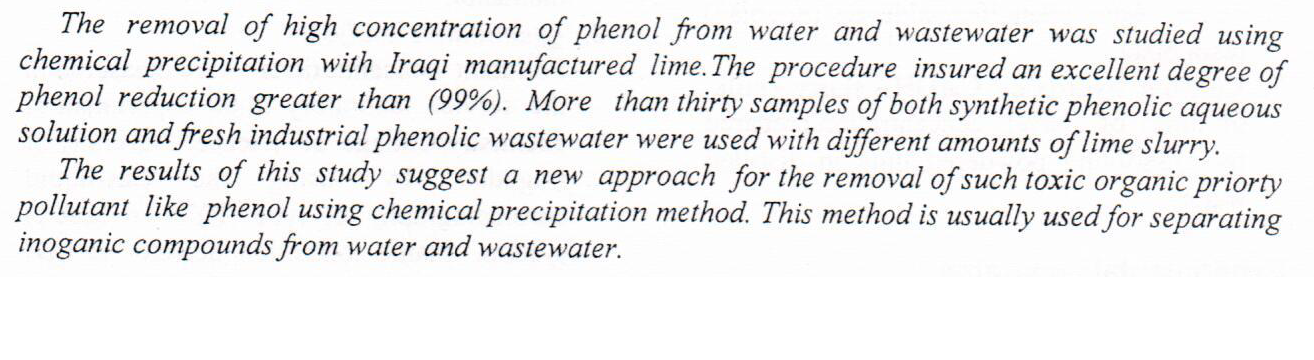
Removal of Phenol from Water and Wastewater by Chemical Precipitation with Lime

In the present research, the chemical washing method has been selected using three chelating agents: citric acid, acetic acid and Ethylene Diamine Tetraacetic Acid (EDTA) to remove 137Cs from two different contaminated soil samples were classified as fine and coarse grained. The factors that affecting removal efficiency such as type of soil, mixing ratio and molarity have been investigated. The results revealed that no correlation relation was found between removal efficiency and the studied factors. The results also showed that conventional chemical washing method was not effective in removing 137Cs and that there are further studies still need to achieve this objective.

Moisture induced damage can cause a progressive deterioration in the performance of asphalt pavement by the loss of adhesion between asphalt binder and aggregate surface and/or loss of cohesion within the binder in the presence of water. The objective of this paper is to improve the asphalt mixtures resistance to moisture by using hydrated lime as an anti-stripping additive. For this purpose, two types of asphalt binder were utilized; asphalt grades (40-50) and (60-70) with one type of aggregate of 19.0 mm aggregate nominal maximum size, and limestone dust as a mineral filler. Marshall method was adopted to find the optimum asphalt content. Essentially, two parameters were determined to evaluate the moisture susceptibili
... Show More (8)
(8)
 (3)
(2)
(3)
(2)
 (8)
(8)
The inhibitor property of curcuma longa L. extract in different concentrations of simulated refinery wastewater (0.05% - 2% wt) and at various temperatures (30, 35 and 40 ˚C) was investigated using weight loss method. The results showed that the presence of about 1.2 % (v/v) of curcuma extract gave about 84% inhibition indicating its effectiveness on mild steel corrosion in simulated refinery wastewater, besides the adsorption process on the mild steal surface obeyed the Langmuir adsorption isotherm.
The present study aimed to use the magnetic field and nanotechnology in the field of water purification, which slots offering high efficiency to the possibility of removing biological contaminants such as viruses and bacteria rather than the use of chemical and physical transactions such as chlorine and bromine, and ultraviolet light and boiling and sedimentation and distillation, ozone and others that have a direct negative impact on human safety and the environment. Where they were investigating the presence in water samples under study Coli phages using Single agar layer method and then treated samples positive for phages to three types of magnetic field fixed as follows (North Pole - South Pole - Bipolar) and compare the re
... Show More
An agricultural waste (walnut shell) was undertaken to remove Cu(II) from aqueous solutions in batch and continuous fluidized bed processes. Walnut shell was found to be effective in batch reaching 75.55% at 20 and 200 rpm, when pH of the solution adjusted to 7. The equilibrium was achieved after 6 h of contacting time. The maximum uptake was 11.94mg/g. The isotherm models indicated that the highest determination coefficient belongs to Langmuir model. Cu (II) uptake process in kinetic rate model followed the pseudo-second-order with determination coefficient of 0.9972. More than 95% of the Cu(II) were adsorbed on the walnut shells within 6 h at optimum agitation speed of 800 rpm. The main functional groups responsible for biosorption of
... Show More
(1)
(8)
(6)
 (6)
(6)
Iraq suffers the continuing lack of water resources in generdwether it is surface or underearth water or rain. The study of rain has got the utmost importance in order to the rain direction in Iraq and in Mosul in particular and what it will be in future. It also shows the wet as well as the dry seasons and the possibility of expecting them and expecting their quantities in order to invest them and to keep this vital resource The research deals with predict the wet and dry rainy seasons in Mosul using (SPI) Standardized precipitation index extracted from conversion of Gamma distribution to standardized normal distribution , depending on data of monthly rain amounts for 1940-2013 . Results showed existence of 31 w
... Show More