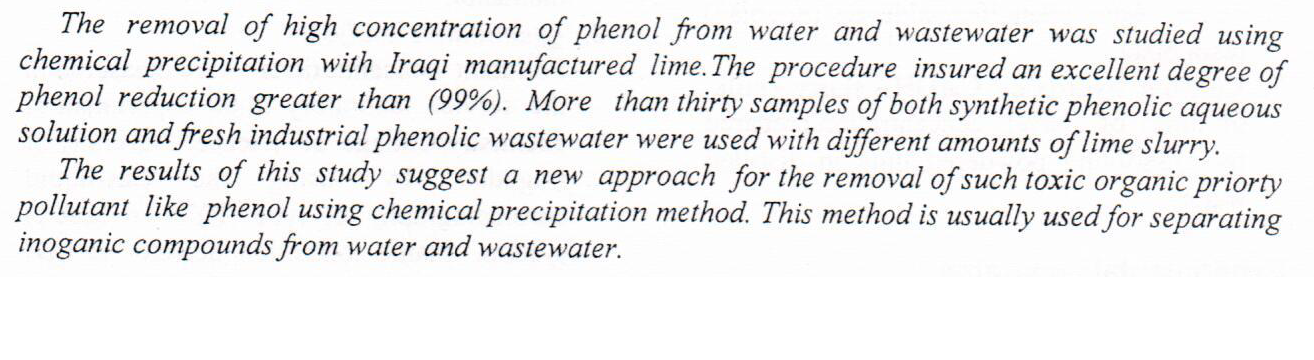
Removal of Phenol from Water and Wastewater by Chemical Precipitation with Lime

Three types of extracts ( aquatic, alcoholic, and oily ) were prepared from the fruits of coconuts, and a series of chemical tests were conducted in addition to the use of the FTIR equipment to determine the active locations in the prepared extracts. The results indicated the presence of active compounds (tannins, saponins, flavonoids, turbines and steroids) in the extracts prepared from the fruits of coconuts, also the antimicrobial capability of these extracts were tested on pathogenic bacteria isolated from wounds and burns infections cases. The results proved that the concentration 80 mg/ml of the aquatic extract is the minimum inhibitory concentration for the microbes: Proteus vulgaris and Pseudomonas fluorescence, while the
... Show More
Staphylococcus lugdunensis, isolation between 12.5 to 1.8% routine works may be a possible peroral route of infective endocarditis and found in the oral cavity by examined using saliva. Similar supragingival plaque isolation was observed. The increased bacteria resistance to antibiotics multiple have led to novel methods for resistance bacteria; antimicrobial agents are well known (ZnO NPs) by biological method and are lower toxicity and biology safety ZnNOPs activity by plant extraction and less toxicity as well as bio-safe. The nanoparticle was synthesized by biological method (Green) by barberry (Berberis vulgaris) extract. In this study using (WAD) method using different concentrations between (128, 64, 32, and 16) mg/mL of ZnO
... Show More (3)
(3)
 (2)
(2)

Staphylococcus lugdunensis, isolation between 12.5 to 1.8% routine works may be a possible peroral route of infective endocarditis and found in the oral cavity by examined using saliva. Similar supragingival plaque isolation was observed. The increased bacteria resistance to antibiotics multiple have led to novel methods for resistance bacteria; antimicrobial agents are well known (ZnO NPs) by biological method and are lower toxicity and biology safety ZnNOPs activity by plant extraction and less toxicity as well as bio-safe. The nanoparticle was synthesized by biological method (Green) by barberry (Berberis vulgaris) extract. In this study using (WAD) method using different concentrations between (128, 64, 32, and 16) mg/mL of ZnO NPs, The
... Show More
(3)
(3)
The current study was conducted to determine the sensitivity of some pathogenic bacterial isolates isolated from wounds and burns water toward the disposer of the Yas Rue tested five crude bacterial isolates isolated from wounds and burns which these isolates sensitive to aqueous extract crude
Stevia rebaudiana Bertoni contains diterpenoid steviol glycosides that have no adverse impact on blood sugar levels despite being 300 times sweeter than sugar. This study aimed to investigate the rate of callus induction from stevia leaves and the content of glycosides when changing the sucrose percentage in the culture medium.. Murashige and Skoog (MS) culture medium supported by 4.0 mg/l naphthalene acetic acid (NAA) and 1.0 mg/l benzyl adenine (BA) was used, and different concentrations of sucrose (2, 3, 4, 5 and 6%) were tested .The extraction of glycosides from leaf and callus tissues was performed by using methanol. Extracted glycosides were analyzed by high-performance liquid chromatography (HPLC). The results showed signific
... Show MoreEM International
The study was conducted to estimate the economic losses caused by insect mole cricket Gryllotalpa gryllotalpa on some agricultural crops and Potato tubers in collage of Agriculture- Abu Ghraib season 2012-2013. Study showed Mole cricket caused percentage of infestation in spring potato tubers variety Luciana reached to 11.61% and the percentage of loss in weight of tubers reached 18.88%. The study showed that addition of animal manure (organic fertilizer) to the soil when planting potatoes in the autumn increased the incidence of infestation and the number of tunnels caused by mole cricket which led to from increased economic losses. When matured potato tubers were left for a longer period in the soil percentage of infestation by mole cr
... Show More
Organic soil is problematic soils in geotechnical engineering due to its properties, as it is characterized by high compressibility and low bearing capacity. Therefore, several geotechnical techniques tried to stabilize and improve this soil type. In this study, sodium silicate was used to stabilize sand dune columns. The best sodium silicate concentration (9%) was used, and the stabilized sand dune columns were cured for seven days. The results for this soil were extracted using a numerical analysis program (Plaxis 3D, 2020).In the case of studying the effect of (L/D) (where ‘’L” and ‘’D’’ length and diameter of sand dune columns) of a single column of sand dunes stabilized with sodium silicate with a diff
... Show More
(3)