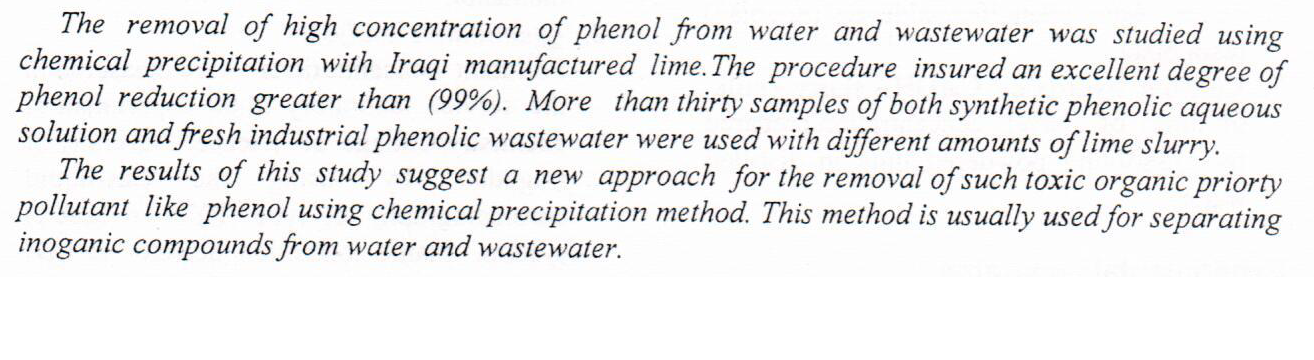
Removal of Phenol from Water and Wastewater by Chemical Precipitation with Lime


A series of batch demulsification runs were carried out to evaluate the final emulsified water content of emulsion samples after the exposure to microwave. An experimental study was conducted to evaluate the effects of a set of operating variables on the demulsification performance. Several microwave irradiation demulsification runs were carried out at different irradiation powers (700, 800, and 900 watt), using water-in-oil emulsion samples containing different water contents (20-80%, 30-70%, and 50-50%) and salt contents (10000, 20000, and 30000 ppm). It was found that the best separation efficiency was obtained at 900watt, 50% water content and 160 s of irradiation time. Experimental results showed that microwave radiation method can
... Show MoreThe determination of river pollution impact on the performance of water treatment plants is achieved by two main objectives. The first is to study raw and treated water qualities and comparing them with standards and the second is to evaluate the treatment plants efficiency. The analyzed data were those water quality parameters in relation to physical, chemical and bacteriological characteristics for river water and produced water by seven water treatment plants located on Tigris River passing through Baghdad City.
The results of this study indicated that all raw water characteristic are within the surface water standards established by Iraqi and USA criteria except Bacterial Counts.
Tigris River water is of good quality to be trea
After restoration of Iraqi marshes during 2003, three locations were chosen, one in each main marsh (Um Al-Naaj site in Al-Hwaizeh marsh; Al-Nagarah site in Al-Hammar marsh and Al-Baghdadia site in Al-Chebaysh marsh) to determine the concentrations of nutrients (Nitrate, Nitrite, Phosphate and Silicate) in water seasonally for the period winter, spring, summer, and autumn at 2007. Five water replicates were collected from each site, seasonally. In the Lab., the samples were analyzed by colorimetric methods; the results showed that Um-Al-Naaj site has the highest nutrients level, while Al-Nagarah site has the lowest level. The statistical program t-test was applied at the significant levels (P-value < 0.01) and (P-value < 0.05) to know
... Show More (2)
(2)
 (13)
(8)
(13)
(8)

Background: Strangles is a highly contagious equine respiratory disease caused by Streptococcus equi subsp. equi. It is a globally significant pathogen and one of the most common infectious agents in horses. In Iraq, no sequencing data on this pathogen are available, and only two molecular studies have been published to date. This study provides preliminary insights into strain diversity and provides a foundation for future large-scale investigations. Aim: This study aimed to investigate the molecular characteristics, identify SeM gene alleles, and perform a phylogenetic analysis of S. equi isolates from horses in Baghdad, Iraq. Methods: We analyzed 59 Streptococcus spp. isolates previously obtained from equine clinical sample
... Show More
 (118)
(109)
(18)
(15)
(118)
(109)
(18)
(15)
The water injection of the most important technologies to increase oil production from petroleum reservoirs. In this research, we developed a model for oil tank using the software RUBIS for reservoir simulation. This model was used to make comparison in the production of oil and the reservoir pressure for two case studies where the water was not injected in the first case study but adding new vertical wells while, later, it was injected in the second case study. It represents the results of this work that if the water is not injected, the reservoir model that has been upgraded can produce only 2.9% of the original oil in the tank. This case study also represents a drop in reservoir pressure, which was not enough to support oil production
... Show More
(5)
A field experiment was conducted during the agricultural season 2017-2018. In the research station of the Ministry of Agriculture AL Rasheed side, and within the activities and researches of the national program to develop wheat cultivation in Iraq, Two factors were experienced in the cultivation of wheat, The first factor is the method of cultivation of five treatments were used: : Treatment of the cultivation of wheat in the plots (B), Treatment of wheat crops on bed with 50 cm width (S1), 60cm (S2), 70cm (S3) and 80cm (S4), The second factor is irrigation levels depletion of 40, 60 and 80% of available water coded as W1, W2 and W3, respectively, The experiment was designed under randomized complete block design (RCBD) with three replicat
... Show More
(4)