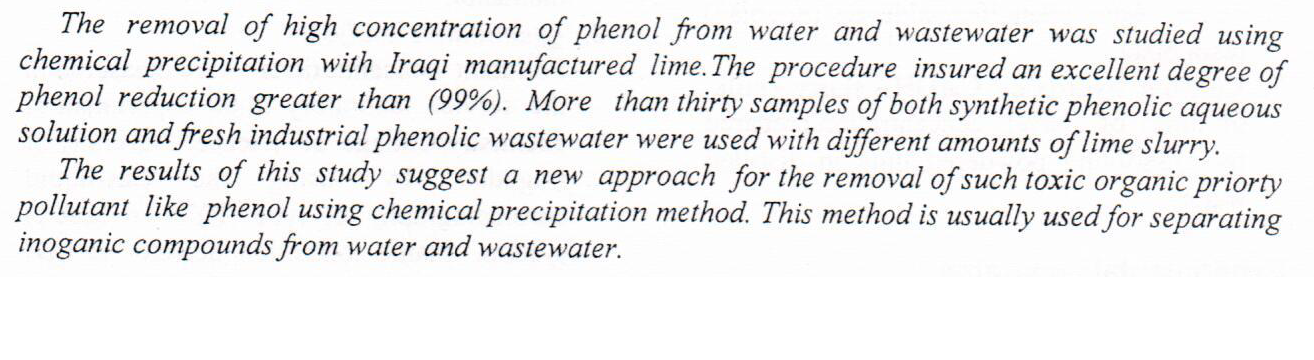
Removal of Phenol from Water and Wastewater by Chemical Precipitation with Lime

Background: Radiotherapy, is therapy using ionizing radiation in order to deliver an optimal dose of either particulate or electromagnetic radiation to a particular area of the body with minimal damage to normal tissues. The source of radiation may be outside the body of the patient (external beam irradiation) or it may be an isotope that has been implanted or instilled into abnormal tissue or a body cavity. Called also radiotherapy. The aim of work studies the relationship between the depth dose and the high photon xray energies (6MeV and 10MeV). Patients and methods: in our work, we studied the dose distribution in water phantom given at different depths (zero-18) cm deep at1cm intervals treated with different field size (5×5-,10×1
... Show MoreThe aim of this study was to investigate antibiotic amoxicillin removal from synthetic pharmaceutical wastewater. Titanium dioxide (TiO2) was used in photocatalysis treatment method under natural solar irradiation in a tubular reactor. The photocatalytic removal efficiency was evaluated by the reduction in amoxicillin concentration. The effects of antibiotics concentration, TiO2 dose, irradiation time and the effect of pH were studied. The optimum conditions were found to be irradiation time 5 hr, catalyst dosage 0.6 g/L, flow rate 1 L/min and pH 5. The photocatalytic treatment was able to destruct the amoxicillin in 5 hr and induced an amoxicillin reduction of about 10% with 141.8 kJ/L accumulate
... Show More (14)
(14)

The study investigates the water quality of the Orontes River, which is considered one of the important water recourses in Syria, as it is used for drinking, irrigation, swimming and industrial needs. A database of 660 measurements for 13 parameters concentrations used, were taken from 11 monitoring points distributed along the Orontes River for a period of five years from 2015-2019, and to study the correlation between parameters and their impact on water quality, statistical analysis was applied using (SPSS) program. Cluster analysis was applied in order to classify the pollution areas along the river, and two groups were given: (low pollution - high pollution), where the areas were classified according to the sources of pollution to w
... Show More (9)
(4)
(9)
(4)


The driving idea for the present work was to combine the effect of polyvinyl alcohol (PVA) as corrosion inhibitor with the distance between the anodic and cathodic elements of the galvanic cell, beside their area ratio, in scope of synergistic suppression of galvanic corrosion on Cu/Fe model couple, using weight loss method. The performance affecting galvanic corrosion process has been tested for three major factors affect the process:
1. Four PVA inhibitor concentrations were selected to be (0, 1000, 4000 and 7000 ppm) in simulated cooling water.
2. Two cathode: anode area ratios as 1:1 and 2.4:1.
3. Two distances apart cathode – anode as 3 and 7 cm.
Maximum corrosion inhibition achieved was 86% which indicates that increa
Abstract
The aim of this paper is to investigate and discuss the mechanisms of corrosion of epoxy coatings used for potable water tanks. Two distinct types of Jotun epoxy coatings: Tankguard 412 contained polyamine cured epoxy and Penguard HB contained polyamide cured epoxy, were tested and studied using the electrochemical impedance spectroscopic (EIS) method. The porosity of epoxy coatings was determined using EIS method. The obtained results showed that the two epoxy coatings have excellent behavior when applied and tested in potable water of Basrah city. Polyamine is more resistance to water corrosion compared to polyamide curing epoxy and has high impedance values. Microscopic inspection after te
... Show More
(3)
(1)
This in vivo study was conducted to investigate the effect of different concentrations of ozonated water on experimentally skin infection with some of bacterial isolates (Pseudomonas aeruginosa and Staphylococcus aureus ) which Showed dermal infection in experimental animals after 48 hours of exposure to these Microorganisms. Results revealed that ozone has the power to accelerated the healing process depending on the perfect concentration of ozonated water used and the severity of infection & nature of causative agent , in which the recovering period was 7 days for the infection caused by P. aeruginosa and 5 day for S.aureus by using the concentration 60 µg/ml . Results also indicated in this study the stimulated effect of O
... Show More
Occurrence the heavy metals in water is one of the most important concerns. may cause savior health problems. In this work we made an attempt to know the quantity of six heavy metals in groundwater in different locations of Baghdad city. Examinations were made on groundwater of the review region to assess the heavy metals. Groundwater samples were gathered and analyzed utilizing Atomic Absorption Spectrophotometer for their Manganese, Iron, Zinc, Cadmium, Copper and Lead content and their levels compared with World Health Organization (WHO) specified maximum contaminant level. In order to accomplish this, water samples were obtained from 10 randomly selected wells in the region, in February and August, 2016. The study showed that the ground
... Show More
(7)
Water injection equipments such as pipelines, which are used in the second recovery of oil in the Al-Ahdeb wells, suffer from the corrosion in water during maintaining vacuum deoxygenated tower that used to decrease concentration of the dissolved oxygen gas in the water from 6.2-9.1 ppm to o.5 ppm. This study involved calculation the corrosion rates of the internal surfaces of the pipelines either during operation of the vacuum unit or when the tower out of operation. Finally, find the solution by one of the following suggestions. In the first suggestion removal of the dissolved O2 from water is achieved by increasing the dosage of the oxygen scavenger (sodium sulphite). The second suggestion involves re
... Show MoreWater injection equipments such as pipelines, which are used in the second recovery of oil in the Al-Ahdeb wells, suffer from the corrosion in water during maintaining vacuum deoxygenated tower that used to decrease concentration of the dissolved oxygen gas in the water from 6.2-9.1 ppm to o.5 ppm. This study involved calculation the corrosion rates of the internal surfaces of the
pipelines either during operation of the vacuum unit or when the tower out of operation. Finally, find the solution by one of the following suggestions. In the first suggestion removal of the dissolved O2 from water is achieved by increasing the dosage of the oxygen scavenger (sodium sulphite). The second suggestion involves removing the dissolved O2 from w