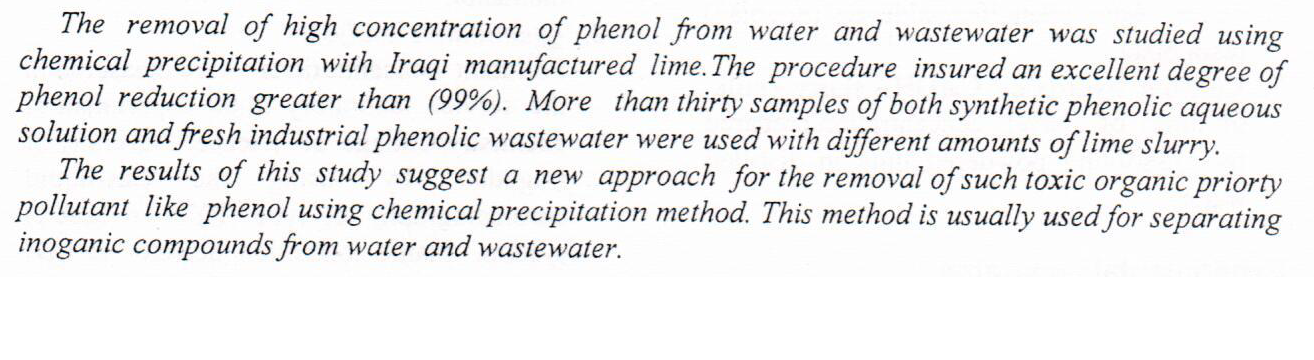
Removal of Phenol from Water and Wastewater by Chemical Precipitation with Lime

Two field experimسents were conducted in one of the fields of the Agriculture Division of Ain Al-Tamr /Holy Karbala Governorate at two sites of different textures during the agricultural season 2020/2021. The first site has sandy loam texture (gypsum soils). The second site has loamy sand texture (calcareous soils). The factors of the study included: The first factor included two types of soil, gypsum and calcareous soil. The second factor is the tillage systems (no-tillage, spring spike harrows, disc harrows, and mold board plow). The experiment was designed in the two study sites according to the RCBD with three replications. The Valley type center pivot irrigation system was evaluated before planting, three speeds, 30, 50 and 100% of th
... Show More (8)
(8)
 (6)
(6)


The present paper aims at evaluating the vailability quality and future horizons of potable water in the city of Shatra as a model. This is done in accordance with certain subjective and objective factors alongside the classification map of Shatra as a residential area. This system follows geographical studies specialized in urban construction. The problem of the present paper as well as the data approaching that problem have been chosen from the records of 2018. The researcher offered (919) questionnaire forms to be answered by a sample of dwellers in that area. Besides, the researcher also followed lab analysis of water samples collected from districts in the city of Shatra. GIS technology was also used to arrive at the real water shar
... Show More
Background: Plasma-activated water (PAW) is considered one of the emerging strategies that has been highlighted recently in the food industry for microbial decontamination and mycotoxin detoxification, due to its unique provisional characteristics. Aim: The effectiveness of PAW for aflatoxin B1 (AFB1), ochratoxin A (OTA), and fumonisin B1 (FB1) detoxification in naturally contaminated poultry feeds with its impacts on the feed quality were inspected. Methods: PAW-30 and PAW-60 were utilized for feed treatment for six time durations (5, 10, 15, 20, 40 and 60 min) each. The alterations in the physicochemical properties of PAW after different time durations of plasma inducement and treatment with and without feed samples were monit
... Show More
(3)
(3)

This investigation pertains to the evaluation of water quality in SAWA Lake, located in the Al-Muthanna province of Southern Iraq, from 1977 to 2020. Understanding the water quality and assessments of this Lake is of great importance. The Lake is home to small, transparent, blind fish measuring approximately 10 cm and is often referred to as the "wonderful" or "strange" Lake due to its many unique features. The study focuses on several elements to represent water quality, including total dissolved solids (TDS), electrical conductivity (EC), pH, and temperature (T), which were measured directly in the field. Additionally, scientific concepts such as K+, Ca2+, Cl-, HCO
(1)
The principal forms of radiation dosage for humans from spontaneous radiation material are being recognized as radon and its progenitors in the interior environment. Radiation-related health risks are caused by radon in water supply, which can be inhaled or ingested. Materials and Methods: The solid-state CR-39 nuclear trace detectors method was using in this research for measuring accumulation of radioactivity in water supply in different locations of Iraq's southwest corner of Baghdad. In Baghdad district, 42 samples were selected from 14 regions (3 samples out of each region) and put in dosimeters for 50 days. Results: The mean radon concentration was 49.75 Bq/m3, that is lower than the internationally recognized limit of 1100 Bq /m3. Th
... Show More
(2)
The research aims to improve the performance of the Directorate of Maysan water by reconciling the objectives of the employees of the directorate with the objectives of the Directorate itself, as well as to identify the strengths and weaknesses in the performance of the Directorate (Leadership - Individuals - Knowledge - Operations - Financial) and presented to experts and arbitrators of specialized, and the researchers have relied on the case study methodology as a descriptive approach is comprehensive analysis, and draws on more than one approach, method and scientific design, has been interviewed a number of experts in the Directorate Maysan's water Identify the weaknesses and strengths of the Directorate, the research has rea
... Show More
A water crisis is a circumstance in which a region accessible potable, unpolluted water is less than the requirement of that country. Two converging trends cause water scarcity, that are expanded use of irrigation, and loss of available freshwater supplies. Water scarcity can arise from two mechanisms, the physical water scarcity because of deficient natural water supply to fulfil the country demand, and economic water scarcity due to bad management for sufficient available water resources. This research examines data set as multispectral Landsat 8 satellite images that are detected for Basrah city, located in southern Iraq, and positioned between Kuwait and Iran on the Shatt al-Arab. Such raw data are satellite images. Using ENVI 5.3 softw
... Show More
(8)
(3)