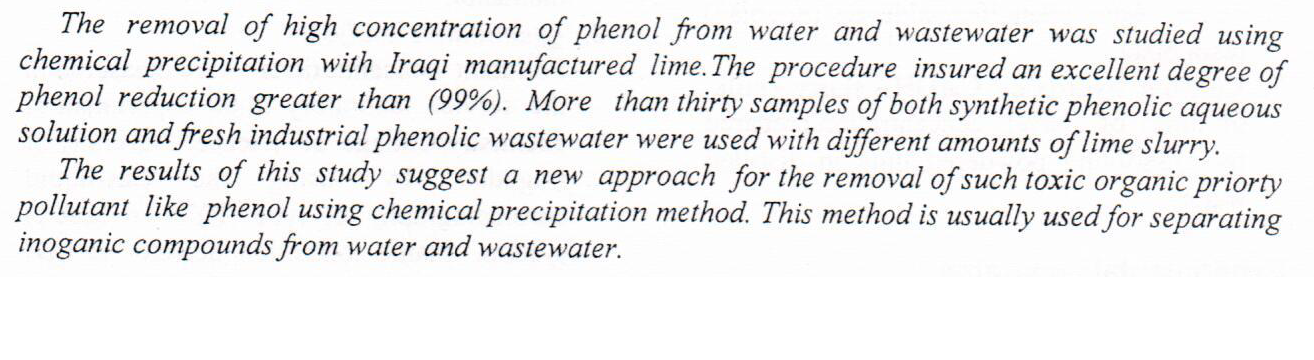
Removal of Phenol from Water and Wastewater by Chemical Precipitation with Lime

Abstract. Froth flotation is a well-known solid-liquid separation technique. Hydrophobicity is the main driving force for such processes. Hydrophobic solids attach to air bubbles and rise up while hydrophilic or less hydrophobic species settle down. Froth can be produced with chemical frothers such as alcohols and polyglycols. However, the use of chemicals limits the use of this separation method in applications such as drinking water, food, and pharmaceutical industries. Therefore, developing a technique that produces froth without adding any chemicals would be useful to such industries. This work demonstrates that with suitable operating parameters a 27 cm froth height can be obtained in a 20 cm diameter column by using an air
... Show More
In this research the specifications of Iraqi drinking bottled water brands are investigated throughout the comparison between local brands, Saudi Arabia and the World Health Organization (WHO) for bottled water standard specifications. These specifications were also compared to that of Iraqi Tap Water standards. To reveal variations in the specifications for Iraqi bottled water, and above mentioned standards some quality control tools are conducted for more than 33% of different bottled water brands (of different origins such as spring, purified,..etc) in Iraq by investigating the selected quality parameters registered on their marketing labels. Results employing Minitab software (ver. 16) to generate X bar,
... Show MoreThis research was aimed to study the efficiency of microfiltration membranes for the treatment of oily wastewater and the factors affecting the performance of the microfiltration membranes experimental work were includes operating the microfiltration process using polypropylene membrane (1 micron) and ceramic membrane (0.5 micron) constructed as candle; two methods of operation were examined: dead end and cross flow. The oil emulsion was prepared using two types of oils: vegetable oil and motor oil (classic oil 20W-50). The operating parameters studied are: feed oil concentration 50 – 800 mg/l, feed flow rate 10 – 40 l/h, and temperature 30 – 50 oC, for dead end and cross flow microfiltration.
It was found that water flux decrea
Smart water flooding (low salinity water flooding) was mainly invested in a sandstone reservoir. The main reasons for using low salinity water flooding are; to improve oil recovery and to give a support for the reservoir pressure.
In this study, two core plugs of sandstone were used with different permeability from south of Iraq to explain the effect of water injection with different ions concentration on the oil recovery. Water types that have been used are formation water, seawater, modified low salinity water, and deionized water.
The effects of water salinity, the flow rate of water injected, and the permeability of core plugs have been studied in order to summarize the best conditions of low salinity
... Show More (2)
(2)
 (2)
(1)
(2)
(1)

The efficiency of Nd:YAG laser radiation in removing debris and smear layer from prepared root
canal walls was studied. Fifty-seven human extracted single rooted anterior teeth were divided into three
groups. A group that was not lased is considered as a control group. The remaining teeth were exposed to
different laser parameters regarding laser energy, repetition rate and exposure time. For the case of the set of
parameters of 7 mJ laser energy, the cleaning was maximum at 3 p.p.s. repetition rate for 3 seconds exposure
time for, the coronal, middle and apical thirds. Above and below this energy level, there was an overdose
(melting) or under dose (no effect). Nevertheless for 10mJ laser energy case, the cleaning effi
120 samples were collected from children (ages between new born and 10 years) who infected with oral thrush. The results revealed that the Minimum Inhibitory Concentration (MIC) and Minimum Fungicidal Concentration (MFC) of extracted oil of lemon grass against C.albicans, C.tropicalis, C.keyfr, C.glabrata and C.guilliermondii were 1.25,1.25,1.25,2.5 and 2.5µl/ml and 2.5, 2.5, 2.5, 5 and 5 µl /ml respectively. while the (MIC) and (MFC) for the extraction oil of thyme against C.albicans, C.tropicalis, C.keyfr, C.glabrata and C.guilliermondii were 0.6, 0.6, 1.25, 1.25, and 1.25µl/ml and 1.25, 1.25, 2.5, 2.5, and 2.5µl/ml respectively . While the value of (MIC) and (MFC) for Nystatin against Candida species were 32 and 64 µg
... Show More
The research includes the preparation of several complexes of the internal transition elements lanthanide (Ln = La, Nd, Er, Gd, and Dy) containing the 4f shell, with Schiff bases resulting from condensation reactions between 4-antipyrinecarboxaldehyde and 2-aminobenzothiazoles. Schiff's base was identified using FTIR spectra, UV-vis spectroscopy, elemental microanalysis CHNSO, nuclear magnetic resonance, mass spectrometry, and TGA thermal analysis. The complexes were studied and identified with elemental microanalysis CHNSO, FTIR spectroscopy, UV-vis spectroscopy, TGA thermal analysis, conductivity measurement, and magnetic sensitivity. The result showed that these complexes were classified as homogeneous bidentate complexes with th
... Show More
(7)
(1)

This research focus on studying 3 types of Bakhour in the markets of Baghdad city and assessing their impact on the quality of life for asthmatic whom used Bakhour at their houses through investigating particles physical properties, also estimating the levels of heavy metals (Cd, Cu, Mn, Pb and Zn), Particulate Matter PM2.5, PM10, Total Volatile Organic Compounds (TVOC) and formaldehyde (HCHO). The quality of life for asthmatic patients whom use Bakhour was assessing by Mini Asthma Quality of Life Questionnaire. The results indicated that shapes of Bakhour particles were irregular or spherical. Burning process generated the higher percent of PM ˂1μm. Type 2 Bakhour showed the highest percent of <1μm which was 73%.The amount of
... Show More
(1)