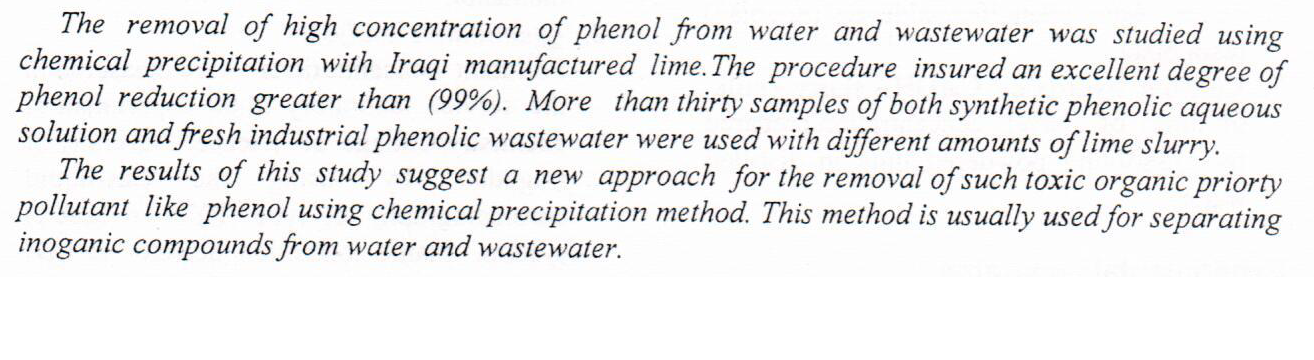
Removal of Phenol from Water and Wastewater by Chemical Precipitation with Lime

The increasing drinking water demand in many countries leads to an increase in the use of desalination plants, which are considered a great solution for water treatment processes. Reverse osmosis (RO) and electro-dialysis (ED) systems are the most popular membrane processes used to desalinate water at high salinity. Both systems work by separating the ionic contaminates and disposing of them as a brine solution, but ED uses electrical current as a driving force while RO uses osmotic pressure. A direct comparison of reverse osmosis and electro-dialysis systems is needed to highlight process development similarities and variances. This work aims to provide an overview of previous studies on reverse osmosis and electro-dial
... Show More (13)
(13)

 (17)
(17)


Abstract:
This study aims to identify the level of patients’ satisfaction among a sample of hospitalized patients in the targeted hospital (Al-Kindy Teaching Hospital, and Al-Yarmook Teaching Hospital). Moreover, this study highlights the reality of services for patients, especially in the targeted governmental teaching hospitals. The Patient Satisfaction with Nursing Care (PSNCS) has been measured in these hospitals through the revised scale by Tang et al, (2013).This scale includes four major domains; Health Information (5 items), Influencing Support (4 items), Decision Control (4 items), Specialized Technical Competence (7 items). The method of surveying patients’ opinions about the degree
... Show More
Wastewater treatment plants operators prefer to make adjustments because they are more cost effective, to use the existing tank instead of building new ones. In this case an imported materials would be used as bio-loads to increase biomass and thus maintain efficiency as the next organic loading increases.In the present study, a local substance "pumice stone" was used as a biological carrier in the aeration tank, and the experiments were carried out in five stages: without biological carriers, filling ratio of 4%,10%,20%, and25% with pumice stone, the maximum organic loading at each stage (1.1884, 1.2144, 1.9432, 2.7768, 3.3141)g BOD /l.d respectively.Other experiments were carried out to determine the best filling ratio, the SS remova
... Show More
(4)
Di Benzylidenes were prepared by condensation of 1,2-diamino benzene with o- hydroxy benzaldehyde. These dibenzylidenes when treated with one equivalent of malonic anhydride or 5-oxo-spiro[2,3]hexane-4,6-dione in dry benzene give 6-membered heterocyclic ring system of 3-{2-[(2-Hydroxy-benzylidene)-amino]-phenyl}-2-(2-hydroxy –phenyl)-[1,3]oxazinane-4,6-diones ( 1-3) or 7-{2-[(2-hydroxy-benzylidene)-amino]-phenyl}-6-(2-hydroxy-phenyl)-5-oxa-7-aza-spiro[2.5]octane-4,8-diones ( 7- 9 ) But when two equivalents of malonic anhydride or 5-oxo-spiro[2,3]hexane-4,6-dione were used and under sam conditions compounds (4-6 , 10-12 ) were obtained .
(12)
Polymers have the ability to extract water after they have been added to the mortar or concrete mixture. They provide the absorbed water during hydration functioning as internal water source. Absorption polymers can absorb up to hundred times of their own weight of pure water.This research deals with the use of water absorption polymer balls in concrete and study the volumetric change of these mixes and compared the results with reference mix (without polymers). Samples were cured both in air and in water for the mixes to compare results which show that samples in air behave for expansion while sample in water acted for shrinkage.
(3)
(3)
