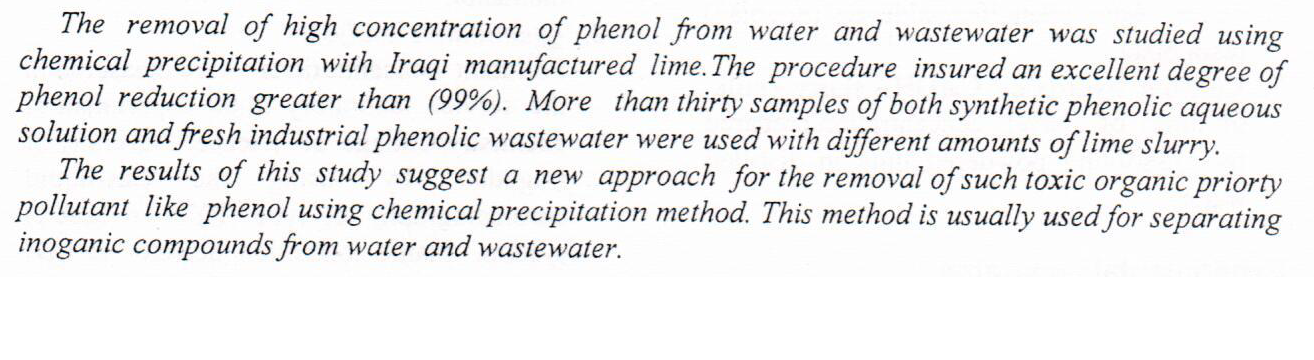
Removal of Phenol from Water and Wastewater by Chemical Precipitation with Lime

|
Background: Repeated blood transfusion is the main therapeutic option for transfusion-dependent anaemias with consequent iron overload and organ damage .Therefore iron chelating agents are important protective measures for these patients. The aim of this study was to investigate the efficiency and safety of Desferroxamine in paediatrics population subjected to iron overload as a consequence of repeated transfusion in a group of Sudanese children Subjects & Methods: This was a descriptive cross-sectional hospital based study. Conducted in two main paediatric reference hospitals in, Su |
 (1)
(1)

In this work, lanthanium (III) complexes were synthesized using by Schiff base ligand (L) derived from benzaldehyde and o-aminoaniline with five amino acids (AA) from glycine (Gly), L-alanine (Ala), L-valine (Val), L-asparagine (Asp) and DL- phenylalanine (Phe). The Schiff base ligand has been characterized by elemental analysis, (MASS, FTIR, 1HNMR, 13CNMR, UV-VIS) electronic spectra. The structures of the new complexes have been described of analysis of elements, molar conductivity, (UV-Vis electronic, FTIR, mass) spectra also magnetic moment. The molar conductivity values of the complexes indicat this every of complexes are electrolytes and other analytical studies reveal octahedral geometry for La (III) ion. The Schiff base ligand, five
... Show MoreThe Sequencing Batch Reactor system (SBR) is a major component of the municipal wastewater biological treatment system and water reclamation that provides high-quality water that could be reused in restricted plants that which require large quantities of water despite the lack of water. The research aims to investigate the performance of a pilot plant SBR unit under real operation conditions that was installed and operated in Al-Rustamiya Wastewater Treatment Plant (WWTP), Baghdad, Iraq. Results showed that the BOD5/COD ratio of the raw wastewater was within the average value at 0.66 emphasizing the organic nature of the influent flow and hence the amenability to biological treatment. The results also ensured that the treatment pro
... Show MoreIn the present study, advanced oxidation treatment, the TiO2 /UV/H2O2 process was applied to decolorisation of the reactive yellow dyes in aqueous solution. The UV radiation was carried out with a 6 W low-pressure mercury lamp. The rate of color removal was studied by measuring the absorbency at a characteristic wavelength. The effects of H2O2 dosage, dye initial concentration and pH on decolorisation kinetics in the batch photoreactor were investigated. The highest decolorisation rates were observed (98.8) at pH range between 3 and 7. The optimal levels of H2O2 needed for the process were examined. It appears that high levels of H2O2 could reduce decolori
... Show More
(22)
Investigation of the adsorption of acid fuchsin dye (AFD) on Zeolite 5A is carried out using batch scale experiments according to statistical design. Adsorption isotherms, kinetics and thermodynamics were demonstrated. Results showed that the maximum removal efficiency was using zeolite at a temperature of 93.68751 mg/g. Experimental data was found to fit the Langmuir isotherm and pseudo second order kinetics with maximum removal of about 95%. Thermodynamic analysis showed an endothermic adsorption. Optimization was made for the most affecting operating variables and a model equation for the predicted efficiency was suggested.
An in-depth experimental study of the matrix effect of antifreeze (ethylene glycol) and water contamination of engine oil through FT-IR spectroscopy. With a comparison of the percent by volume concentration of contaminated fresh 15W-40 engine oil, there appeared to be a noticeable reduction in the O–H stretching signal in the infrared spectrum when ethylene glycol based antifreeze was included as a contaminant. The contaminants of distilled water, a 50/50 mixture of water and commercial ethylene glycol antifreeze, and straight ethylene glycol antifreeze were compared and a signal reduction in the O–H stretch was clearly evident when glycol was present. Doubling the volume of the 50/50 mixture as compared to water alone still res
... Show More
(2)
ABSTRACT
The purpose of the research is to identify the role of drinking water quality in achieving customer satisfaction in one of the formations of the Ministry of Construction, Housing and Public Municipalities (Diwaniyah Water Directorate), as they are important service organizations that have a fundamental role in serving the community. Faced many administrative challenges, as a result of the continuous and accelerating environmental changes, environmental pollution and immaturity of social awareness and social responsibility, as these contributed to and affected the quality of drinking water, Therefore, it is necessary to know the role of quality, specifically "drinking water and its effect o
... Show More
(31)
In spite of increasing clinical cases which caused by enteroviruses transferred by water and no documents about entericviruses in the Iraqi water standards. The use of coliphages as an indicator of enteroviruses and fecal pollution were suggested two procedures were applied . The first is Two-Step Enrichment Method and the second is Single Agar Layer Method. Both methods gives good results in Identification of coliphages through testing fifty different water samples (Tap water, Surface water and Bottled water) the study shows the presence of coliphages in fourteen samples.
Background: The use of Miswak, chewing sticks (salvadorapersica) can be traced back to Babylonians some 7000 years ago. It is commonly used throughout the world especially for the purpose of oral hygiene. Muslims are using as the religious view. Current study aimed to test the ability of aqueous siwak extract to increase the resistance of enamel surface against acid dissolution compared to sodium fluoride. Materials and Method: Twenty maxillary first premolars were treated with the selected solutions included two aqueous siwak extract concentration(5%,10%) and sodium fluoride(0.05%)as control positive for 2 minutes once daily for 20days interval, de ionized water was used as control negative. The concentration of the dissolved phosphorus i
... Show More