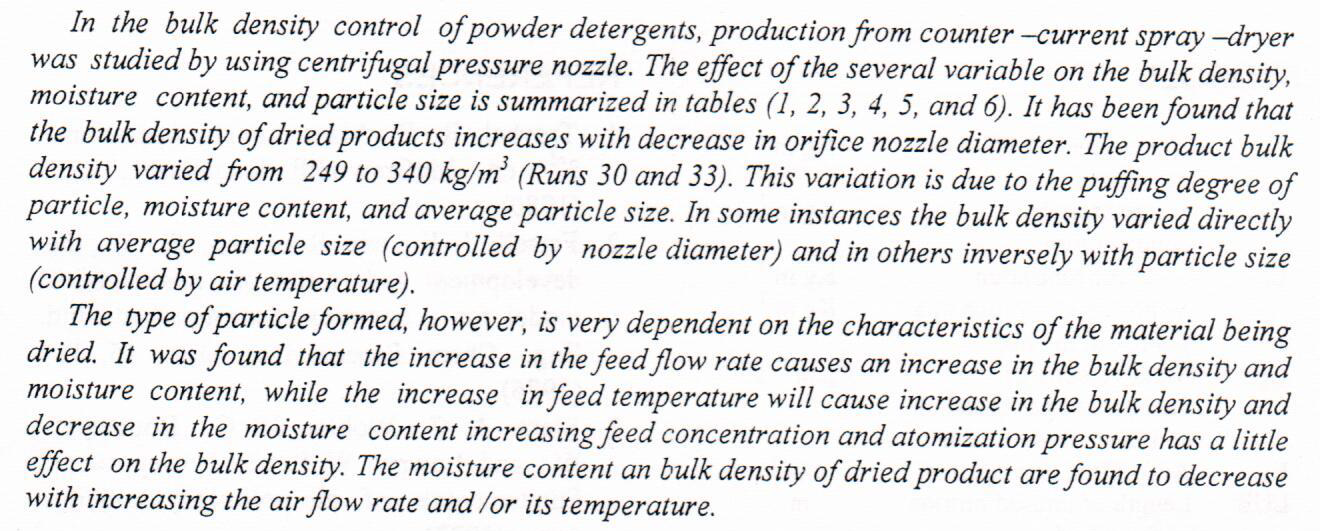
The Control of Powder Detergent Bulk Density by Means of Counter current Spray Dryer

The ligand [Potassium (E)-(4-(((2-((1-(3-aminophenyl) ethylidene) amino)-4-oxo-1,4- dihydropteridin-6-yl) methyl) amino)benzoyl)-L-glutamate] was prepared from the condensation reaction of folic acid with (3-aminoacetophenone) through Schiff reaction to give a new Schiff base ligand [H2L]. The ligand [H2L] was characterized by elemental analysis CHN, atomic absorption (A.A), (FT-I.R.), (U.V.-Vis), TLC, E.S. mass (for spectroscopes), molar conductance, and melting point. The new Schiff base ligand [H2L], reacts with Mn(II), Co(II), Ni(II), Cu(II), Cr(III) and Cd(II) metal ions and (2-aminophenol), (metal : derivative ligand : 2-aminophenol) to give a series of new mixed complexes in the general formula:- K3[M2(HL)(HA)2], (where M=Mn(II) and
... Show MoreBackground: Type 2 diabetes mellitus is a condition characterized by an elevation of oxidative stress, which has been implicated in diabetic progression and its vascular complications. Aim: Assessing the impact of gliclazide modified release (MR) versus glimepiride on oxidative stress markers, glycemic indices, lipid profile, and estimated glomerular filtration rate in uncontrolled type 2 diabetic patients on metformin monotherapy. Methods: This was an observational comparative study conducted in Thi-Qar specialized diabetic, endocrine, and metabolism center. Sixty-six patients were randomized into two groups based on the addition of the sulfonylureas (SUs). Group 1 (33 patients) was on gliclazide MR, whereas Group 2 (33 patients)
... Show More (3)
(3)
 (2)
(2)


Background: Ultrasonography has been used to examine the thickness of the lower uterine segment in women with previous cesarean sections in an attempt to predict the risk of scar dehiscence during subsequent pregnancy. The predictive value of such measurement has not been adequately assessed. Objectives: To correlate lower uterine segment thickness measured by trans abdominal ultrasound in pregnant women with previous cesarean section with that measured during cesarean section by caliper and to find out minimum lower uterine segment thickness indicative of integrity of the scar.Methods: A prospective observational study at Elwyia Maternity Teaching Hospital, from January 2011 to January 2012. A total of 143 women were enrolled in the stu
... Show MoreBackground: Strangles is a highly contagious equine respiratory disease caused by Streptococcus equi subsp. equi. It is a globally significant pathogen and one of the most common infectious agents in horses. In Iraq, no sequencing data on this pathogen are available, and only two molecular studies have been published to date. This study provides preliminary insights into strain diversity and provides a foundation for future large-scale investigations. Aim: This study aimed to investigate the molecular characteristics, identify SeM gene alleles, and perform a phylogenetic analysis of S. equi isolates from horses in Baghdad, Iraq. Methods: We analyzed 59 Streptococcus spp. isolates previously obtained from equine clinical sample
... Show More

Abstract
The research aims to examine the relationship between psychological flow, psychological well-being, and self-management among a sample of fine artists in the Makkah region and its governorates. The research also aims to examine the mean group differences in psychological flow, psychological well-being, and self-management due to demographic variables (sex and years of practicing arts). The sample consists of (110) male and female fine artists. The descriptive correlational approach was performed to collect the data by using the psychological flow scale developed by Payne et al (2011), which was translated by the researcher, the Oxford happiness questionnaire developed by Hills and Argyle (2002), it has t
... Show More
(9)
(5)
Background: Chronic kidney disease is a gradual loss of kidney function with diabetes and hypertension as the leading cause. Chronic kidney disease is one of these systemic diseases that can affect salivary contents. Aims: This study aimed to assess salivary immunoglobulin A, interleukin-6 and C- reactive protein in chronic kidney disease patients on hemodialysis and those on conservative treatment in comparison with control subjects. Materials and methods: Ninety subjects were included in this study divided into three groups: 30 patients with chronic kidney disease on hemodialysis for at least 6 months ago; 30 patients with chronic kidney disease on conservative treatment and 30 healthy control subjects. Secretory immunoglobulin A, inte
... Show More
(10)
(8)
(61)
(48)
2-benzamide benzothiazole complexes of Pd(II) , Pt(IV) and Au(III) ions were prepared by microwave assisted radiation. The ligand and the complexes were isolated and characterized in solid state by using FT-IR, UV-Vis spectroscopy, flame atomic absorption, elemental analysis CHNS , magnetic susceptibility measurements , melting points and conductivity measurements. The nature of complexes in liquid state was studied by following the molar ratio method which gave results approximately identical to those obtained from isolated solid state; also, stability constant of the prepared complexes were studied and found that they were stable in molar ratio 1:1.The complexes have a sequar planner geometry except Pt(IV) complex has octahedral .
... Show More
(1)
Herein, date palm (Phoenix dactylifera) bunch (DPB) waste was transformed into activated carbon (DPAC) adsorbent by using microwaveinduced ZnCl2 activation for 15 min at a power of 600 W. Several analytical methods were used to explain the physicochemical parameters of DPBAC including XRD, pHpzc, BET, SEM–EDX, and FTIR. Afterwards, the adsorptive performance of DPBAC was thoroughly investigated for the removal of two structurally different organic dyes namely methyl violet (MV) and fuchsin basic (FB). The key adsorption parameters, including the dose of DPBAC (A: 0.02–0.06 g), the solution pH (B: 4–10), and the contact time (C: 2–20 min) were statistically optimized using the Box-Behnken design with response surface methodology (RSM
... Show More
(3)
(2)