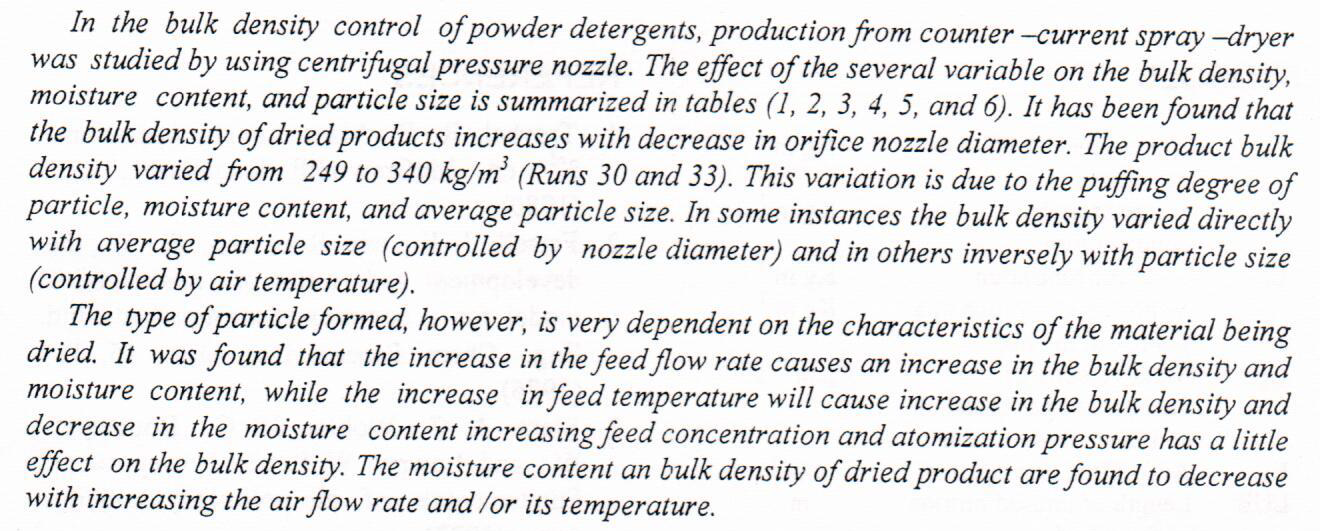
The Control of Powder Detergent Bulk Density by Means of Counter current Spray Dryer

The aim of this paper was to investigate the removal efficiencies of Zn+2 ions from wastewater by adsorption (using tobacco leaves) and forward osmosis (using cellulose triacetate (CTA) membrane). Various experimental parameters were investigated in adsorption experiment such as: effect of pH (3 - 7), contact time (0 - 220) min, solute concentration (10 - 100) mg/l, and adsorbent dose (0.2 - 5)g. Whereas for forward osmosis the operating parameters studied were: draw solution concentration (10 - 150) g/l, pH of feed solution (4 - 7), feed solution concentration (10 - 100) mg/l. The result showed that the removal efficiency by using adsorption was 70% and the removal efficiency by using forward osmosis was 96.2 %.
... Show More (2)
(2)

 (17)
(17)
 (8)
(8)
This paper reports the effect of Mg doping on structural and optical properties of ZnO prepared by pulse laser deposition (PLD). The films deposited on glass substrate using Nd:YAG laser (1064 nm) as the light source. The structure and optical properties were characterized by X-ray diffraction (XRD) and transmittance measurements. The films grown have a polycrystalline wurtzite structure and high transmission in the UV-Vis (300-900) nm. The optical energy gap of ZnO:Mg thin films could be controlled between (3.2eV and 3.9eV). The refractive index of ZnO:Mg thin films decreases with Mg doping. The extinction coefficient and the complex dielectric constant were also investigate.
(5)
Optical properties of chromium oxide (Cr2O3) thin films which were prepared by pulse laser deposition method, onto glass substrates. Different laser energy (500-900) mJ were used to obtain Cr2O3 thin films with thickness ranging from 177.3 to 372.4 nm were measured using Tolansky method. Then films were annealed at temperature equal to 300 °C. Absorption spectra were used to determine the absorption coefficient of the films, and the effects of the annealing temperature on the absorption coefficient were investigated. The absorption edge shifted to red range of wavelength, and the optical constants of Cr2O3 films increases as the annealing temperature increased to 300 °C. X-ray diffraction (XRD) study reveals that Cr2O3 thin films are a
... Show More
(1)
The corrosion of carbon steel in single phase (water with 0.1N NaCl ) and two immiscible phases (kerosene-water) using turbulently agitated system is investigated. The experiments are carried out for Reynolds number (Re) range of 38000 to 95000 corresponding to rotational velocities from 600 to 1400 rpm using circular disk turbine agitator at 40 0C. In two-phase system test runs are carried out in aqueous phase (water) concentrations of 1 % vol., 5 % vol., 8% vol., and 16% vol. mixed with kerosene at various Re. The effect of Reynolds number (Re), percent of dispersed phase, dispersed drops diameter, and number of drops per unit volume on the corrosion rate is investigated and discussed. Test runs are carried out using two types of
... Show MoreRemoval of heavy metals from waste water has received a great deal of attention. The compare Cr
(VI) adsorption characteristics removing from wastewater by using thermally modified and non-modified
eggshells were examined
(6)
(3)
 (14)
(8)
(14)
(8)
It is well known that petroleum refineries are considered the largest generator of oily sludge which may cause serious threats to the environment if disposed of without treatment. Throughout the present research, it can be said that a hybrid process including ultrasonic treatment coupled with froth floatation has been shown as a green efficient treatment of oily sludge waste from the bottom of crude oil tanks in Al-Daura refinery and able to get high yield of base oil recovery which is 65% at the optimum operating conditions (treatment time = 30 min, ultrasonic wave amplitude = 60 micron, and (solvent: oily sludge) ratio = 4). Experimental results showed that 83% of the solvent used was recovered meanwhile the main water
... Show More
(1)