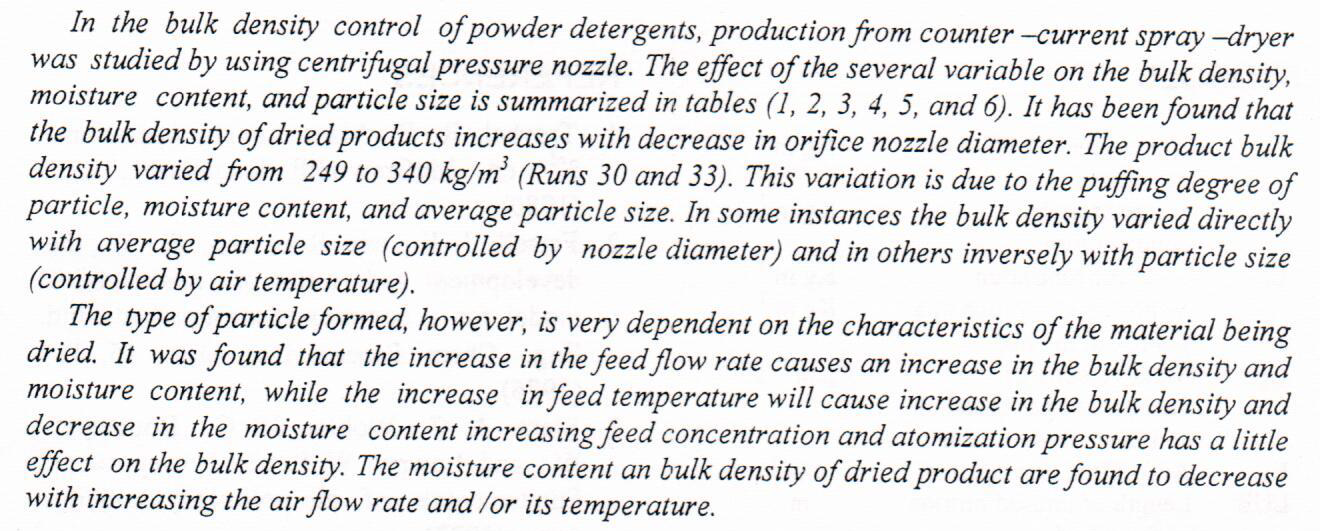
The Control of Powder Detergent Bulk Density by Means of Counter current Spray Dryer

This work deals with thermal cracking of three samples of extract lubricating oil produced as a by-product from furfural extraction process of lubricating oil base stock in AL-Dura refinery. The thermal cracking processes were carried out at a temperature range of 325-400 ºC and atmospheric pressure by batch laboratory reactor. The distillation of cracking liquid products was achieved by general ASTM distillation (ASTM D -86) for separation of gasoline fraction up to 220 ºC from light cycle oil fraction above 220 ºC. The comparison between the conversions at different operating conditions of thermal cracking processes indicates that a high conversion was obtained at 375°C, according to gasoline production. According to gasoline produ
... Show More
 (1)
(1)
 (1)
(1)


The measurement of vitamin B1 in pure and pharmaceutical formulations was proposed by using a straightforward and sensitive spectrophotometric approach. Sulfacetamide (SFA) is diazotized, then coupled with vitamin B1 in alkaline media to produce a colored azo dye complex with a stability constant of 5.597 × 10⁵ L/mol. The product is stable, with a maximum absorption wavelength of 489.5 nm, molar absorptivity of 10108 L/mol∙cm, Sandell's sensitivity of 0.0334 μg/cm2, detection limit of 0.0135 μg/mL, and Beer's law being observed over the concentration range of 0.2–20.0 μg/mL. The stability constant and stoichiometry of the produced azo dye were calculated using the continuous variation (Job's) and mole ratio methods. The suggested ap
... Show More
The use of blended cement in concrete provides economic, energy savings, and ecological benefits, and also provides. Improvement in the properties of materials incorporating blended cements. The major aim of this investigation is to develop blended cement technology using grinded local rocks . The research includes information on constituent materials, manufacturing processes and performance characteristics of blended cements made with replacement (10 and 20) % of grinded local rocks (limestone, quartzite and porcelinite) from cement.
The main conclusion of this study was that all ty
... Show MoreThe presence of heavy metals in the environment is major concern due to their toxicity. In the present study a strong acid cation exchange resin, Amberlite IR 120 was used for the removal of lead, zinc and copper from simulated wastewater. The optimum conditions were determined in a batch system of concentration 100 mg/L, pH range between 1 and 8, contact time between 5 and 120 minutes, and amount of adsorbent was from 0.05 to 0.45 g/100 ml. A constant stirring speed, 180 rpm, was chosen during all of the experiments. The optimum conditions were found to be pH of 4 for copper and lead and pH 6 for zinc, contact time of 60 min and 0.35 g of adsorbent. Three different temperatures (25, 40 and 60°C) were selected to investigate the effect
... Show More
(7)
Objective: to evaluate the results of (Modification of Russe method) in treatment of nonunion fracture scaphoid bone by bone graft with external splintage (plaster of paris cast (pop ).
Methods:Prospective study done on 26 patients (24 male, 2 female), age range between 25-42 years (mean age 34 years), fracture site at middle 1/3 with minimal displacements with no carpal bone or radial bone injury, technique of Matte- Russe method (explore the bone through volar approach using bone graft from iliac crest (cortico-cancellous peg plus cancellus bone) with thumb spica for 90 days with period of follow up 12-18 months.
Results: out of 26 patients treated by this method , 23 patients (88.5%) union was achieved radiologically by the end
The objective of this research work is to evaluate the quality of central concrete plant of Al-Rasheed Company by using Six Sigma approach which is a measure of quality that strives for near elimination of defects using the statistical methods to improve outputs that are critical to customers. The fundamental objective of Six Sigma methodology is the implementation of a measurement-based strategy that focuses on process improvement and variation reduction to reach delighting customers, and then suggesting an improvement system to improve the production of concrete in Al-Rasheed State Contracting Construction Company.
A field survey includes two parts (open and close questionnaire) that aimed to get the data and information required f
This research presents a method of using MATLAB in analyzing a nonhomogeneous soil (Gibson-type) by
estimating the displacements and stresses under the strip footing during applied incremental loading
sequences. This paper presents a two-dimensional finite element method. In this method, the soil is divided into a number of triangle elements. A model soil (Gibson-type) with linearly increasing modulus of elasticity with depth is presented. The influences of modulus of elasticity, incremental loading, width of footing, and depth of footing are considered in this paper. The results are compared with authors' conclusions of previous studies.
(1)
This study focuses on studying the effect of reinforced steel in detail, and steel reinforcement (tensile ratio, compression ratio, size, and joint angle shape) on the strength of reinforced concrete (compressive strength) Fc' and searching for the most accurate details of concrete divisions, their behavior, and corner resistance of reinforced concrete joint. The comparison of this paper with previous studies, especially in the studied properties. The conclusions of the chapter are summarized that these effects had a clear effect and a specific effect on the behavior and resistance of the reinforced concrete corner joints under the negative moments and under their influence and the resulting stress conditions. The types of defects that can
... Show More
(1)