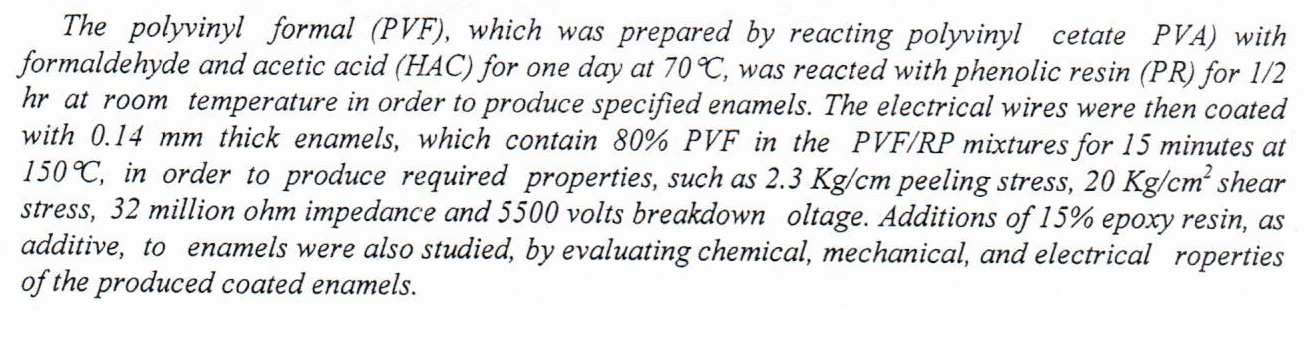
Copper Wires Coated with Enamel

A cost-effective and efficient detector was created to conduct thorough turbidimetric measurements by reaction of Co (II) ion with calcium ferro cyanide to form bright green particulate, using the method of continuous flow injection analysis, the use of NAG-5SX1-1D-SSP Analyzer in determining cobalt (II) ion in a test for the validity of the new design. The NAG-5SX1-1D-SSP Analyzer is composed of five irradiation sources of white snow leds having the diameter of 10 mm with one solar cell of 55 mm length, 13.5 mm width. Using a selector switch to select the optimum voltage to be used which was 2.7 VDC. Under conditions of optimization, cobalt (II) ion was determined at 0.005–20 mmol. L–1(n = 23) while linearity dynamic range 0.005–7 mm
... Show More (3)
(3)
 (5)
(5)



The research includes the preparation of several complexes of the internal transition elements lanthanide (Ln = La, Nd, Er, Gd, and Dy) containing the 4f shell, with Schiff bases resulting from condensation reactions between 4-antipyrinecarboxaldehyde and 2-aminobenzothiazoles. Schiff's base was identified using FTIR spectra, UV-vis spectroscopy, elemental microanalysis CHNSO, nuclear magnetic resonance, mass spectrometry, and TGA thermal analysis. The complexes were studied and identified with elemental microanalysis CHNSO, FTIR spectroscopy, UV-vis spectroscopy, TGA thermal analysis, conductivity measurement, and magnetic sensitivity. The result showed that these complexes were classified as homogeneous bidentate complexes with th
... Show More
(10)
(5)
ABSTRACT
This research deals with the two item namely, the monetary policy central Bank of Iraqi and money supply . that contribute in up the problem of the paper that is concerned with the fact that to what extent the effectiveness of monetary policy conducted by the central Bank of Iraqi is valid in controlling money supply as well as the possibility of applying it in practical environment restricted to the scope of financial in stitiutions particularly in research population represented by central Bank of Iraqi .
For the purpose of a practical contribution for monetary and financial institutions . To achieve this , A hypothesis has been carried out and it suggested that the mon
... Show More
Background A case-control study was performed to explore eight pro-inflammatory and anti-inflammatory cytokines, namely interleukin (IL)-1α, IL-1Ra (IL-1 receptor antagonist), IL-12, IL-17A, IL-31, IL-33, CXCL10 (C-X-C motif chemokine ligand 10), and CXCL16, with the aim to understand their role in ankylosing spondylitis (AS) pathogenesis and evaluate their utility as markers to differentiate between diseased and healthy individuals. Among these cytokines, IL-31 and CXCL16 have not been well studied in AS. Patients and methods The study included 94 male patients with AS and 91 age-matched control males. Interleukin and chemokine levels were measured using ELISA kits. Results Serum levels of IL-17A, CXCL10, and CXCL16 were significantly ele
... Show More
(7)
(7)
Some coordination complexes of Co(??), Ni(??), Cu(??), Cd(??) and Hg(??) are reacted in ethanol with Schiff base ligand derived from of 2,4,6- trihydroxybenzophenone and 3-aminophenol using microwave irradiation and then reacted with metal salts in ethanol as a solvent in 1:2 ratio (metal: ligand). The ligand [H4L] is characterized by FTIR, UV-Vis, C.H.N, 1H-NMR,13C-NMR, and mass spectra. The metal complexes are characterized by atomic absorption, infrared spectra, electronic spectra, molar conductance, (C.H.N for Ni(??) complex) and magnetic moment measurements. These measurements indicate that the ligand coordinates with metal (??) ion in a tridentate manner through the nitrogen and oxygen atoms of the ligand, octahedral st
... Show More
(1)
A new two Schiff bases derivatives was synthesized and characterized with studying their biological activity and employed Manganese(II), Cobalt(II), Nickel(II), Copper(II) and Mercury(II) complexes: 2-((Z)-4-((Z)-2-hydroxy-1,2- diphenylethylideneamino)-1,5-dimethyl-2-phenyl-1H-pyrazol-3(2H)-ylideneamino) benzoic acid and (E)-4-(2-hydroxy-1,2- diphenylethylideneamino)-1,5-dimethyl-2-phenyl-1H-pyrazol-3(2H)-one. The first ligand were obtained through are action of Benzoin and 4-Aminoantipyrine while the second result from the condensation of the first ligand with 2-aminobenzoic acid. Ten new coordination compounds were synthesized and structurally characterized: [Co(L1)(Cl)], [Cu(L1)(Cl)] [Ni(L1)(Cl)], [Mn(L1)(Cl)], [Hg(L1)(Cl)], [Co(L2)], [N
... Show Moresynthesis and characterization of New Bidentate schiff base Ligand Type(NO)Donor Atoms Derived from isatin and 3-Amino benzoic acid and Its complexes with Co(||),Cu(||),Cd(||)and Hg(||)Ions
New metal complexes of the ligand 4-[5-(2-hydoxy-phenyl)-[1,3,4- oxadiazol -2-ylimino methyl]-1,5-dimethyl-2-phenyl-1,2-dihydro-pyrazol-3-one (L) with the metal ions Co(II), Ni(II), Cu(II) and Zn(II) were prepared in alcoholic medium. The Schiff base was synthesized through condensate of [4-antipyrincarboxaldehyde] with[2-amino-5-(2-hydroxy-phenyl-1,3,4- oxadiazol] in alcoholic medium . Two tetradentate Schiff base ligand were used for complexation upon two metal ions of Co2+, Ni2+, Cu2+ and Zn2+ as dineucler formula M2L2.4H2O. The metal complexes were characterized by FTIR Spectroscopy, electronic Spectroscopy, elemental analysis, magnetic susceptidbility measurements, and also the ligand was characterized by 1H-NMR spectra, and m
... Show More