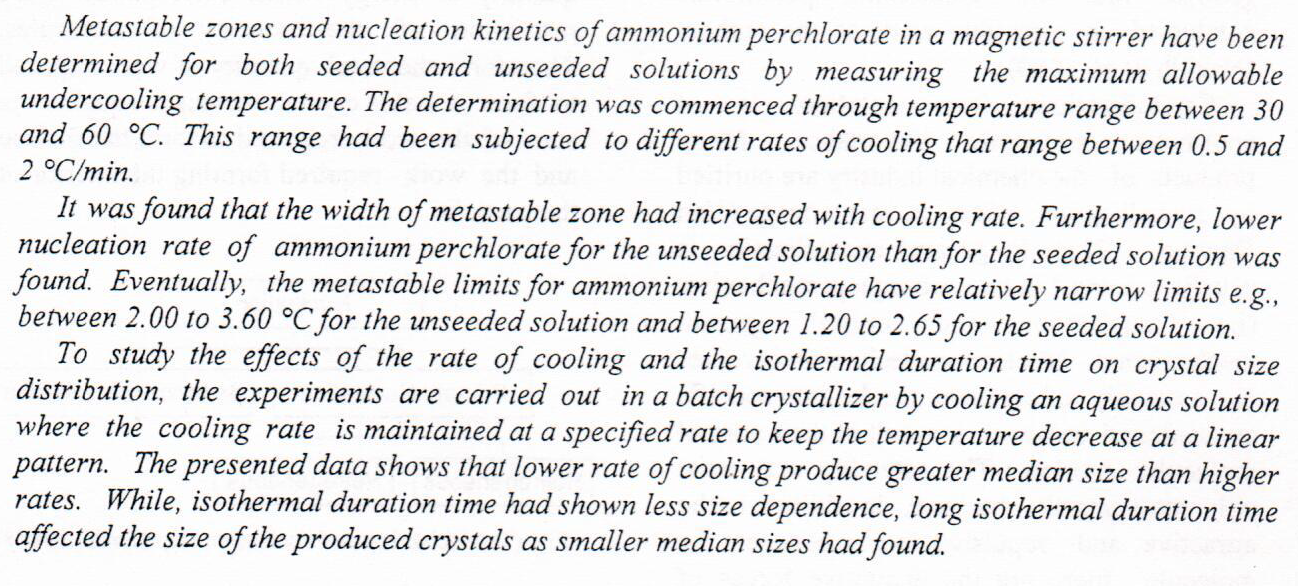
Nucleation Kinetics of Ammonium Perchlorate

 (10)
(10)
 (11)
(11)


Combining different treatment strategies successively or simultaneously has become recommended to achieve high purification standards for the treated discharged water. The current work focused on combining electrocoagulation, ion-exchange, and ultrasonication treatment approaches for the simultaneous removal of copper, nickel, and zinc ions from water. The removal of the three studied ions was significantly enhanced by increasing the power density (4–10 mA/cm2) and NaCl salt concentration (0.5–1.5 g/L) at a natural solution pH. The simultaneous removal of these metal ions at 4 mA/cm2 and 1 g NaCl/L was highly improved by introducing 1 g/L of mordenite zeolite as an ion-exchanger. A remarkable removal of heavy metals was reported
... Show More
(6)
(4)
Combining different treatment strategies successively or simultaneously has become recommended to achieve high purification standards for the treated discharged water. The current work focused on combining electrocoagulation, ion-exchange, and ultrasonication treatment approaches for the simultaneous removal of copper, nickel, and zinc ions from water. The removal of the three studied ions was significantly enhanced by increasing the power density (4–10 mA/cm2) and NaCl salt concentration (0.5–1.5 g/L) at a natural solution pH. The simultaneous removal of these metal ions at 4 mA/cm2 and 1 g NaCl/L was highly improved by introducing 1 g/L of mordenite zeolite as an ion-exchanger. A remarkable removal of heavy metals was reported
... Show More
(6)
(4)
The 17 α-ethinylestradiol (EE2) adsorption from aqueous solution was examined using a novel adsorbent made from rice husk powder coated with CuO nanoparticles (CRH). Advanced analyses of FTIR, XRD, SEM, and EDSwere used to identify the classification parameters of a CRH-like surface morphology, configuration, and functional groups. The rice husk was coated with CuO nanoparticles, allowing it to create large surface area materials with significantly improved textural qualities with regard to functional use and adsorption performance, according to a detailed characterization of the synthesized materials. The adsorption process was applied successfully with elimination effectiveness of 100% which can be kept up to 61.3%. The parameters of ads
... Show More
(18)
(18)

The Electro-Fenton oxidation process is one of the essential advanced electrochemical oxidation processes used to treat Phenol and its derivatives in wastewater. The Electro-Fenton oxidation process was carried out at an ambient temperature at different current density (2, 4, 6, 8 mA/cm2) for up to 6 h. Sodium Sulfate at a concentration of 0.05M was used as a supporting electrolyte, and 0.4 mM of Ferrous ion concentration (Fe2+) was used as a catalyst. The electrolyte cell consists of graphite modified by an electrodepositing layer of PbO2 on its surface as anode and carbon fiber modified with Graphene as a cathode. The results indicated that Phenol concentration decreases with an increase in current dens
... Show More
(15)
This study explores eggshell waste as a low-cost, eco-friendly adsorbent for removing Aniline Blue dye from water. Batch and continuous experiments under various conditions showed effective performance. FTIR and SEM analyses confirmed porosity and functional groups. The adsorption followed the Sips isotherm and pseudo-first-order kinetics. The porous calcium carbonate structure enhanced dye removal. Thermodynamic results indicated an endothermic and spontaneous process. Lower flow rates improved performance in fixed-bed columns. The study supporting environmentally friendly solutions aligned with the Sustainable Development Goals (SDGs).
(9)
(4)
The purpose of this research was to evaluate rice husk functionalized with Mg-Fe-layered double hydroxide (RH-Mg/Fe-LDH) as an adsorbent for the removal of meropenem antibiotic (MA) from an aqueous solution. Several batch experiments were undertaken using various conditions. Based on the results, the optimal Mg/Fe-LDH adsorbent with a pH of 9 and an M2+/M3+ ratio of 0.5 was associated with the lowest particle size (specifically. 11.1 nm). The Langmuir and Freundlich models were consistent with the experimental isotherm data (R2 was 0.984 and 0.993, respectively), and MA’s highest equilibrium adsorption capacity was 43.3 mg/g. Additionally, the second-order model was consistent with the adsorption kinetic results.
(15)
The adsorption of hexavalent chromium by preparing activated carbon from date seeds with zinc chloride as chemical activator and granular date seeds was studied in a batch system. The characteristics of date seeds and prepared activated carbon (ZAC) were determined and found to have a surface area 500.01 m2/g and 1050.01 m2/g , respectively and iodine number of 485.78 mg/g and 1012.91 mg/g, respectively. The effects of PH value (2-12), initial sorbate concentration(50-450mg/L), adsorbent weight (0.004-0.036g) and contact time (30-150 min) on the adsorption process were studied . For Cr(VI) adsorption on ZAC, at 120 min time contact, pH solution 2 and 0.02 adsorbent weight will ach
... Show MoreCommercial graphite (CGT) powder was used as an adsorbent surface for cationic dye, Janus green (JG), from aqueous solutions. This study aims to highlight the practical significance of using inexpensive CGT as an efficient adsorbent for the removal of JG dye from industrial wastewater. CGT was characterized by Fourier transform infrared spectroscopy, scanning electron microscopy, and X-ray diffraction. The adsorption process was investigated by examining parameters like the weight of the adsorbent, contact time, and temperature. Pseudo-second-order kinetic (PSO), pseudo-first-order, and intraparticle diffusion were used for analyzing the kinetic data. JG dye's adsorption kinetics fit the PSO kinetic model well (R2= 0.999). Furthermo
... Show More
(6)
(6)