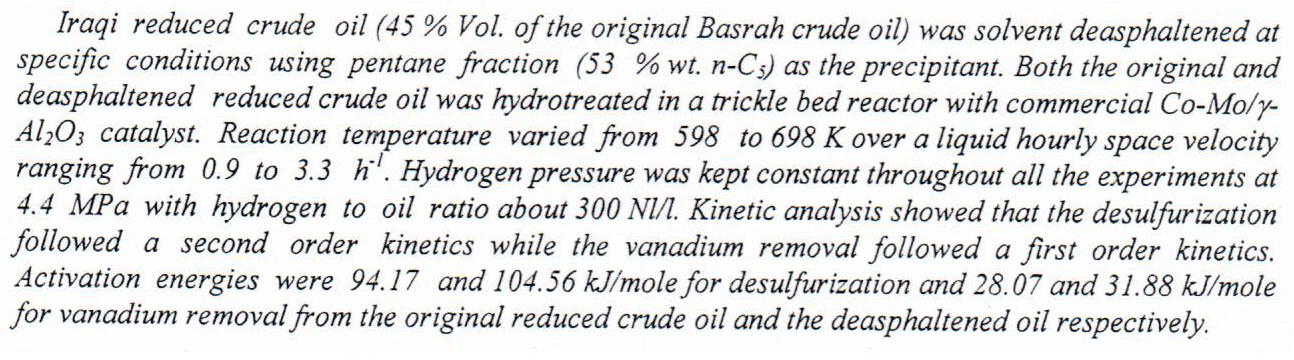
The Effect of Asphaltenes Removal on the Kinetics of Iraqi Reduced Crude Oil Hydrotreating

Al-Wasiti's drawings are the first attempt to document the Arab landscape more than 778 years ago. These drawings were associated with a fine literary material, and the relationships between words and poetic sentences are matched by artistic, aesthetic and color relations in drawing, as they are all outputs of a sense that agreed in creativity and differed in the language of expression. Al-Wasiti was creative in drawing these events. Islamic painting has a goal that differs from the goals of the painting arts that preceded it or its contemporary, as it tends to “beautification” only. This is achieved by true copying from nature, just as it is achieved by drawing what is transmitted from nature, transforming and refining it. The
... Show More
This study was conducted to estimate some heavy metals cadmium, lead, nickel and iron in 15 samples of Iraqi honey with 3 replicates for each sample which were collected from apiaries near potential contamination areas in five Iraqi governorates, including Baghdad, Karbala, Babylon, Diyala and Salah al-Din. The atomic absorption technique was used to estimate the concentrations of heavy metals, the results showed that there were significant differences at (P≤0.05) between the concentrations of these elements in the honey samples, the highest concentrations of cadmium 0.123 mg/kg were recorded in Baghdad, near the petrochemical production complex, lead 4.657 mg/kg and nickel 0.023 mg/kg in Babylon near the power plant, iron was
... Show MoreThe best optimum temperature for the isolate was 30○C while the pH for the maximum mineral removal was 6. The best primary mineral removal was 100mg/L, while the maximum removal for all minerals was obtained after 8 hrs, and the maximum removal efficiency was obtained after 24 hrs. The results have proved that the best aeration for maximum removal was obtained at rotation speed of 150 rpm/ minute. Inoculums of 5ml/ 100ml which contained 106 cell/ ml showed maximum removal for the isolate.
Feasibility of biosorbent of England bamboo plant origin was tested for removal of priority metal ions such as Cu and Zn from aqueous solutions in single metal state. Batch single metal state experiments were performed to determine the effect of dosage (0.5, 1 and 1.5 g), pH (3, 4, 4.5, 5 and 6), mixing speed (90, 111, 131, 156 and 170 rpm), temperature (20, 25, 30 and 35 °C) and metal ion concentration (10, 50, 70, 90 and 100 mg/L) on the ability of dried biomass to remove metal from solutions which were investigated. Dried powder of bamboo removed (for single metal state) about 74 % Cu and 69% Zn and maximum uptake of Cu and Zn was 7.39 mg/g and 6.96 mg/g respectively, from 100 mg/L of synthetic metal solution in 120 min. of contact t
... Show MoreIn this study, aromatic polyamide reverse osmosis membranes were used to remove zinc ions from electroplating wastewater. Influence of different operating conditions such as time, zinc concentration and pressure on reverse osmosis process efficiency was studied. The experimental results showed, concentration of zinc in permeate increase with increases of time from 0 to 70 min, and flux of water through membrane decline with time. While, the concentrations of zinc in permeate increase with the increase in feed zinc concentration (10–300 mg/l), flux decrease with the increment of feed concentration. The raise of pressure from 1 to 4 bar, the zinc concentration decreases and the flux increase. The highest recovery percentage was found is 54.
... Show MoreCoated sand (CS) filter media was investigated to remove phenol and 4-nitrophenol from aqueous solutions in batch experiments. Local sand was subjected to surface modification as impregnated with iron. The influence of process variables represented by solution pH value, contact time, initial concentration and adsorbent dosage on removal efficiency of phenol and 4-nitrophenol onto CS was studied. Batch studies were performed to evaluate the adsorption process, and it was found that the Langmuir isotherm effectively fits the experimental data for the adsorbates better than the Freundlich model with the CS highest adsorption capacity of 0.45 mg/g for 4-nitrophenol and 0.25 mg/g for phenol. The CS was found to adsorb 85% of 4-nitrophenol and
... Show More (11)
(11)

Extraction of copper (Cu) from aqueous solution utilizing Liquid Membrane technology (LM) is more effective than precipitation method that forms sludge and must be disposed of in landfills. In this work, we have formulated a liquid surfactant membrane (LSM) that uses kerosene oil as the main diluent of LSM to remove copper ions from the aqueous waste solution through di- (2-ethylhexyl) phosphoric acid - D2EHPA- as a carrier. This technique displays several advantages including one-stage extraction and stripping process, simple operation, low energy requirement, and. In this study, the LSM process was used to transport Cu (II) ions from the feed phase to the stripping phase, which was prepared, using H2SO4. For LSM p
... Show More (11)
(11)
