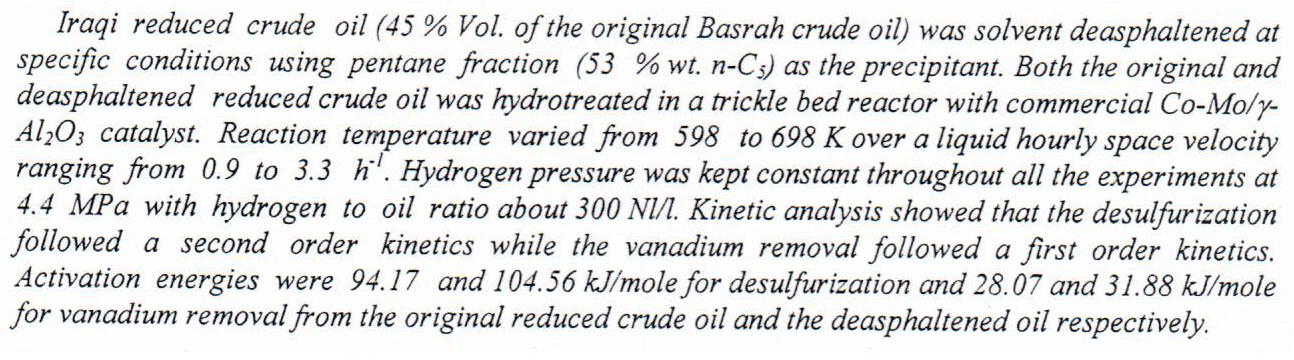
The Effect of Asphaltenes Removal on the Kinetics of Iraqi Reduced Crude Oil Hydrotreating

Gypseous soil covers approximately 30% of Iraqi lands and is widely used in geotechnical and construction engineering as it is. The demand for residential complexes has increased, so one of the significant challenges in studying gypsum soil due to its unique behavior is understanding its interaction with foundations, such as strip and square footing. This is because there is a lack of experiments that provide total displacement diagrams or failure envelopes, which are well-considered for non-problematic soil. The aim is to address a comprehensive understanding of the micromechanical properties of dry, saturated, and treated gypseous sandy soils and to analyze the interaction of strip base with this type of soil using particle image
... Show More (9)
(9)
 (9)
(9)



Myelosuppression is one of the serious adverse effects of cancer chemotherapy that lead to life threatening febrile neutropenia and considered a limiting factor for successful therapy. Cyclophosphamide a widely used anticancer drugs, induces severe bone marrow suppression by damaging hematopoietic stem cells. As cancer incidence expands globally, the demand for an effective myeloprotective therapy during cancer treatment is also increasing.Nigella sativa seed oil, a well-known plant extract that widely used for various health conditions. This study aims to evaluate the myeloprotective activity of Nigella sativa seed oil in cyclophosphamide-induced myelosuppression mice model. Myelosuppression induced by single intraperitoneal injection o
... Show More
(1)
(1)
New nanotechnology-based approaches are increasingly being investigated for enhanced oil recovery (EOR), with a particular focus on heavy oil reservoirs. Typically, the addition of a polymer to an injection fluid advances the sweep efficiency and mobility ratio of the fluid and leads to a higher crude oil recovery rate. However, harsh reservoir conditions, including high formation salinity and temperature, can limit the performance of such polymer fluids. Recently, nanofluids, that is, dispersions of nanoparticles (NPs) in a base fluid, have been recommended as EOR fluids; however, such nanofluids are unstable, even under ambient conditions. In this work, a combination of ZrO2 NPs and the polyacrylamide (PAM) polymer (ZrO2 NPs–PAM) was us
... Show More
(91)
(89)
In the present work advanced oxidation process, photo-Fenton (UV/H2O2/Fe+2) system, for the treatment of wastewater contaminated with oil was investigated. The reaction was influenced by the input concentration of hydrogen peroxide H2O2, the initial amount of the iron catalyst Fe+2, pH, temperature and the concentration of oil in the wastewater. The removal efficiency for the system UV/ H2O2/Fe+2 at the optimal conditions and dosage (H2O2 = 400mg/L, Fe+2 = 40mg/L, pH=3, temperature =30o C) for 1000mg/L load was found to be 72%.
(13)
This study was carried out to investigate the cytogenetic effects of crude aqueous extract of Lycium barbarum on the roots tip of Allium cepa Using three concentration 125, 25, 50 mg/ ml for 2, 4, 6 hours treatment periods.This study were included some cytogenetic analysis such as mitotic index , phase index and chromosome aberration. The data showed that the treatment with 50mg/ml for 6huors led to reduce the mitotic index less than 50% . This reduction considered to have toxic and sublethal effect . These results revealed mutagenic potency by inducing differents type of chromosome aberration.
The increase globally fossil fuel consumption as it represents the main source of energy around the world, and the sources of heavy oil more than light, different techniques were used to reduce the viscosity and increase mobility of heavy crude oil. this study focusing on the experimental tests and modeling with Back Feed Forward Artificial Neural Network (BFF-ANN) of the dilution technique to reduce a heavy oil viscosity that was collected from the south- Iraq oil fields using organic solvents, organic diluents with different weight percentage (5, 10 and 20 wt.% ) of (n-heptane, toluene, and a mixture of different ratio
... Show More
(6)
(14)
(9)
Several correlations have been proposed for bubble point pressure, however, the correlations could not predict bubble point pressure accurately over the wide range of operating conditions. This study presents Artificial Neural Network (ANN) model for predicting the bubble point pressure especially for oil fields in Iraq. The most affecting parameters were used as the input layer to the network. Those were reservoir temperature, oil gravity, solution gas-oil ratio and gas relative density. The model was developed using 104 real data points collected from Iraqi reservoirs. The data was divided into two groups: the first was used to train the ANN model, and the second was used to test the model to evaluate their accuracy and trend stability
... Show More