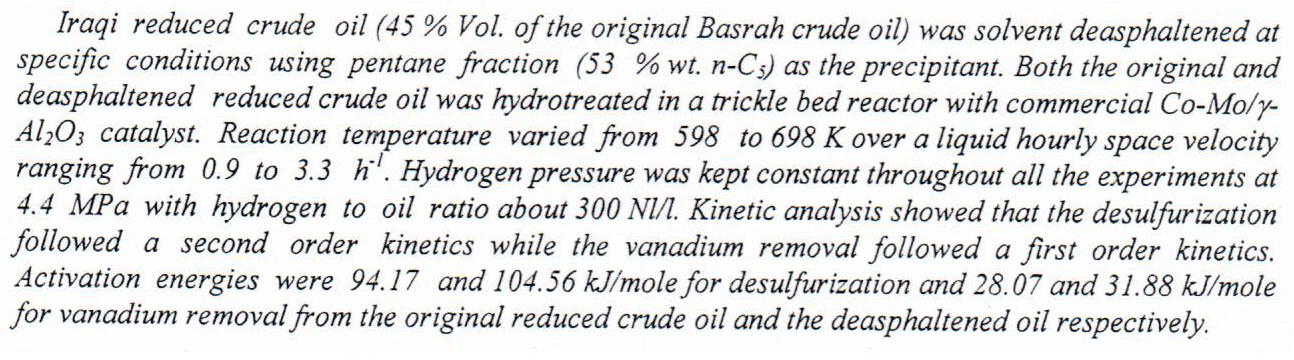
The Effect of Asphaltenes Removal on the Kinetics of Iraqi Reduced Crude Oil Hydrotreating

For this research, the utilisation of electrocoagulation (EC) toremove theciprofloxacin (CIP) and levofloxacin (LVX) from aqueous solutions was examined. The effective removal efficiencies are 93.47% for CIP and 88.00% for LVX, under optimum conditions. The adsorption isotherm models with suitable mechanisms were applied to determine the elimination of CIP and LVX utilizingtheEC method. Thefindingsshowed the adsorption of CIP and LVX on iron hydroxide flocs followed the Sips isotherm, with correlation coefficient values (R2) of 0.939 and 0.937. Threekinetic models were reviewed to determine the accurate CIP and LVX elimination methods using the EC method. The results showed that itfittedfor the second-order model, which indicated that the c
... Show More (50)
(50)
 (35)
(35)



The uptake of Cd(II) ions from simulated wastewater onto olive pips was modeled using artificial neural network (ANN) which consisted of three layers. Based on 112 batch experiments, the effect of contact time (10-240 min), initial pH (2-6), initial concentration (25-250 mg/l), biosorbent dosage (0.05-2 g/100 ml), agitation speed (0-250 rpm) and temperature (20-60ºC) were studied. The maximum uptake (=92 %) of Cd(II) was achieved at optimum parameters of 60 min, 6, 50 mg/l, 1 g/100 ml, 250 rpm and 25ºC respectively.
Tangent sigmoid and linear transfer functions of ANN for hidden and output layers respectively with 7 neurons were sufficient to present good predictions for cadmium removal efficiency with coefficient of correlatio
... Show MoreAn innovative desalination method called electrosorption or capacitive deionization (CDI) has significant benefits for wastewater treatment. This process is performed by using a carbon fiber electrode as a working electrode to remove hexavalent chromium ions from an aqueous solution. The pH, NaCl concentration, and cell voltage were optimized using the Box-Behnken experimental design (BDD) in response surface methodology (RSM) to study the effects and interactions of selected variables. To attain the relationship between the process variables and chromium removal, the experimental data were subjected to an analysis of variance and fitted with a quadratic model. The optimum conditions to remove Cr(VI) ions were: pH of 2, a cell voltage of 4.
... Show More
(10)
(9)
The research discussed the possibility of adsorption of Brilliant Blue Dye (BBD) from wastewater using 13X zeolite adsorbent, which is considered a byproduct of the production process of potassium carbonate from Iraqi potash raw materials. The 13X zeolite adsorbent was prepared and characterized by X-ray diffraction that showed a clear match with the standard 13X zeolite. The crystallinity rate was 82.15% and the crystal zeolite size was 5.29 nm. The surface area and pore volume of the obtained 13X zeolite were estimated. The prepared 13X zeolite showed the ability to remove BBD contaminant from wastewater at concentrations 5 to 50 ppm and the removal reached 96.60% at the lower pollutant concentration. Adsorption measurements versus tim
... Show More
(9)
(8)
(7)
The green method was chosen for the preparation of nano iron oxide due to its simplicity, ease of preparation, and purity, compared to other methods. Nano iron oxide was made using a substance that causes precipitation and a coating from the alcoholic extract of orange leaves from Iraq. It was examined structurally and spectrally using several techniques, including X-ray diffraction, Fourier transform infrared spectroscopy, field-emission scanning microscopy (FESEM), energy-dispersive X-ray spectroscopy, and UV-Vis spectroscopy. The diagnosis proved that the nano iron oxide was successfully prepared in a spherical form and with an average size of 71.1 nm. The nano iron oxide particles were tested for their ability to remove crystal
... Show More
(59)
(43)
For this research, the utilisation of electrocoagulation (EC) toremove theciprofloxacin (CIP) and levofloxacin (LVX) from aqueous solutions was examined. The effective removal efficiencies are 93.47% for CIP and 88.00% for LVX, under optimum conditions. The adsorption isotherm models with suitable mechanisms were applied to determine the elimination of CIP and LVX utilizingtheEC method. Thefindingsshowed the adsorption of CIP and LVX on iron hydroxide flocs followed the Sips isotherm, with correlation coefficient values (R2) of 0.939 and 0.937. Threekinetic models were reviewed to determine the accurate CIP and LVX elimination methods using the EC method. The results showed that itfittedfor the second-order model, which indicated that the c
... Show More
(36)
The antimicrobial activity of ginger extracts ( cold-water, hot-water, ethanolic and essential oil ) against some of pathogenic bacteria ( Escherichia coli , Salmonella sp , Klebsiella sp , Serratia marcescens, Vibrio cholerae , Staphylococcus aureus , Streptococcus sp) was investigated using Disc diffusion method , and the results were compared with the antimicrobial activity of 12 antibiotics on the same bacteria . The results showed that the ginger extracts were more effective on gram-positive bacteria than gram-negative . V. cholerae and S. marcescens,were the most resistant bacteria to the extracts used , while highest inhibition was noticed against Streptococcus sp (28 mm) . The ethanolic extract showed the broadest antibacterial ac
... Show More
(7)
The study seeks to determine the levels of credit structure (independent variable) depending on its components (loans, credit disseminate, other facilities) To get the eight patterns of the structure of bank credit for the purpose of assessing the relationship between changes in levels of each style of structure credit (increase or decrease) and reflected in maximizing the value of the Bank(The adopted a measured variable depending on the approximate equation of simple Tobin's Q) to determine the style that achieves the highest value of the Bank, to take advantage of it in management, planning and control by knowing the strengths and weaknesses of the historical distribution of the facilities . the sample of the
... Show More
(1)