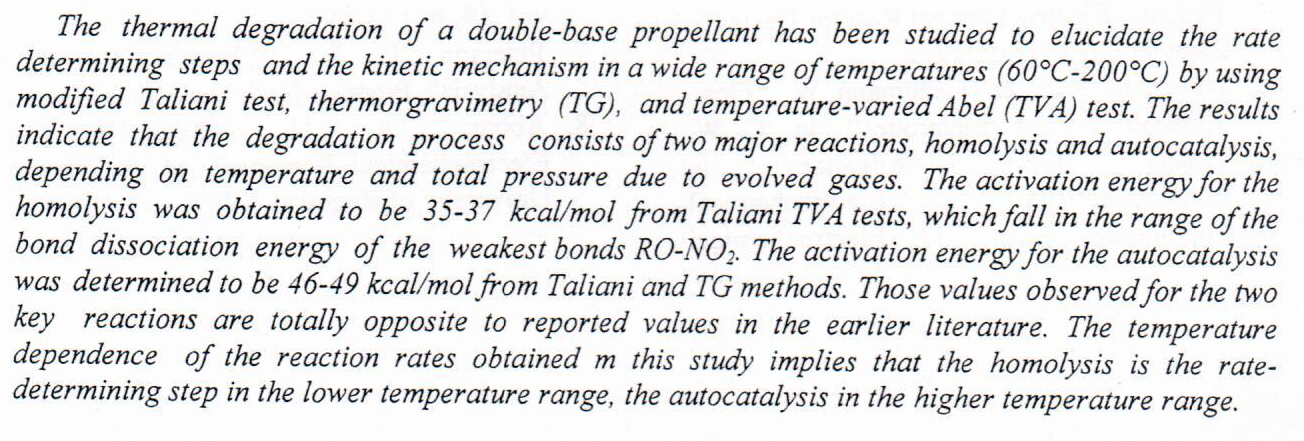
Kinetic Mechanism on Thermal Degradation of a Nitrate Ester Propellant

In this work, a test room was built in Baghdad city, with (2*1.5*1.5) m3 in dimensions, while the solar chimneys (SC) were designed with aspect ratio (ar) bigger than 12. Test room was supplied by many solar collectors; vertical single side of air pass with ar equals 25, and tilted 45o double side of air passes with ar equals 50 for each pass, both collectors consist of flat thermal energy storage box collector (TESB) that covered by transparent clear acrylic sheet, third type of collector is array of evacuated tubular collectors with thermosyphon in 45o instelled in the bottom of TESB of vertical SC. The TESB was
... Show MoreTo create a highly efficient photovoltaic-thermal (PV-T) system and maximise the energy and exergy efficiency, this study aims to propose an innovative configuration of a PV-T system comprising wavy tubes with twisted-tape inserts. Following the validation of a numerical model, a parametric study has been conducted to assess the geometrical effects of twisted tape and wavy tubes, as well as the coolant fluid type and velocity, on the overall performance of a PV-T system, located in Shiraz, Iran. It is found that employing twisted tape improves the energy and exergy efficiency by approx. 6.3%. The best configuration yields 12.4% and 16.8% increase in energy and exergy efficiency compared to conventional PV systems. This is achieved at 15% vo
... Show More (18)
(18)
 (11)
(11)


 (7)
(8)
(7)
(8)
Ultrasonic Extraction method followed by gradient HPLC was carried out for the simultaneous determination of four insecticides are [imidacloprid (Imi), thiamethoxam (Thi), indoxacarb (Ind) and abamectin (Aba)] used to combat the major insect pests in Iraq, whitefly, Dubas Bug, worms fruits as well as to combat the spiders – dream respectively in eco-soil samples. The extraction recovery was in the range of 99.77 to 109.1 %. The dissipation kinetics and residual levels of these insecticides in soil sample was studied under field ecosystem. The half-life of the mix insecticides was determined. The half-life was in range of 0.38 to 4.06 days with the soil samples were brought from the Agricultural Land called Nahrawan located in th
... Show MoreIn this study, Yogurt was dried and milled, then shaked with distilled water to remove the soluble materials, then again dried and milled. Batch experiments were carried out to remove hexavalent chromium from aqueous solutions. Different parameters were optimized such as amount of adsorbent, treatment time, pH and concentration of adsorbate. The concentrations of Cr6+ in solutions are determined by UV-Visible spectrophotometer. Maximum percentage removal of Cr6+ was 82% at pH 2. Two equilibrium adsorption isotherms mechanisms are tested Langmuir and Freundlich, the results showed that the isotherm obeyed to Freundlich isotherm. Kinetic models were applied to the adsorption of Cr6+ ions on the adsorbents, ps
... Show More
(3)
(1)
These days, it is crucial to discern between different types of human behavior, and artificial intelligence techniques play a big part in that. The characteristics of the feedforward artificial neural network (FANN) algorithm and the genetic algorithm have been combined to create an important working mechanism that aids in this field. The proposed system can be used for essential tasks in life, such as analysis, automation, control, recognition, and other tasks. Crossover and mutation are the two primary mechanisms used by the genetic algorithm in the proposed system to replace the back propagation process in ANN. While the feedforward artificial neural network technique is focused on input processing, this should be based on the proce
... Show More
(2)
The adsorption of Pb(II) ions onto bentonite and activated carbon was investigated. The effects of pH, initial adsorbent dosage, contact time and temperature were studied in batch experiments. The maximum adsorption capacities for bentonite and activated carbon were 0.0364 and 0.015 mg/mg, respectively. Thermodynamic parameters such as Gibbs free energy change, Enthalpy change and Entropy change have been calculated. These thermodynamic parameters indicated that the adsorption process was thermodynamically spontaneous under natural conditions and the adsorption was endothermic in nature. Experimental data were also tested in terms of adsorption kinetics, the results showed that the adsorption processes followed well pseudo second- order
... Show More
(45)
(42)
(16)
(15)
This study involved the treatment of textile wastewater contaminated with direct blue 15 dye (DB15) using a heterogeneous photo-Fenton-like process. Bimetallic iron/copper nanoparticles loaded on bentonite clay were used as heterogeneous catalysts and prepared via liquid-phase reduction method using eucalyptus leaves extract (E-Fe/Cu@BNPs). Characterization methods were applied to resultant particles (NPs), including SEM, BET, and FTIR techniques. The prepared NPs were found with porous and spherical shapes with a specific surface area of particles was 28.589 m2/g. The effect of main parameters on the photo-Fenton-like degradation of DB15 was investigated through batch and continuous fixed-bed systems. In batch mode, pH, H2O2 dosage, DB15 c
... Show More
(18)
(18)