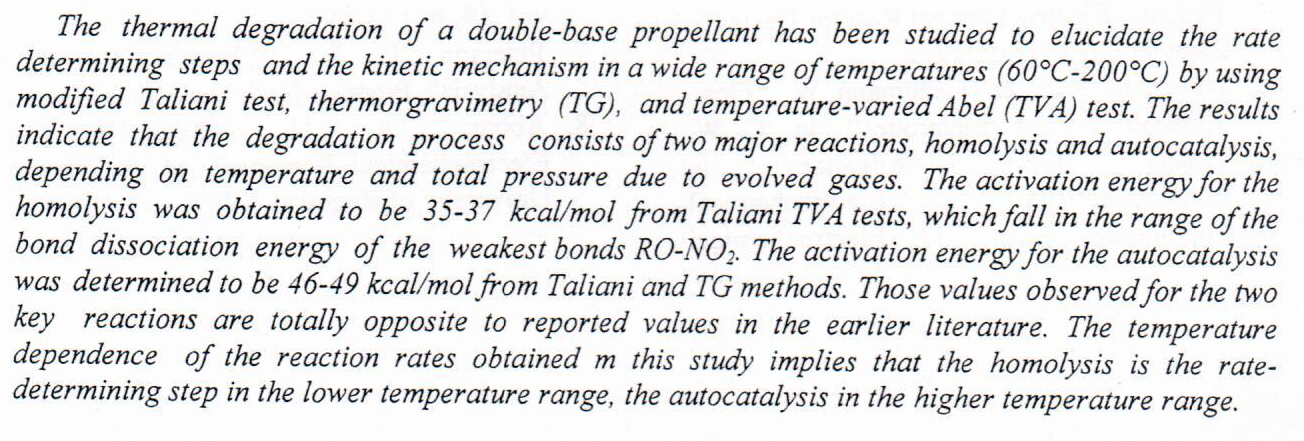
Kinetic Mechanism on Thermal Degradation of a Nitrate Ester Propellant

An experimental study was carried out for an evaporative cooling system in order to investigate the effect of using an aluminum pad coated with fabric polyester. In the present work, it was considered to use a new different type of cooling medium and test its performance during the change in the wet-bulb temperature and dry-bulb temperature of the supply air outside of the pad, the relative humidity of the supply air, the amount of air supplied (300-600) CFM and also the change of the amount of circulated water (1.75, 2.5, 4.5) liter per minute. A decrease in the WBT of the air was obtained, whereas the WBT of the air entering the pad was 26.5 . In contrast, the WBT of the outside air had reached 23 even though eva
... Show More
Expanded use of antibiotics may increase the ability of pathogenic bacteria to develop antimicrobial resistance. Greater attention must be paid to applying more sustainable techniques for treating wastewater contaminated with antibiotics. Semiconductor photocatalytic processes have proven to be the most effective methods for the degradation of antibiotics. Thus, constructing durable and highly active photocatalytic hybrid materials for the photodegradation of antibiotic pollutants is challenging. Herein, FeTiO3/Fe-doped g-C3N4 (FTO/FCN) heterojunctions were designed with different FTO to FCN ratios by matching the energy level of semiconductors, thereby developing effective direct Z-type heterojunctions. The photodegradation behaviors of th
... Show More (32)
(32)
 (32)
(32)


Phosphorus‐based Schiff base were synthesized by treating bis{3‐[2‐(4‐amino‐1.5‐dimethyl‐2‐phenyl‐pyrazol‐3‐ylideneamino)ethyl]‐indol‐1‐ylmethyl}‐phosphinic acid with paraformaldehyde and characterized as a novel antioxidant. Its corresponding complexes [(VO)2L(SO4)2], [Ni2LCl4], [Co2LCl4], [Cu2LCl4], [Zn2LCl4], [Cd2LCl4], [Hg2LCl4], [Pd2LCl4], and [PtL
... Show More
(42)
(23)
A number of ehemical ion materials were used as an absorber against solar energy. These materials were selected according to their absorption spectra in the wavelength range 300-800nm where the solar spectrum is coventrated. A solar olleetorw^esigd and The ability of each material inside the collector for absorbing the solar radiation was examined by a converter parameter “R”.According to the “R” parameter, the cohaltous and copperic ions material seems to be of higher capability for absorbing solar energy than the other materials.All the results were analyzed by means of a least-squared fitting program.
In a hybrid cooling solar thermal systems , a solar collector is used to convert solar energy into heat energy in order to super heat the refrigerant leaving the compressor, and this process helps in the transformation of refrigerant state from gaseous state to the liquid state in upper two-thirds of the condenser instead of the lower two-thirds such as in the traditional air-conditioning systems and this will reduce the energy needed to run the process of cooling .In this research two systems with a capacity of 2 tons each were used, a hybrid air-conditioning system with an evacuated tubes solar collector and a traditional air-conditioning system . The refrigerant of each type was R22.The comparison was in the amou
... Show More
(46)
(43)
In this research, design of advanced material for sunlight conversion requires focused research to obtain efficient photocatalytic system. Nanostructured ZnO was synthesized using spin coating technique. The structural, morphological and optical properties of annealed nanostructured ZnO thin film at 390 Co for 3 hours were characterized by x-ray diffraction, atomic force microscope AFM and UV-VIS spectrophotometer. Nanostructured ZnO was applied for removal Methylene Blue (MB) dye from water using sunlight induced photocatalytic process. Overall degradation of MB/ZnO was achieved after 120 minutes of sunlight irradiation while it needs more time for MB alone. The reaction rate constant fit pseudo first order for MB/ZnO degradation was 0.
... Show More
(2)
This work aims to enhance acoustic and thermal insulation properties for polymeric composite by adding nanoclay and rock wool as reinforcement materials with different rations. A polymer blend of (epoxy+ polyester) as matrix materials was used. The Hand lay-up technique was used to manufacture the castings. Epoxy and polyester were mixed at different weight ratios involving (50:50, 60:40, 70:30, 80:20, and 90:10) wt. % of (epoxy: polyester) wt. % respectively. Impact tests for optimum sample (OMR), caustic and thermal insulation tests were performed. Nano clay (Kaolinite) with ratios ( 5 and 7.5% ) wt.% , also hybrid reinforcement materials involving (Kaolite 5 & 7.5 % wt.% + 10% volume fraction of rockwool ) were added as reinforcem
... Show More
(7)
(6)
This study illustrates the impact of non-thermal plasma (Cold Atmospheric Plasma CAP) on the lipids blood, the study in vivo. The lipids are (cholesterol, HDL-Cholesterol, LDL-Cholesterol and triglyceride) are tested. (FE-DBD) scheme of probe diameter 4cm is used for this purpose, and the output voltage ranged from (0-20) kV with variable frequency (0-30) kHz. The effect of non-thermal atmospheric plasma on lipids were studied with different exposure durations (20,30) sec. As a result, the longer plasma exposure duration decreases more lipids in blood.
